Comparing Official and Unofficial GMAT Practice Questions

Comparing Official and Unofficial GMAT Practice Questions
If you are starting GMAT prep, the sheer number of practice questions available can feel overwhelming. You will see official material from the Graduate Management Admission Council (GMAC), offerings from well-known test-prep companies like Manhattan Prep and Kaplan, and a long list of free question sets online. The central question most test-takers face early is deceptively simple: should you rely mainly on official GMAT practice questions, or can unofficial ones get you the same result for less money?
This article compares the two categories across accuracy, explanation quality, alignment with the real exam, and practical usefulness at different stages of study. No single source fits everyone, but the differences between official and unofficial questions are real and worth understanding before you invest hours in the wrong material.
What counts as official GMAT practice material
Official GMAT practice questions come from one place: GMAC, the organization that owns and administers the GMAT. These questions are either retired from actual past exams or written by the same psychometric teams that produce the live test. You find them in the GMAT Official Guide series, the online question bank on mba.com, the two free full-length practice exams, and the paid official practice exams 3 through 6.
The defining advantage of official material is its origin. Each official question goes through a multi‑round development process that includes field testing, statistical analysis of item performance, and revision before it ever appears on a scored exam. GMAT Ninja notes that developing a single official question can cost thousands of dollars when you account for writer time, psychometric review, and item testing. That level of investment shows up in the precision of the answer choices — the wrong answers are not random; they are designed to catch specific reasoning errors.
You can try a sample of these questions directly on mba.com. The GMAT Mini Quiz pulls nine real questions across all three sections so you can experience the format before committing to a full-length test. For a more thorough introduction, the GMAC GMAT sample questions & answers page provides expert‑written questions with explanations that mirror the structure of Quantitative Reasoning, Verbal Reasoning, and Data Insights.
Because official questions define what the GMAT is, they are the calibration tool. Using them early tells you exactly how the test feels: the density of reading comprehension passages, the subtle wording of Data Sufficiency stems, the particular construction of critical reasoning arguments. No third party replicates every dimension of that experience perfectly.
The cost barrier built into official prep
A full set of official GMAT prep materials is not cheap. The GMAT Official Guide 2026‑2027 eBook and online question bank, the additional Verbal and Quantitative Review books, and the paid practice exams can total several hundred dollars. GMAT Ninja argues that the raw development cost of official questions makes the price inevitable — but it still puts official material out of reach for some test‑takers on tight budgets.
That cost dynamic pushes many people toward free or low‑cost third‑party question banks. If you are working with $0 after covering the GMAT registration fee, unofficial questions are often the only option. The key is knowing which unofficial sources put real effort into question quality and which ones recycle poorly‑written knock‑offs that can hurt more than help.
On Quizra, for example, you can access GMAT practice questions as part of a broader library of independently developed exam‑aligned question banks. These questions are not retired GMAC items, but they are authored to match the exam’s structure and include integrated explanations designed to move you from guessing to understanding.
Perspectives from the prep ecosystem
Different voices in the GMAT prep world have taken strong, evidence‑based positions on the official‑versus‑unofficial debate. Their arguments help clarify what each type of question is actually worth.
PrepScholar GMAT
PrepScholar’s guide to GMAT sample questions offers a balanced view that many test‑takers find useful for early‑stage planning. It lists characteristics of good practice questions — similarity to the real exam in length, topic coverage, and answer‑choice logic — and acknowledges that while unofficial questions can supplement study, they need to be chosen carefully. The article provides a large collection of free sample questions that span all sections and is useful as a starting point before committing to any paid resource. PrepScholar GMAT
GMAT Ninja
GMAT Ninja has published one of the most direct arguments against unofficial GMAT questions. The central claim is economic: no test‑prep company can match GMAC’s per‑question investment, so unofficial questions will always be less precise. The article goes further to suggest that unofficial questions can build false confidence or teach bad habits because they often lack the exactly‑calibrated “logic traps” that official questions embed. Whether you agree completely or not, the piece is a useful push to treat unofficial question scores as directional rather than diagnostic. GMAT Ninja
GMATPrep Blog
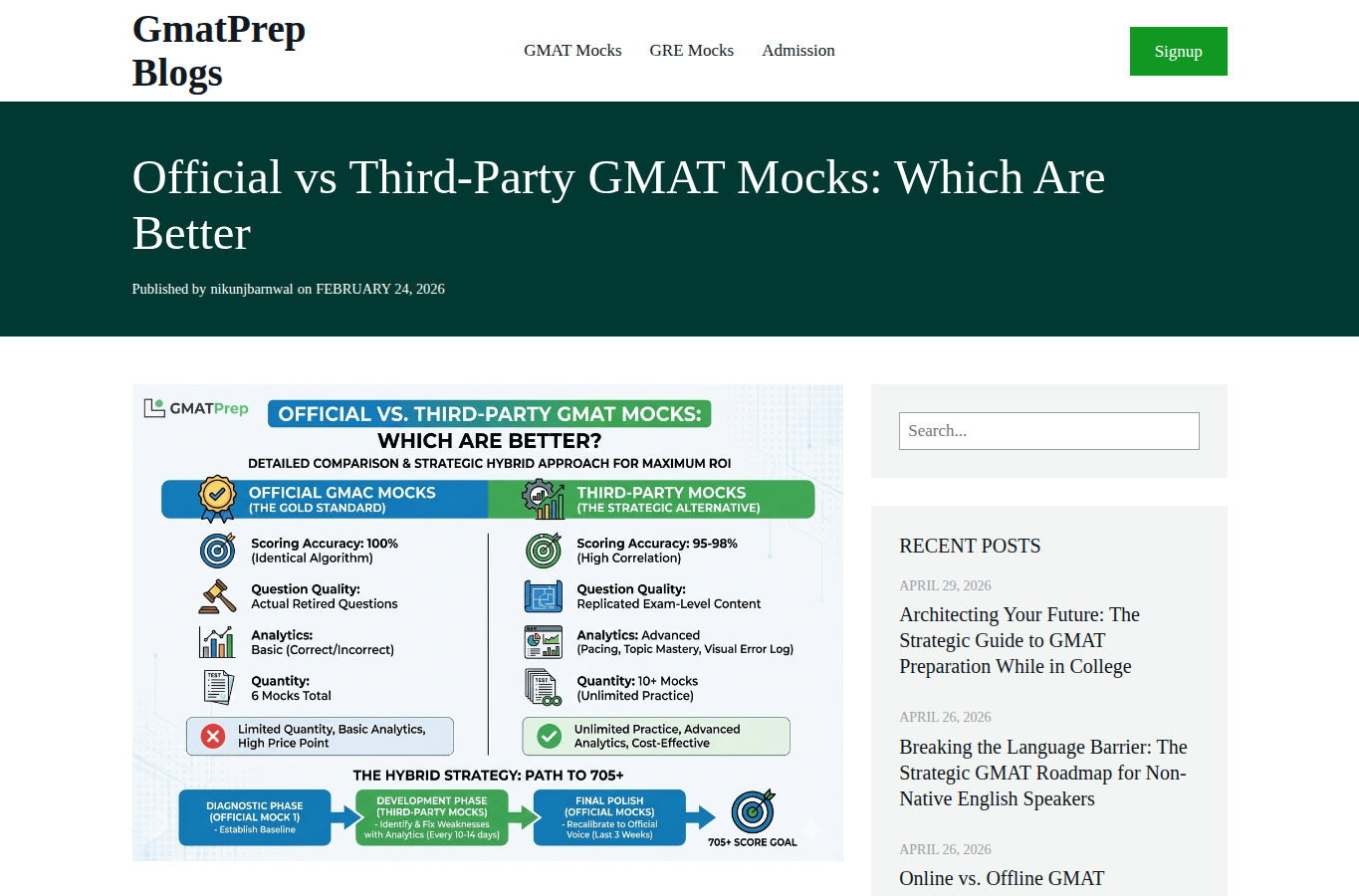
The GMATPrep blog compares official and third‑party mock exams through the lens of the GMAT’s computer‑adaptive testing algorithm. The argument centers on a single fact: only official mocks use the real scoring engine that adjusts difficulty based on your performance. Third‑party scoring algorithms approximate the adaptive logic but cannot replicate it exactly, which means section scores from unofficial mocks can be off by several points. The article concedes that third‑party mocks still serve a role for building endurance and practicing timing, but it draws a sharp line around score interpretation. GMATPrep Blog
When unofficial GMAT questions make sense
Despite the limitations, unofficial questions are not all the same. Some publishers invest heavily in question quality, answer explanations, and content alignment. Manhattan Prep’s GMAT strategy guides, for instance, contain hundreds of questions that teachers and tutors have refined over years. They do not duplicate official questions, but they target the same underlying skills and provide layered answer explanations that official guides often skip.
Unofficial questions become especially useful for skill‑building in narrow areas. If you need 50 extra Data Sufficiency problems on number properties to internalize a concept, a quality third‑party book or platform can give you the volume you need without exhausting the limited pool of official items. Using unofficial questions here preserves official questions for full‑length practice tests and final‑stage calibration.
The trade‑off is always accuracy. Unofficial verbal questions, in particular, have a reputation for being imperfect. Sentence Correction questions might test grammar rules that GMAC almost never includes, and Critical Reasoning questions can feel slightly off in their logical structure. The same warning applies to Data Insights multi‑source reasoning sets, where the density of information and the integration of text and data are hard to mimic exactly.
A practical rule: treat unofficial question accuracy as 80–90% of the real thing. If you are scoring at or above your target on official material, unofficial sets can help reinforce weak areas. But if your unofficial scores are low, confirm with an official practice test before adjusting your study plan.
How to build a practice plan using both types
An effective GMAT study plan often uses both official and unofficial resources, just at different points.
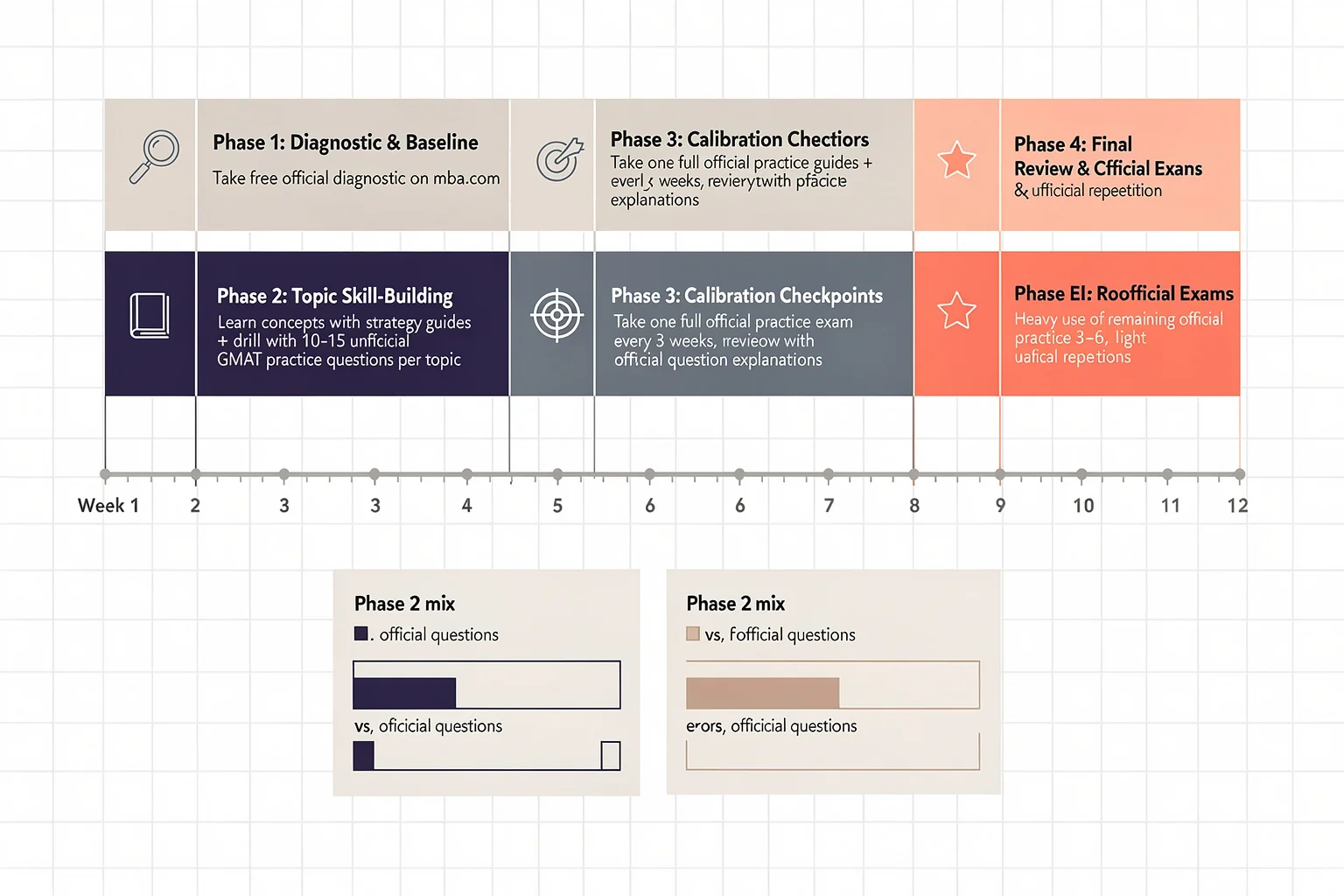
Start with a short official diagnostic. The free sample questions on mba.com or the nine‑question GMAT Mini Quiz give a quick, accurate read on your starting point across sections. Then move to topic‑by‑topic learning with a mix of unofficial strategy guides and official practice sets. For many people, the sequence looks like this:
- Learn a topic (e.g., Critical Reasoning weaken questions) from a strategy guide.
- Drill with 10–15 unofficial questions to test understanding and get immediate feedback.
- Check your skill with 5–10 official questions from the GMAT Official Guide to confirm the learning transferred.
- Save full official practice exams for every two to three weeks of study to measure overall progress.
This pattern keeps the official questions fresh for calibration while giving you the repetition dose that unofficial material provides at a lower cost.
If you use a platform like Quizra, the model is similar: you work through independently authored questions that target the same exam objectives, then validate with official tests. The key is that you treat the unofficial score as practice feedback, not a guarantee of final performance.
A quick decision guide
The table below summarizes which type of GMAT practice question fits your primary need. Use it as a filter, not as a rigid rule.
| Your situation | Lean toward | Why |
|---|---|---|
| You need to know your exact current score | Official practice exam (1–6) | Only official mocks use the real scoring algorithm. |
| You are on a tight budget and need volume | High-quality unofficial (Manhattan Prep, Quizra, etc.) | More questions per dollar; preserve official items for later. |
| You are early in study and learning content | Unofficial question banks with explanations | Volume and answer rationale help build concept knowledge. |
| You are two weeks from test day | Official questions only | At this stage, the feel and precision of real questions matter most. |
| You want to drill a specific skill to automaticity | Unofficial topic sets | Official sets often lack the specialized drill volume you need. |
This is not a clean “one is better” answer. The right mix depends on your budget, your timelines, and how close you are to your target score.
Addressing the skepticism around third-party questions
The criticism of unofficial GMAT practice questions is loud for a reason. Many free internet sources pull questions from old, non‑GMAT exams or are written by people who have never taken the current version of the test. Those questions can distort your sense of what the GMAT expects.
Even well‑regarded third‑party publishers have weaknesses. Some verbal questions over‑test idioms that GMAC has deemphasized. Some quantitative questions require calculation steps that the official test would simplify through a reasoning shortcut. This does not make unofficial questions useless, but it means you should never let an unofficial score shape your confidence more than an official one does.
One way to guard against misleading feedback is to mix official and unofficial questions within the same practice session. After working through 15 unofficial Data Sufficiency problems, answer five official ones and note any difference in how they read and where you got stuck. If the unofficial set feels easier or harder in a consistent way, adjust your interpretation of the score accordingly.
What the GMAT Superscore changes for your prep
As of June 2026, GMAC now calculates a GMAT Superscore — an automatic combination of your highest section scores across all valid GMAT attempts. The change reduces pressure to hit every section on a single test day but also changes how you practice. Because you may take the exam multiple times and focus on different sections each sitting, having a mix of affordable unofficial practice for heavy repetition alongside official material for final accuracy checks becomes even more sensible. The GMAT Superscore announcement confirms that every valid attempt now contributes to your best possible profile, which rewards sustained, section‑targeted preparation.
Questions that come up when choosing practice material
Do I need to buy all official GMAT resources?
No. Start with the GMAT Official Guide and the two free full‑length practice exams on mba.com. Those alone give you a solid foundation of real questions and baseline scores. Add more official practice exams only if you need additional reliable score data points closer to test day.
Can I reach a 700+ using only unofficial questions?
It is possible, but risky. Unofficial questions can teach you the content and reasoning patterns, but the final calibration — knowing exactly how your performance will translate on the real adaptive test — requires official practice exams. Use unofficial materials for content building and official ones for diagnostic checkpoints.
How can I spot bad unofficial GMAT questions?
Watch for answer choices that rely on cheats, tricks, or obscure rules that never appear in official guides. Also be skeptical of questions that read like they were written by someone who has not looked at a recent GMAT — outdated idioms, overly complex math that requires a calculator, or reading passages that are too short and simple. If a source makes you feel like the test is easy, it is probably not realistic.
Are GMAT Club questions unofficial?
Yes, but GMAT Club aggregates thousands of questions from many sources, including official GMAC retirements and user‑generated content. The quality varies widely. GMAT Club is most useful for tackling specific problem types with community‑verified answer explanations rather than as a primary question bank.
What about the new Data Insights section?
Data Insights is the hardest section to replicate unofficially. The integration of graphics, tables, and text demands a level of in‑house psychometric testing that few test‑prep companies match. Prioritize official Data Insights questions when you can, and use third‑party ones only for extra exposure to multi‑source reasoning format, not for accurate scoring.
When you are ready to branch out
If you are preparing for the GMAT alongside other exams, the same principles apply across certification types. Platforms that offer independently developed, exam‑aligned question banks can supplement your study across multiple goals. Below are a few paths to explore once your GMAT prep is on track.
- PMP Scheduling Professional Practice Questions
- Dell EMC Cloud Services Expert Exam Questions
- COBIT 5 Enterprise IT Governance Questions
Click through to browse exams and begin a practice session. — Get started