CIW Site Development Associate Practice Questions
Prepare for 1D0-61B with more than an answer.
- Exam fee
- $175 USD
- Level
- Associate
- Valid for
- lifetime
Domains covered on the exam 8
- Markup Language and Site Development Essentials15%
- HTML5 Coding25%
- CSS and Graphical Elements20%
- Hyperlinks and Navigation10%
- HTML Tables8%
- Web Forms12%
- Multimedia and Advanced Techniques10%
- Web Standards and Best Practices10%
- 1
Marion is formatting a simple Web page. She has been asked to create headings before the first and third paragraphs. To accomplish this most efficiently, which type of HTML elements should Marion use?
Show answer details
Correct answer: D
Paragraph-level elements, also known as block-level elements, are the most efficient choice for creating headings because they create distinct content blocks that structure the document hierarchically. Heading elements (h1-h6) are block-level elements that automatically create vertical spacing, establish document outline structure, and provide semantic meaning for screen readers and search engines. Unlike inline elements that flow with text, block-level heading elements create clear visual and structural separation between content sections. This semantic structure improves accessibility, SEO performance, and maintainability while following HTML best practices for document organization. Using appropriate heading elements also enables automatic table of contents generation and helps users navigate content more effectively through assistive technologies.
- 2
A user is submitting data from a form on your Web page to a database using a CCI script. Which attribute of the form field elements organizes the user’s information into name=value pairs?
Show answer details
Correct answer: A
The name attribute is essential for organizing form data into name=value pairs that CGI scripts and server-side applications can process. When a form is submitted, each form field's name attribute becomes the identifier, and the user's input becomes the value, creating structured data like "email=[email protected]" or "age=25". Without name attributes, form data cannot be properly organized or accessed by server-side scripts. This attribute enables server-side processing languages (PHP, Python, etc.) to retrieve specific form values using the name as a key. The name attribute is fundamental to form functionality, database integration, and web application development, making it possible to create dynamic, interactive websites that collect and process user information systematically and reliably.
- 3
You are developing a Web site in HTML5 You want the new HTML5 structural elements (such as or ) to be styled consistently in all browsers. You must add a CSS rule that will change them to which
element type, to ensure the site will render successfully?Show answer details
Correct answer: D
HTML5 structural elements like , , , , and must be set to display: block in CSS to ensure proper rendering in older browsers that do not recognize these semantic elements. Older browsers treat unknown elements as inline by default, which breaks the intended layout structure. By explicitly declaring these elements as block-level, developers ensure consistent rendering across all browsers while maintaining the semantic benefits of HTML5. This CSS rule is essential for progressive enhancement strategies where modern semantic markup is used with fallback styling for legacy browser support. The block display type ensures these elements create proper document structure, vertical spacing, and full-width containers as intended by HTML5 specifications.
- 4
Which line of code uses the correct syntax to apply an external CSS style sheet to HTML documents?
Show answer details
Correct answer: D
The correct syntax for linking external CSS stylesheets uses the element with three essential attributes: rel="stylesheet" to specify the relationship type, type="text/css" to indicate the MIME type, and href="path/file.css" to specify the stylesheet location. This element must be placed in the section of the HTML document to load styling before the page renders. External stylesheets provide better maintainability, faster loading through browser caching, and separation of concerns between content and presentation. Proper CSS linking enables consistent styling across multiple pages, reduces code duplication, and supports responsive design implementations that are crucial for modern web development practices.
- 5
A developer needs to link to a stylesheet located at
/css/theme.cssfrom an HTML file located at/pages/about.html. What is the correct relative path to use in thehrefattribute of theShow answer details
Correct answer: B
A path starting with a forward slash
/is an absolute path relative to the root of the domain. This is the most robust way to link to assets like CSS files because it works regardless of the current page's location in the directory structure. The path/css/theme.csscorrectly points to the file from the site's root. - 6
Which choice describes a correct order of precedence for implementing CSS?
Show answer details
Correct answer: A
Inline styles have the highest priority in the CSS cascade hierarchy and override all other style declarations. The correct CSS precedence order is: inline styles (style=) override internal/embedded styles ( tags), which override external stylesheets ( tags). This cascade system allows developers to create flexible styling architectures where more specific declarations take precedence. The other options incorrectly describe the cascade order - external styles have the lowest precedence, and internal styles cannot override inline styles due to specificity rules.
- 7
Web developers typically include comments in their code for which reason?
Show answer details
Correct answer: C
Comments in web development code serve as documentation to explain the purpose, functionality, and logic of code sections to other developers and future maintainers. Well-written comments improve code maintainability, facilitate team collaboration, and help developers understand complex algorithms or business logic. The other options are incorrect because comments are not for inserting server-side programs (JavaScript runs separately), they are not visible to site visitors, and they do not declare HTML versions (that is done with DOCTYPE declarations).
- 8
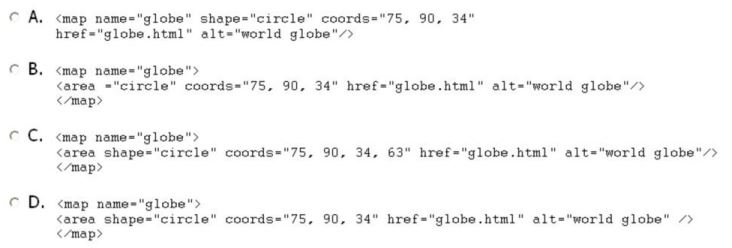
To define a circle-shaped hot-spot for an image map, which of the following code fragments would you use?
Show answer details
Correct answer: D
Based on the code shown in the image, Option D demonstrates the correct HTML syntax for defining a circle-shaped hot-spot in an image map. The element must include shape="circle" with coordinates specifying the center point (x, y) and radius - in this format: coords="x-center,y-center,radius". The other options show incorrect syntax for circle definitions, such as using shape="rect" for rectangles or incorrect coordinate formats that do not match the three-value requirement for circular areas.
- 9
You need to center and indent a quote on your Web page. Which is the best way to accomplish this using HTML5?
Show answer details
Correct answer: B
The element is the semantically correct HTML5 approach for marking up quoted content, as it provides both meaning and default styling (indentation). Modern HTML5 development prioritizes semantic markup over presentational elements, and automatically provides appropriate indentation while also conveying the semantic meaning of quoted content to screen readers and search engines. The element is for preformatted text, while style attributes and text-align are presentational approaches that lack semantic meaning.
- 10
Which HTML element aligns content both horizontally and vertically to the center of the table cell by default?
Show answer details
Correct answer: C
The (table header) element has default CSS styling that centers content both horizontally and vertically within the cell, distinguishing it from regular (table data) cells which align left by default. This built-in styling reflects the semantic purpose of header cells to stand out from data cells. The element defines table rows, creates standard data cells with left alignment, and is for preformatted text, none of which provide the centered alignment behavior inherent to elements.
