Professional Machine Learning Engineer Practice Questions
Prepare for GCP-PMLE with more than an answer.
Unlock the full exam and previous versions
- v1Standard 241 questions Current
- GCP-PMLE-ExtLegacy Google Cloud Professional Machine Learning Engineer 135 questions Locked
- Exam fee
- $200 USD
- Time limit
- 120 minutes
- Questions on the exam
- 50-60
- Passing score
- 70%
- Level
- Professional
- Valid for
- 2 years
Domains covered on the exam 6
- Architecting Low-Code AI Solutions13%
- Collaborating Within and Across Teams to Manage Data and Models14%
- Scaling Prototypes into ML Models18%
- Serving and Scaling Models20%
- Automating and Orchestrating ML Pipelines22%
- Monitoring AI Solutions13%
- 1
You need to build classification workflows over several structured datasets currently stored in BigQuery. Because you will be performing the classification several times, you want to complete the following steps without writing code: exploratory data analysis, feature selection, model building, training, and hyperparameter tuning and serving. You use Gemini Enterprise Agent Platform (formerly Vertex AI). What should you do?
Show answer details
Correct answer: A
AutoML on Gemini Enterprise Agent Platform trains tabular classification models directly from BigQuery through the console: it shows data statistics, applies feature transformations, selects and tunes the model architecture automatically, and lets you deploy the model for serving, all without writing code. BigQuery ML requires writing SQL, and notebooks or custom training jobs require code.
- 2
You are training an LSTM-based model on Gemini Enterprise Agent Platform (formerly Vertex AI) to summarize text using the following job submission command:
gcloud ai custom-jobs create \
--region=$REGION \
--display-name=$JOB_NAME \
--worker-pool-spec=machine-type=n1-standard-4,replica-count=1,executor-image-uri=$EXECUTOR_IMAGE_URI,local-package-path=$TRAINER_PACKAGE_PATH,python-module=trainer.task \
--args=--epochs=20,--batch_size=32,--learning_rate=0.001
You want to ensure that training time is minimized without significantly compromising the accuracy of your model. What should you do?
Show answer details
Correct answer: D
The job runs on a single modest CPU machine. Giving the worker pool more powerful compute (a larger machine type or a GPU accelerator) shortens training time without changing the model or its hyperparameters, so accuracy is not affected. Reducing epochs or changing the batch size or learning rate alters the training dynamics and can significantly reduce accuracy.
- 3
Your organization wants to make its internal shuttle service route more efficient. The shuttles currently stop at all pick-up points across the city every 30 minutes between 7 am and 10 am. The development team has already built an application on Google Kubernetes Engine that requires users to confirm their presence and shuttle station one day in advance. What approach should you take?
Show answer details
Correct answer: B
Because riders confirm their presence and station one day in advance, passenger demand is already known and nothing needs to be predicted. The task is an optimization problem: compute the shortest route through all stations with confirmed attendance under capacity constraints and dispatch an appropriately sized shuttle. Rules of ML: do not use ML when a simple deterministic solution solves the problem; regression, classification or RL models would only approximate known data.
- 4
You need to design a customized deep neural network in Keras that will predict customer purchases based on their purchase history. You want to explore model performance using multiple model architectures, store training data, and be able to compare the evaluation metrics in the same dashboard. What should you do?
Show answer details
Correct answer: A
An experiment groups the runs of different model architectures, records their parameters, metrics and artifacts, and lets you compare the evaluation metrics of all runs side by side in one view (Experiments on Gemini Enterprise Agent Platform; Kubeflow Pipelines experiments serve the same purpose). AutoML does not build your custom Keras architectures, Composer only schedules jobs, and similarly named training jobs provide no shared comparison dashboard.
- 5
You are training a PyTorch model on a very large dataset that does not fit into the memory of a single machine. You decide to use distributed training on Gemini Enterprise Agent Platform (formerly Vertex AI) across multiple nodes. You want to use an open-source framework that integrates well with PyTorch for this purpose and is supported in Agent Platform environments. Which framework should you use?
graph TD subgraph Node1 GPU1_1 GPU1_2 end subgraph Node2 GPU2_1 GPU2_2 end subgraph Node3 GPU3_1 GPU3_2 end Coordinator --> Node1 Coordinator --> Node2 Coordinator --> Node3 Node1 Node2 Node2 Node3 Node1 Node3Show answer details
Correct answer: B
Horovod is a popular open-source distributed deep learning training framework that works with PyTorch, TensorFlow, and other frameworks. It is well-suited for data parallelism and is supported on Agent Platform. It simplifies the process of scaling a single-GPU program to run on multiple GPUs across multiple nodes.
- 6
You are an ML engineer at a large grocery retailer with stores in multiple regions. You have been asked to create an inventory prediction model. Your model’s features include region, location, historical demand, and seasonal popularity. You want the algorithm to learn from new inventory data on a daily basis. Which algorithms should you use to build the model?
Show answer details
Correct answer: C
Predicting inventory from region, location, historical demand and seasonal popularity is a supervised forecasting problem over time-ordered data. Recurrent neural networks (for example, LSTMs) model temporal dependencies such as seasonality and trends, and the model can be retrained daily on the newest inventory data. Reinforcement learning learns a policy for taking actions from reward signals rather than predicting a labeled quantity, classification predicts discrete classes rather than a demand quantity, and CNNs are designed for spatial (image-like) data.
- 7
You have trained a deep neural network model on Google Cloud. The model has low loss on the training data, but is performing worse on the validation data. You want the model to be resilient to overfitting. Which strategy should you use when retraining the model?
Show answer details
Correct answer: C
Low loss on the training data with worse performance on the validation data means that the model is overfitting. L2 regularization and dropout are the standard ways to reduce overfitting, and their best values are found by experiment. So run a hyperparameter tuning job on Agent Platform (formerly Vertex AI) that searches over the L2 regularization and dropout parameters. Choosing one fixed dropout or L2 value and reducing the learning rate is guesswork, and the learning rate isn't a regularization setting. Tuning only the learning rate and doubling the number of neurons adds model capacity, which makes overfitting worse.
- 8
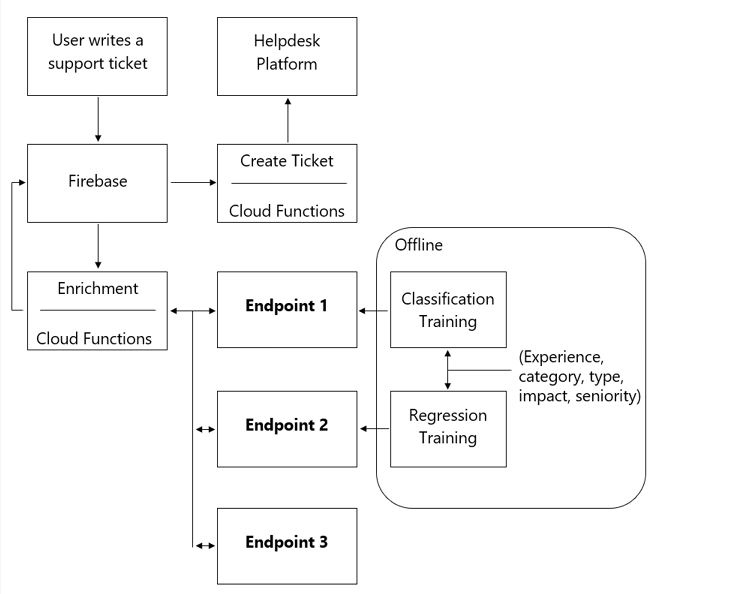
You are designing an architecture with a serverless ML system to enrich customer support tickets with informative metadata before they are routed to a support agent. You need a set of models to predict ticket priority, predict ticket resolution time, and perform sentiment analysis to help agents make strategic decisions when they process support requests. Tickets are not expected to have any domain-specific terms or jargon.
In the proposed architecture, new tickets trigger enrichment Cloud Run functions that call three endpoints: endpoint 1 predicts ticket priority, endpoint 2 predicts ticket resolution time, and endpoint 3 performs sentiment analysis. The enriched tickets are then routed to support agents.
Which endpoints should the enrichment functions call?
Show answer details
Correct answer: C
Ticket priority and resolution time are organization-specific predictions that require custom models trained on your own ticket history, so they are served from Gemini Enterprise Agent Platform (formerly Vertex AI) endpoints. Sentiment analysis of general-language text with no domain-specific jargon is exactly what the pre-trained Cloud Natural Language API provides, so no custom sentiment model needs to be trained or maintained. Vision models do not apply to text tickets.
- 9
You work for a credit card company and have been asked to create a custom fraud detection model based on historical data using AutoML on Gemini Enterprise Agent Platform (formerly Vertex AI). You need to prioritize detection of fraudulent transactions while minimizing false positives. Which optimization objective should you use when training the model?
Show answer details
Correct answer: A
Fraud is the rare (less common) class. For AutoML tabular classification, the AUC PR objective "maximize the area under the precision-recall curve" optimizes results for inferences for the less common class, balancing precision (few false positives) and recall (catching fraud). AUC ROC is the binary default and weighs both classes, log loss optimizes probability calibration, and precision at a fixed recall of 0.50 would miss half of the fraud.
- 10
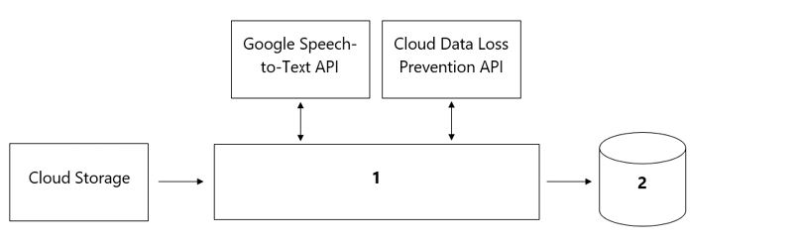
Your organization’s call center has asked you to develop a model that analyzes customer sentiments in each call. The call center receives over one million calls daily, and data is stored in Cloud Storage. The data collected must not leave the region in which the call originated, and no Personally Identifiable Information (PII) can be stored or analyzed. The data science team has a third-party tool for visualization and access which requires a SQL ANSI-2011 compliant interface. You need to select components for data processing (component 1) and for analytics (component 2). How should the data pipeline be designed?
Show answer details
Correct answer: A
Dataflow can process more than a million calls per day at scale in the originating region and can call Sensitive Data Protection (DLP) to de-identify PII before storage. BigQuery provides regional datasets and GoogleSQL, an ANSI-compliant SQL dialect, for the third-party visualization tool. Pub/Sub is messaging rather than processing, Datastore has no ANSI SQL interface, and Cloud SQL and Cloud Run functions are not designed for analytics at this scale.
