CLEP-CHEMISTRY CLEP Chemistry Practice Questions
Prepare for CLEP-CHEMISTRY with more than an answer.
- 1
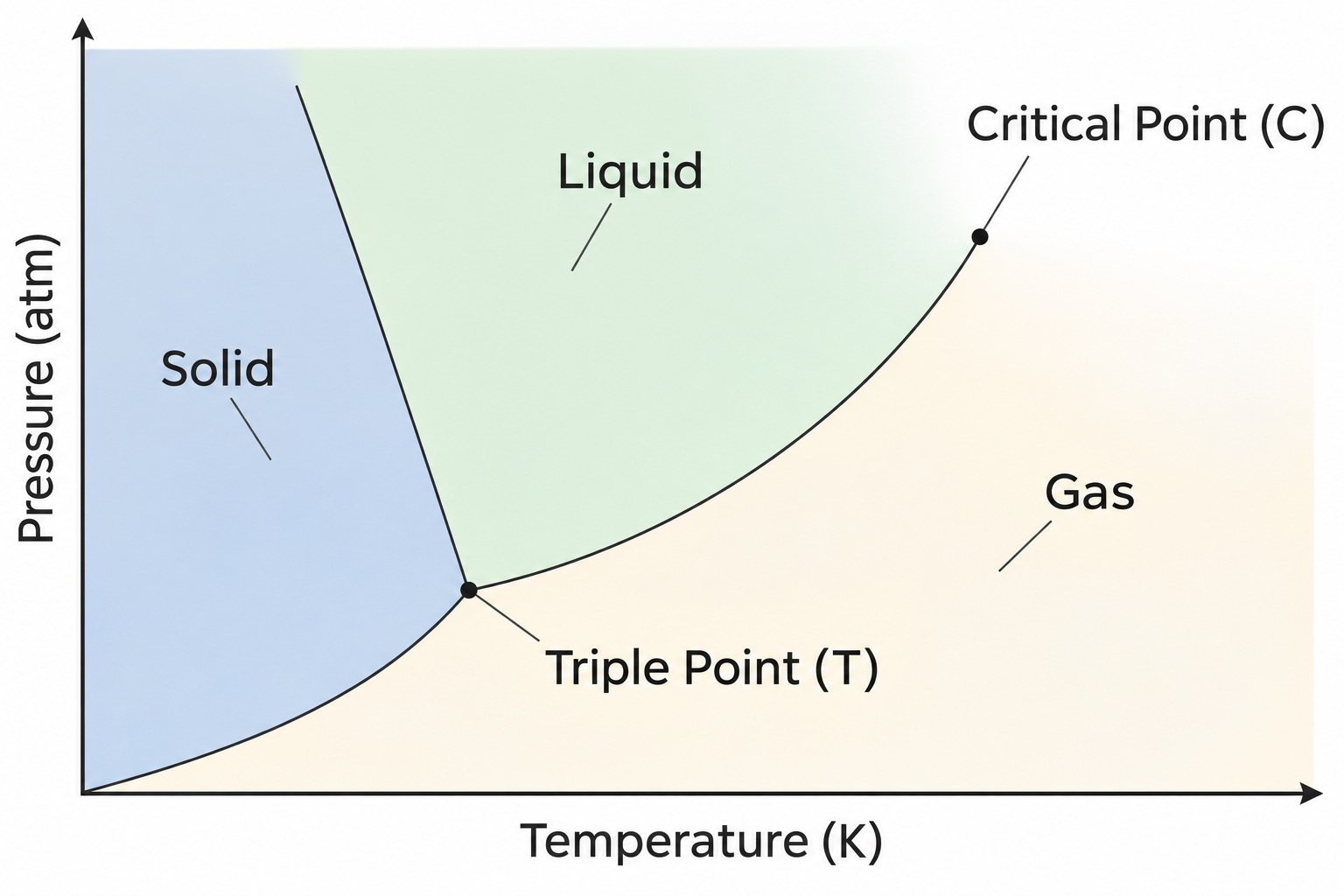
A physical chemistry research group evaluates the one-component phase diagram of Substance X shown in the figure.
Substance X exhibits three stable phases: solid, liquid, and gas. The triple point (T) is located at 0.006 atm and 273 K, and the critical point (C) is located at 218 atm and 647 K. Notably, the solid-liquid coexistence boundary curve extending from the triple point exhibits a distinct negative slope (dP/dT < 0).
A 10.0 g sample of solid Substance X is placed inside a variable-pressure piston chamber at a constant temperature of 272 K and an initial pressure of 0.50 atm. The piston is then compressed isothermally until the pressure reaches 50 atm. Based on the phase diagram in the figure, what phase change occurs during this compression, and what fundamental property of Substance X is revealed by the negative slope of the melting line?
Show answer details
Correct answer: D
Applying pressure at constant temperature below normal freezing drives the system across the negative melting curve into the denser liquid phase.
- 2
Assuming complete electrolyte dissociation and ideal solution behavior, which of the following aqueous solutions has the LOWEST freezing point?
Show answer details
Correct answer: C
Al(NO3)3 produces 4 ions per formula unit (i = 4), yielding an effective particle molality of 4 × 0.050 m = 0.200 m, the largest ΔTf.
- 3
At 25 °C, pure liquid water has an equilibrium vapor pressure of 23.8 mmHg. A solution is prepared by dissolving 0.200 mol of a nonvolatile, nonelectrolyte solute in 1.800 mol of pure water. Assuming the solution behaves ideally according to Raoult's law, what is the vapor pressure of water above this solution at 25 °C?
Show answer details
Correct answer: A
By Raoult's law, P = X_solvent · P° = [1.800 / (1.800 + 0.200)] · 23.8 mmHg = (0.900)(23.8 mmHg) = 21.4 mmHg.
- 4
Gallium has two naturally occurring stable isotopes: Ga-69 with an isotopic mass of 68.926 amu and Ga-71 with an isotopic mass of 70.925 amu. Given that the standard atomic weight of gallium reported on the periodic table is 69.723 amu, what is the natural percent abundance of the Ga-69 isotope?
Show answer details
Correct answer: B
Solving 68.926(x) + 70.925(1 - x) = 69.723 yields -1.999x = -1.202, so x = 0.6013 (60.13% Ga-69).
- 5
The successive molar ionization energies for an unknown representative element in Period 3 are determined experimentally as follows:
- First ionization energy (IE1): 738 kJ/mol
- Second ionization energy (IE2): 1,451 kJ/mol
- Third ionization energy (IE3): 7,733 kJ/mol
- Fourth ionization energy (IE4): 10,543 kJ/mol
Based on these ionization energy values, which element is being evaluated?
Show answer details
Correct answer: D
The sharp jump between IE2 and IE3 indicates removal of an inner core electron, confirming two valence electrons characteristic of Group 2 magnesium.
- 6
In the radioactive decay series of uranium-238, a thorium-234 nucleus undergoes beta-minus (β⁻) emission to form an excited daughter nucleus of _____.
Show answer details
Correct answer: D
Beta-minus decay increases atomic number Z by 1 (from 90 Th to 91 Pa) while leaving the mass number A unchanged at 234.