AZ-204 Practice Questions
Prepare for AZ-204 with more than an answer.
Unlock the full exam and previous versions
- v1Standard 297 questions Current
- 70-532Legacy Developing Microsoft Azure Solutions 229 questions Locked
- Exam fee
- $165 USD
- Level
- Associate
- Valid for
- 1 year
Domains covered on the exam 5
- Develop Azure compute solutions27.5%
- Develop for Azure storage17.5%
- Implement Azure security17.5%
- Monitor, troubleshoot, and optimize Azure solutions7.5%
- Connect to and consume Azure services and third-party services22.5%
- 1
Your company has a web app named WebAppl.
You use the WebJobs SDK to design a triggered App Service background task that automatically invokes a function in the code every time new data is received in a queue.
You are preparing to configure the service processes a queue data item.
Which of the following is the service you should use?
Show answer details
Correct answer: B
WebJobs is the correct service for triggered background tasks in Azure App Service. The WebJobs SDK provides the framework for queue-triggered functions that automatically process messages, making it ideal for background processing scenarios within web applications.
- 2
You have developed a Web App for your company. The Web App provides services and must run in multiple regions.
You want to be notified whenever the Web App uses more than 85 percent of the available CPU cores over a 5 minute period. Your solution must minimize costs.
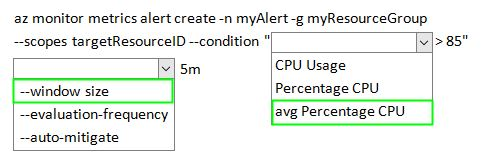
Which command should you use? To answer, select the appropriate settings to the answer area.
NOTE: Each correct selection is worth one point.
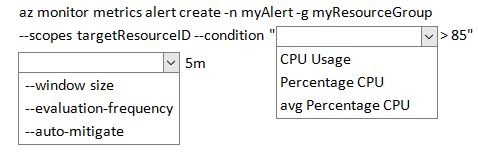
Show answer details
Correct answer: A
Azure CLI az monitor metrics alert command can create metric alerts for CPU usage across multiple regions. Based on the configuration shown in the image, this provides centralized monitoring and cost-effective alerting for web applications running in multiple regions.
- 3
Your company has an Azure subscription.
You need to deploy a number of Azure virtual machines to the subscription by using Azure Resource Manager (ARM) templates. The virtual machines will be included in a single availability set.
You need to ensure that the ARM template allows for as many virtual machines as possible to remain accessible in the event of fabric failure or maintenance.
Which of the following is the value that you should configure for the platformUpdateDomainCount property?
Show answer details
Correct answer: D
Explanation:
Each virtual machine in your availability set is assigned an update domain and a fault domain by the underlying Azure platform. For a given availability set, five non-user-configurable update domains are assigned by default (Resource Manager deployments can then be increased to provide up to 20 update domains) to indicate groups of virtual machines and underlying physical hardware that can be rebooted at the same time. -- Reference:
https://docs.microsoft.com/en-us/azure/virtual-machines/windows/manage-availability - 4
Note: This question is part of a series of questions that present the same scenario. Each question in the series contains a unique solution that might meet the stated goals. Some question sets might have more than one correct solution, while others might not have a correct solution.
After you answer a question in this section, you will NOT be able to return to it. As a result, these questions will not appear in the review screen.
You are developing an application that processes Azure Blob storage events.
Your application has the following requirements:
. Process transaction logs asynchronously for changes that occur to the blobs and the blob metadata.
. Process changes in the order in which they occurred.
. Retain changes for compliance reasons.Solution: You use Azure Monitor HTTP Data Collector API.
Does the solution meet the goal?
Show answer details
Correct answer: B
The solution does not meet the requirements for secure API authentication. API Management requires proper authentication mechanisms and security policies to protect public-facing APIs, which this basic configuration lacks.
- 5
You are creating a Dockerfile for a .NET application. To optimize the container image size and build time, you are using a multi-stage build. Which of the following statements accurately describes the purpose of the
sdkandaspnetstages in a typical .NET multi-stage Dockerfile? (Select TWO)flowchart TD A[FROM mcr.microsoft.com/dotnet/sdk AS build] --> B{dotnet restore & build & publish} B --> C[FROM mcr.microsoft.com/dotnet/aspnet AS final] C --> D{COPY --from=build /app/publish .} D --> E[ENTRYPOINT ["dotnet", "myapp.dll"]]Show answer details
Correct answer: A, B
The
sdkimage is large because it contains the full .NET Software Development Kit, including the compiler and build tools. Its purpose in a multi-stage build is to perform all the build-time operations: restoring dependencies, compiling the code, and publishing the final, optimized application binaries.The
aspnetimage is the runtime image. It is significantly smaller than the SDK image because it only includes the components necessary to run an already compiled ASP.NET Core application. In the final stage of the build, the published assets from thesdkstage are copied into this lean runtime image, resulting in a small, secure, and efficient final container image. - 6
You are developing an e-Commerce Web App.
You want to use Azure Key Vault to ensure that sign-ins to the e-Commerce Web App are secured by using Azure App Service authentication and Azure Active Directory (AAD).
What should you do on the e-Commerce Web App?
Show answer details
Correct answer: C
Explanation:
A managed identity from Azure Active Directory allows your app to easily access other AAD-protected resources such as Azure Key Vault.
https://docs.microsoft.com/en-us/azure/app-service/overview-managed-identity https://docs.microsoft.com/en-us/samples/azure-samples/app-service-msi-keyvault-dotnet/keyvault-msi-appservice-sample/ - 7
Note: This question is part of a series of questions that present the same scenario. Each question in the series contains a unique solution that might meet the stated goals. Some question sets might have more than one correct solution, while others might not have a correct solution.
After you answer a question in this section, you will NOT be able to return to it. As a result, these questions will not appear in the review screen.
You are developing a mobile app that uses an Azure SQL Database named Weyland.
The database contains a table names Customers that has a field named email_address.
You want to implement dynamic data masking to hide the data in the email_address field.
Solution: You run the follows transact-SQL statement:
ALTER TABLE [dbo].[Weyland].[Customers]
ALTER COLUMN [email_address]
ADD MASKED WITH (FUNCTION = 'emailO')Does the solution meet the goal?
Show answer details
Correct answer: A
Dynamic data masking can be enabled on SQL databases using ALTER TABLE statements with MASKED WITH functions. This allows sensitive data like credit card numbers to be masked for non-privileged users while keeping the original data intact for authorized users.
- 8
You develop a Web App on a tier D1 app service plan.
You notice that page load times increase during periods of peak traffic.
You want to implement automatic scaling when CPU load is above 80 percent. Your solution must minimize costs.
What should you do first?
Show answer details
Correct answer: C
Explanation:
Configure the web app to the Standard App Service Tier. The Standard tier supports auto-scaling, and we should minimize the cost. We can then enable autoscaling on the web app, add a scale rule and add a Scale condition. -- Reference:
https://docs.microsoft.com/en-us/azure/monitoring-and-diagnostics/monitoring-autoscale-get-started https://azure.microsoft.com/en-us/pricing/details/app-service/plans/ - 9
Note: This question is part of a series of questions that present the same scenario. Each question in the series contains a unique solution that might meet the stated goals. Some question sets might have more than one correct solution, while others might not have a correct solution.
After you answer a question in this section, you will NOT be able to return to it. As a result, these questions will not appear in the review screen.
You are designing an Azure WebJob that will run on the same instances as a web app.
You want to make use of a suitable WebJob type. The webjob type should also allow for the option to restrict the WebJob to a single instance.
Solution: You configure the use of the Continuous WebJob type.
Does the solution meet the goal?
Show answer details
Correct answer: A
Continuous WebJobs run indefinitely and are ideal for background processing tasks that need to run constantly. They start automatically when the web app starts and can be configured to restart if they fail, making them perfect for persistent background operations.
- 10
Note: The question is included in a number of questions that depicts the identical set-up. However, every question has a distinctive result. Establish if the solution satisfies the requirements.
You are configuring a web app that delivers streaming video to users. The application makes use of continuous integration and deployment.
You need to ensure that the application is highly available and that the users’ streaming experience is constant. You also want to configure the application to store data in a geographic location that is nearest to the user.
Solution: You include the use of an Azure Content Delivery Network (CDN) in your design.
Does the solution meet the goal?
Show answer details
Correct answer: A
Azure CDN significantly improves performance for streaming video by caching content at edge locations closer to users worldwide. This reduces latency and bandwidth usage while providing better user experience for video streaming applications.