1z0-060 Upgrade to Oracle Database 12c Practice Questions
Prepare for 1z0-060 with more than an answer.
- Exam fee
- $245 USD
- Time limit
- 120 minutes
- Questions on the exam
- 80
- Passing score
- 65% (scale 0-100%)
- Level
- Professional
- Valid for
- Must be recertified for current database versions
Domains covered on the exam 10
- Oracle Enterprise Manager and Other Tools8%
- Basics of Multitenant Container Database (CDB)12%
- Configuring and Creating CDBs and PDBs15%
- Managing CDBs and PDBs18%
- Managing Tablespaces, Users, Privileges and Roles10%
- Backup, Recovery and Flashback for CDB/PDB12%
- SQL Enhancements8%
- Information Lifecycle Management and Storage Enhancements10%
- Auditing Enhancements10%
- Performance and Optimizer Enhancements7%
- 1
A database is stored in an Automatic Storage Management (ASM) disk group, DGROUP1, created with SQL.
There is enough free space in the disk group for mirroring to be done.
What happens if the CONTROLLER1 failure group becomes unavailable due to error or for maintenance?

Show answer details
Correct answer: C
C
- 2
Which three are true about the large pool for an Oracle database instance that supports shared server connections? (Choose three.)
Show answer details
Correct answer: A, D, E
A,D,E--Explanation:
The large pool can provide large memory allocations for the following: / (B)UGA (User Global Area) for the shared server and the Oracle XA interface (used where transactions interact with multiple databases) /Message buffers used in the parallel execution of statements / (A) Buffers for Recovery Manager (RMAN) I/O slaves
Note:- largepool
Optional area in the SGA that provides large memory allocations for backup and restore operations, I/O server processes, and session memory for the shared server and Oracle XA. - Oracle XA An external interface that allows global transactions to be coordinated by a transaction manager other than Oracle Database.
- UGA
User global area. Session memory that stores session variables, such as logon information, and can also contain the OLAP pool. - Configuring the Large Pool Unlike the shared pool, the large pool does not have an LRU list (not D). Oracle Database does not attempt to age objects out of the large pool. Consider configuring a large pool if the database instance uses any of the following Oracle Database features:
- Shared server In a shared server architecture, the session memory for each client process is included in the shared pool.
- Parallel query Parallel query uses shared pool memory to cache parallel execution message buffers.
- Recovery Manager Recovery Manager (RMAN) uses the shared pool to cache I/O buffers during backup and restore operations. For I/O server processes, backup, and restore operations, Oracle Database allocates buffers that are a few hundred kilobytes in size.
A,D,E--Explanation:
The large pool can provide large memory allocations for the following: / (B)UGA (User Global Area) for the shared server and the Oracle XA interface (used where transactions interact with multiple databases) /Message buffers used in the parallel execution of statements / (A) Buffers for Recovery Manager (RMAN) I/O slaves
Note:- largepool
Optional area in the SGA that provides large memory allocations for backup and restore operations, I/O server processes, and session memory for the shared server and Oracle XA. - Oracle XA An external interface that allows global transactions to be coordinated by a transaction manager other than Oracle Database.
- UGA
User global area. Session memory that stores session variables, such as logon information, and can also contain the OLAP pool. - Configuring the Large Pool Unlike the shared pool, the large pool does not have an LRU list (not D). Oracle Database does not attempt to age objects out of the large pool. Consider configuring a large pool if the database instance uses any of the following Oracle Database features:
- Shared server In a shared server architecture, the session memory for each client process is included in the shared pool.
- Parallel query Parallel query uses shared pool memory to cache parallel execution message buffers.
- Recovery Manager Recovery Manager (RMAN) uses the shared pool to cache I/O buffers during backup and restore operations. For I/O server processes, backup, and restore operations, Oracle Database allocates buffers that are a few hundred kilobytes in size.
A,D,E--Explanation:
The large pool can provide large memory allocations for the following: / (B)UGA (User Global Area) for the shared server and the Oracle XA interface (used where transactions interact with multiple databases) /Message buffers used in the parallel execution of statements / (A) Buffers for Recovery Manager (RMAN) I/O slaves
Note:- largepool
Optional area in the SGA that provides large memory allocations for backup and restore operations, I/O server processes, and session memory for the shared server and Oracle XA. - Oracle XA An external interface that allows global transactions to be coordinated by a transaction manager other than Oracle Database.
- UGA
User global area. Session memory that stores session variables, such as logon information, and can also contain the OLAP pool. - Configuring the Large Pool Unlike the shared pool, the large pool does not have an LRU list (not D). Oracle Database does not attempt to age objects out of the large pool. Consider configuring a large pool if the database instance uses any of the following Oracle Database features:
- Shared server In a shared server architecture, the session memory for each client process is included in the shared pool.
- Parallel query Parallel query uses shared pool memory to cache parallel execution message buffers.
- Recovery Manager Recovery Manager (RMAN) uses the shared pool to cache I/O buffers during backup and restore operations. For I/O server processes, backup, and restore operations, Oracle Database allocates buffers that are a few hundred kilobytes in size.
- largepool
- 3
What are three purposes of the RMAN “FROM SERVICE” clause? (Choose three.)
Show answer details
Correct answer: A, C, D
A,C,D--Explanation:
- With a control file autobackup, RMAN can recover the database even if the current control file, recovery catalog, and server parameter file are inaccessible. * RMAN uses a recovery catalog to track filenames for all database files in a Data Guard environment. A recovery catalog is a database schema used by RMAN to store metadata about one or more Oracle databases. The catalog also records where the online redo logs, standby redo logs, tempfiles, archived redo logs, backup sets, and image copies are created.
A,C,D--Explanation:
- With a control file autobackup, RMAN can recover the database even if the current control file, recovery catalog, and server parameter file are inaccessible. * RMAN uses a recovery catalog to track filenames for all database files in a Data Guard environment. A recovery catalog is a database schema used by RMAN to store metadata about one or more Oracle databases. The catalog also records where the online redo logs, standby redo logs, tempfiles, archived redo logs, backup sets, and image copies are created.
A,C,D--Explanation:
- With a control file autobackup, RMAN can recover the database even if the current control file, recovery catalog, and server parameter file are inaccessible. * RMAN uses a recovery catalog to track filenames for all database files in a Data Guard environment. A recovery catalog is a database schema used by RMAN to store metadata about one or more Oracle databases. The catalog also records where the online redo logs, standby redo logs, tempfiles, archived redo logs, backup sets, and image copies are created.
- 4
A new report process containing a complex query is written, with high impact on the database. You want to collect basic statistics about query, such as the level of parallelism, total database time, and the number of I/O requests.
For the database instance STATISTICS-LEVEL, the initialization parameter is set to TYPICAL and the CONTROL_MANAGEMENT_PACK_ACCESS parameter is set to DIAGNOSTIC+TUNING.
What should you do to accomplish this task?
Show answer details
Correct answer: D
D--Explanation:
The REPORT_SQL_MONITOR function is used to return a SQL monitoring report for a specific SQL statement.
Incorrect answers:
D: SET SESSION-LONGOPS Procedure This Procedure sets a row in the V$SESSION_LONGOPS view. This is a view that is used to indicate the on-going progress of a long running operation. Some Oracle functions, such as parallel execution and Server Managed Recovery, use rows in this view to indicate the status of, for example, a database backup.
Applications may use the SET_SESSION_LONGOPS procedure to advertise information on the progress of application specific long running tasks so that the progress can be monitored by way of the V$SESSION_LONGOPS view.
A: Not interested in session statistics, only in statistics for the particular SQL query.
B: We are interested in statistics, not tracing. - 5
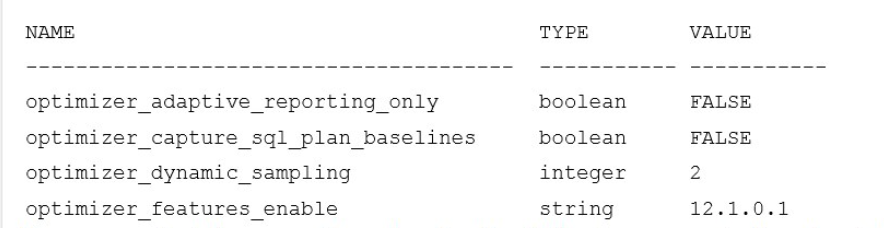
Examine the parameter for your database instance below.
You generated the execution plan for the following query in the plan table and noticed that the nested loop join was done. After actual execution of the query, you notice that the hash join was done in the execution plan:
SQL> SELECT product_name
FROM order_items o, product_information p
WHERE o.unit_price = 15
AND quantity > 1
AND p.product)id = o.product_id;30 rows selected.
Identify the reason why the optimizer chose different execution plans.
Show answer details
Correct answer: A
A--Explanation:
- optimizer_dynamic_sampling OPTIMIZER_DYNAMIC_SAMPLING controls both when the database gathers dynamic statistics, and the size of the sample that the optimizer uses to gather the statistics.
Range of valuesO to 11
- optimizer_dynamic_sampling OPTIMIZER_DYNAMIC_SAMPLING controls both when the database gathers dynamic statistics, and the size of the sample that the optimizer uses to gather the statistics.
- 6
You install a non-RAC Oracle Database. During Installation, the Oracle Universal Installer (OUI) prompts you to enter the path of the Inventory directory and also to specify an operating system group name.
Which statement is true?
Show answer details
Correct answer: A
A--Explanation:
Note: Providing a UNIX Group Name
If you are installing a product on a UNIX system, the Installer will also prompt you to provide the name of the group which should own the base directory.
You mtist choose a UNIX group name which will have permissions to update, install, and deinstall Oracle software. Members of this group must have write permissions to the base directory chosen.
Only users who belong to this group are able to install or deinstall software on this machine. - 7
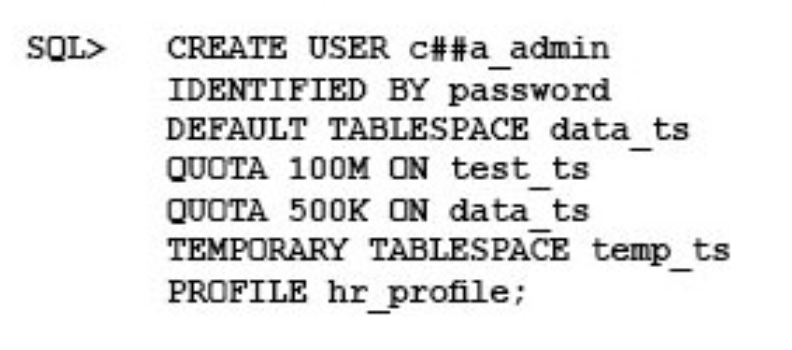
Your multitenant container database (CDB) contains some pluggable databases (PDBs), you execute the command below in the root container.
Which two statements are true? (Choose two.)
Show answer details
Correct answer: B, D
B,D
B,D
- 8
Which three statements are true about tablespaces in a multitenant container database (CDB)? (Choose three.)
Show answer details
Correct answer: B, D, E
B,D,E
B,D,E
B,D,E
- 9
Which two statements are true about variable extent size support for large ASM files? (Choose two.)
Show answer details
Correct answer: A, D
A,D
A,D
- 10
Examine the current values for the following parameters in your database instance:
SGA_MAX_SIZE = 1024M
SGA_TARGET = 700M
DB_8K_CACHE_SIZE = 124M
LOGJ3UFFER = 200M
You issue the following command to increase the value of DB_8K_CACHE_SIZE: SQL> ALTER SYSTEM SET DB_8K_CACHE_SIZE=140M;Which statement is true?
Show answer details
Correct answer: A
A
