1z0-063 Oracle Database 12c: Advanced Administration Practice Questions
Prepare for 1z0-063 with more than an answer.
- Exam fee
- $245 USD
- Level
- Professional
- Valid for
- Until recertification required
- 1
Which two statements are true about a multitenant architecture? (Choose two.)
Show answer details
Correct answer: C, D
C, D
C, D
- 2
In your database, there are tablespaces that were read-only when the last backup was taken. These tablespaces have not been made read/write since then. You want to perform an incomplete recovery on the database by using a backup control file.
What precaution must you take for the read-only tablespaces before performing an incomplete recovery?Show answer details
Correct answer: A
A
- 3
user_data is a non-encrypted tablespace containing tables with data.
You must encrypt all data in this tablespace.
Which three methods can do this? (Choose three.)Show answer details
Correct answer: A, B, C
A, B, C
A, B, C
A, B, C
- 4
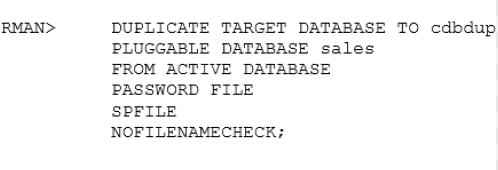
You plan to duplicate the multitenant container database (CDB) cdb1 that contains the pluggable database (PDB) SALES:
Which two statements are true? (Choose two.)
Show answer details
Correct answer: A, D
A, D -- Explanation: D: When duplicating a whole CDB or one more PDBs:You must create the auxiliary instance as a CDB. To do so, start the instance with the following declaration in the initialization parameter file:enable_pluggable_database=TRUEA: To duplicate PDBs, you must create the auxiliary instance as a CDB. To do so, start the instance with the declaration enable_pluggable_database=TRUE in the initialization parameter file. When you duplicate one or more PDBs, RMAN also duplicates the root (CDB$ROOT) and the seed database (PDB$SEED). The resulting duplicate database is a fully functional CDB that contains the root, the seed database, and the duplicated PDBs.
References: docs.oracle.com/database/121/BRADV/rcmdupdb.htm')https://docs.oracle.com/database/121/BRADV/rcmdupdb.htmA, D -- Explanation: D: When duplicating a whole CDB or one more PDBs:You must create the auxiliary instance as a CDB. To do so, start the instance with the following declaration in the initialization parameter file:enable_pluggable_database=TRUEA: To duplicate PDBs, you must create the auxiliary instance as a CDB. To do so, start the instance with the declaration enable_pluggable_database=TRUE in the initialization parameter file. When you duplicate one or more PDBs, RMAN also duplicates the root (CDB$ROOT) and the seed database (PDB$SEED). The resulting duplicate database is a fully functional CDB that contains the root, the seed database, and the duplicated PDBs.
References: docs.oracle.com/database/121/BRADV/rcmdupdb.htm')https://docs.oracle.com/database/121/BRADV/rcmdupdb.htm - 5
You created a tablespace with this statement:
CREATE BIGFILE TABLESPACE adtbs
DATAFILE Vproddb/data/adtbs.dbf SIZE 10G;The tablespace is nearly full and you need to avoid any out of space errors for the load of a 5 gig table.
Which two alter statements will achieve this? (Choose two.)Show answer details
Correct answer: A, C
A, C -- Explanation: www.techont')http://www.techonthenet.com/oracle/tablespaces/alter_tablespace.phpIb
A, C -- Explanation: www.techont')http://www.techonthenet.com/oracle/tablespaces/alter_tablespace.phpIb
- 6
Which three statements are true about compression of backup sets? (Choose three.)
Show answer details
Correct answer: B, C, E
B, C, E
B, C, E
B, C, E
- 7
Your multitenant container database (CDB) CDB1, which has no startup triggers and contains multiple pluggable databases (PDBs), is started up by using the command:SQL)STARTUPWhich two statements are true about the successful execution of the command? (Choose two.)
Show answer details
Correct answer: A, E
A, E
A, E
- 8
Automatic Shared Memory Management (ASMm) is enabled for your database instance, but parameters for the managed components are not defined.
You execute this command:
SQL> ALTER SYSTEM SET DB_CACHE_SIZE = 100M;Which statement is true?
Show answer details
Correct answer: A
A
- 9
Users report this error message when inserting rows into the orders table:ERROR at line1:
ORA-O1654f:unable to extend index USERS.ORDERS_IND by 8 in tablespace INDEXESYou determine that the indexes tablespace is out of space and there is no free space on the filesystem used by the Oracle database.
Which two must you do to fix this problem without affecting currently executing queries? (Choose two.)Show answer details
Correct answer: B, E
B, E
B, E
- 10
Examine the list of possible steps to transport a tablespace across platforms that have the same compatibility level, character sets, and endian format:
1.Make the tablespace read-only at the source database.
2.Export metadata from the source database.
3.Import metadata into the target database.
4.Transferthe dump file and data files to the target machine.
5.Convert data files by using Recovery Manager (RMAN).
6.Make the tablespace read-write at the target database.Identify the required steps in the correct order.
Show answer details
Correct answer: D
Explanation: Step 1 (1): To copy tablespaces from one database to another using transportable tablespace, the source tablespaces are first kept in READ-ONLY mode (to ensure data consistency). Once the tablespaces are in READ-ONLY mode, the actual datafiles belonging to the source tablespaces are copied from source database to target database (using any available methods like scp, sftp, rcp, etc).Step 2 (2): Once the tablespace is kept in READ-ONLY mode, we need to generate the metadata export of the tablespaces that needs to transported using the DataPump export utility.
Step 3 (4): Once the metadata export is generated on the source database for all the tablespaces that needs to be transported, we need to copy the Export Dump file as well as all the datafiles belonging to the tablespaces to be transported to the target database server.
References: www.oraclebuffer.com/oracle/migrate-oracle-database-using-transportable-tablespace/')http://www.oraclebuffer.com/oracle/migrate-oracle-database-using-transportable-tablespace/
