1z0-064 Oracle Database 12c: Performance Management and Tuning Practice Questions
Prepare for 1z0-064 with more than an answer.
- 1
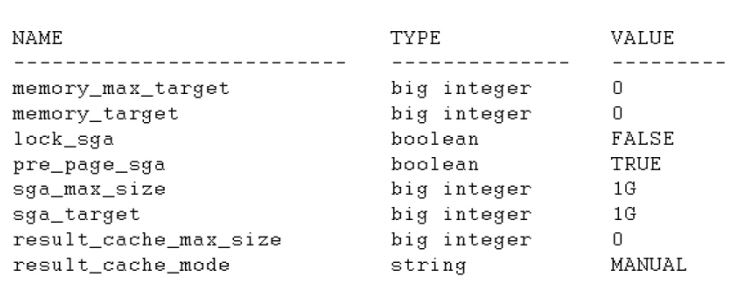
Examine the parameters set for a database instance:
An application performs a large number of identical queries on small lookup tables very frequently. Users complain about the slow response time of queries on these tables. On investigation, you notice that buffers are getting aged out of the buffer cache. To mitigate the issue, you increase the value of the SGA_MAX_SIZE and SGA_TARGET parameters, but after some time, you notice the same issue again.
Which two would you recommend as long-term solutions for this issue? (Choose two.)
Show answer details
Correct answer: A, B
A, B
A, B
- 2
You plan to upgrade your production database from Oracle Database 11 g to 12c and also to introduce new objects to the database. You also want to upgrade the hardware. You have already created a test system with the upgrades to be made to the production database. As part of the testing, you want to:
• analyze and compare the overall database workload with concurrency and transaction characteristics
• find SQL statements that might get regressed because of the upgrade
• analyze execution plans for SQL statements for which performance might get regressed
• analyze the impact of new schema objects on database performanceWhich two tools would you recommend to achieve the objective? (Choose two.)
Show answer details
Correct answer: B, E
B, E
B, E
- 3
For which two requirements can you always use the V$ACTIVE_SESSION_HISTORY view? (Choose two.)
Show answer details
Correct answer: C, E
C, E
C, E
- 4
Which two actions can reduce library cache latch contention for an OLTP application that repeatedly executes queries containing a mix of literals and bind variables? (Choose two.)
Show answer details
Correct answer: C, E
C, E
C, E
- 5
To investigate the slow response time of queries on the TRANS table, you gathered the table statistics and executed the query:
The table is stored in a tablespace that has Automatic Segment Space Management (ASSM) enabled. The tablespace is created with a standard block size of 8192 bytes.
Which three can be reasons for the slow response time of the queries? (Choose three.)

Show answer details
Correct answer: A, B, D
A, B, D
A, B, D
A, B, D
- 6
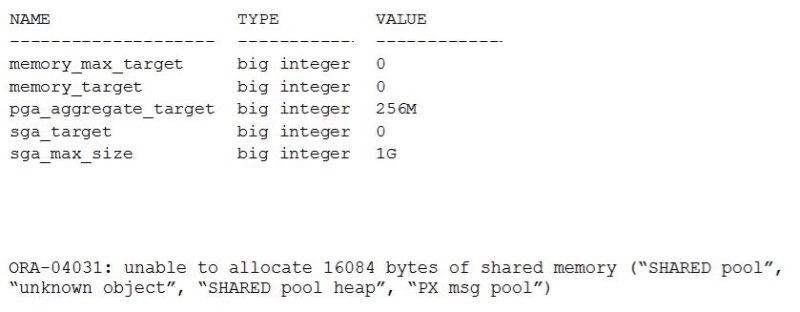
Examine the parameters set for your database instance:
You are administrating a database that supports a DSS workload. You make some changes to the sizes of memory components. Consequently, you receive this error:
Which three actions might resolve the issue?
Show answer details
Correct answer: C, D, F
C, D, F -- https://docs.oracle.eom/en/database/oracle/oracle-database/19/refrn/PGA AGGREGATE TARGET.html#GUID-DEBBD3F7-9F6D-4AC8-952C-0E0B2E62312D
C, D, F -- https://docs.oracle.eom/en/database/oracle/oracle-database/19/refrn/PGA AGGREGATE TARGET.html#GUID-DEBBD3F7-9F6D-4AC8-952C-0E0B2E62312D
C, D, F -- https://docs.oracle.eom/en/database/oracle/oracle-database/19/refrn/PGA AGGREGATE TARGET.html#GUID-DEBBD3F7-9F6D-4AC8-952C-0E0B2E62312D
