Building an AAPC CPC Exam Study Plan for Working Adults

An AAPC CPC exam study plan needs to fit the hours you can protect around work. Build yours by assigning coding topics to repeatable study blocks, practicing with explanations, and reviewing the decisions behind your answers. Your finished calendar should show what to study each week and how to check whether that work helped.
Have the exam outline, appropriate coding references, practice questions, and a calendar ready. The example below uses 12 weeks at eight hours per week: 96 scheduled hours. Treat that as a planning example. Your starting knowledge, practice results, and available time should determine your schedule.
Establish your starting point and check the exam instructions
Start your CPC calendar with the applicable AAPC exam outline and candidate instructions. Check the requirements for your planned exam date and delivery method before arranging your materials or scheduling simulations.
Record the outline and instructions you are using. Confirm the exam format, timing, permitted references, and rules for tabs or annotations. These details determine how closely your practice sessions can match exam conditions.
Keep your study materials manageable. Use one main learning resource, your coding references, and a practice source with explanations. When selecting independently authored questions from Quizra, check the exam label and topic coverage before assigning a set to your calendar.
Then complete a small diagnostic set across the topics in your outline. Choose enough questions to expose different difficulties while leaving time to review every answer.
For each response, record whether you:
- Explained the coding decision and found supporting guidance.
- Reached the answer through uncertain elimination.
- Needed help interpreting the scenario or locating the relevant material.
Count uncertain correct answers as review items. They identify decisions you still need to explain.
The expected result is a short list of study priorities. Check that each priority names a specific task, such as locating instructions within a CPT section, rather than a broad label like CPT weakness. Put your two most persistent difficulties into the first week.
Protect study blocks that survive a working week
Build your CPC schedule around an ordinary workweek. Include commuting, family responsibilities, and the evenings when you usually have little concentration left.
For an eight-hour example, try this arrangement:
- Monday: 45 minutes of CPT study and targeted questions.
- Tuesday: 45 minutes of ICD-10-CM work.
- Wednesday: 45 minutes of HCPCS Level II practice.
- Thursday: 45 minutes on terminology, guidelines, or another identified gap.
- Friday: no scheduled study.
- Saturday: 90 minutes of CPT work and 90 minutes of mixed practice.
- Sunday: 45 minutes each for CPT and ICD-10-CM, followed by 30 minutes of error review and planning.
The weekend blocks can be separated by several hours. They do not need to become one continuous session.
Give each calendar entry a deliverable. Replace review diagnoses with complete a small diagnosis-coding set and explain each missed decision. A task with an observable finish makes it easier to resume after an interruption.
Test this arrangement for one week before filling the entire calendar. If you repeatedly miss the same evening, move that block. Preserve one free evening or another recovery window.
A useful interactive calendar builder would accept your available hours, blocked dates, and study objectives, then produce dated sessions with catch-up space. A paper calendar can handle the same task: total the minutes and mark any week that exceeds your realistic capacity.
Allocate time across CPT, ICD-10-CM, and HCPCS Level II
Give each coding area a place in your CPC calendar, then adjust the allocation using your diagnostic results.
For the eight-hour example, start with:
- Three hours for CPT study, reference navigation, and targeted questions.
- Ninety minutes for ICD-10-CM practice and review.
- Forty-five minutes for HCPCS Level II exercises.
- Forty-five minutes for supporting knowledge and other objectives in your outline.
- Two hours for mixed questions, explanation review, and calendar adjustments.
These are suggested study allocations, independent of official exam weights. Mixed sessions also revisit the coding areas, so they contribute additional practice beyond the dedicated blocks.
Use part of each block to locate supporting guidance in the relevant reference. If your answer is correct but your search takes several wrong turns, record a navigation task for the next session.
After checking the applicable rules, practice with any permitted tabs or annotations you intend to use. Give each marker a clear purpose. Test whether it helps you find a section without hesitation.
Review the allocation weekly. Move some time toward a persistent weakness while retaining contact with the other areas.
Your check is objective coverage: every topic in the applicable outline should appear somewhere on the calendar. A strong week of CPT practice does not close an unassigned gap elsewhere. Mark each objective with a planned session and a later review date.
Build a 12-week calendar with visible milestones
Turn the weekly routine into a CPC preparation calendar by assigning a deliverable to each phase. Keep the dates provisional until you have tested the workload.
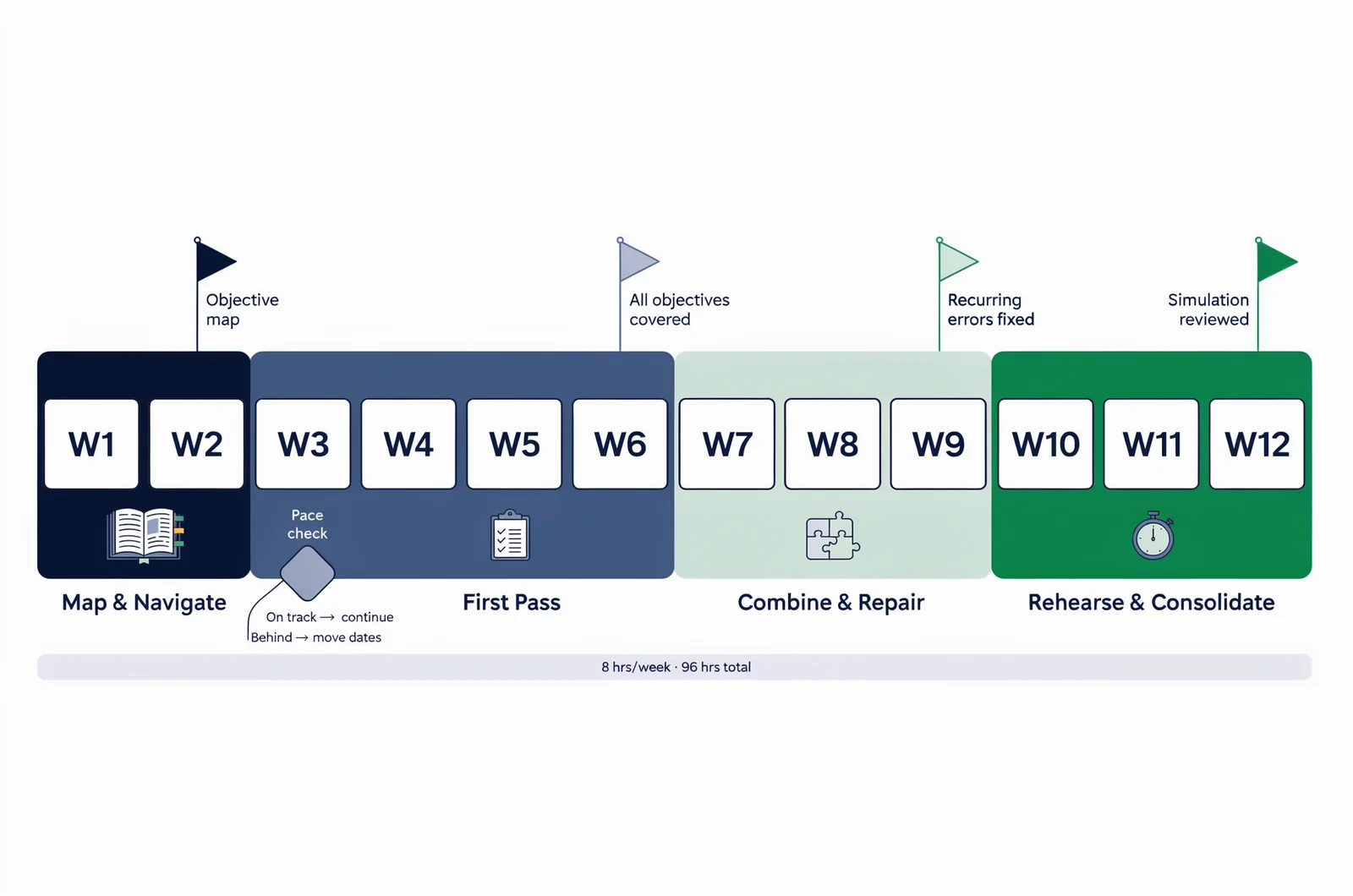
Weeks 1–2: map the outline and practice navigation
Use week 1 for the diagnostic, objective list, and first round of targeted review. In week 2, revisit those weaknesses with different questions and practice finding the relevant instructions.
Finish with an objective map that shows what is scheduled and what still needs attention. Check that your notes identify the reasoning behind errors.
Weeks 3–6: complete a first pass through the objectives
Divide the remaining objectives among these four weeks. Assign named topics from your outline to each week rather than writing broad entries such as study coding.
Continue the shorter ICD-10-CM and HCPCS Level II sessions alongside longer CPT blocks. Include a brief revisit of earlier work.
At the end of each week, mark which objectives you practiced, which you can explain, and which need another session. Leave unfinished topics visible.
Weeks 7–9: combine topics and repair recurring errors
Increase mixed practice so you must identify the relevant topic from the scenario. Keep targeted sessions for errors that recur across different questions.
During week 9, compare your error log with the full outline. Add a check for neglected topics, including those that seemed comfortable during the diagnostic.
The milestone is a coverage record supported by actual practice. Use it to assign the final three weeks.
Weeks 10–12: rehearse, repair, and consolidate
In week 10, complete a simulation that follows the format, timing, and materials permitted by the applicable instructions.
Use week 11 to investigate the simulation’s slow or uncertain decisions. In week 12, revisit recurring errors and confirm exam logistics. If the results show broad gaps, revise the calendar before committing to an unsuitable date.
Make practice questions produce an explanation
Give each CPC practice session enough time for answer review. Select a question count you can complete and examine within the block; reduce it if explanations regularly spill into the next session.
Work through the decision before checking the answer
Read the scenario and identify the information that controls your choice. Locate the candidate code or relevant guidance, then check the surrounding instructions before settling on an answer.
Use explanations after making your own decision. If you use Quizra’s explanation-based practice, compare the rationale with your coding references and record any point you cannot reconcile.
Do this for correct answers too. A correct response reached through an unsupported assumption still needs review.
Finish the session by explaining one difficult decision in plain language. Name the scenario detail that mattered and the guidance that supported your choice.
Write an error log that assigns useful work
Keep each entry short enough to review during a weekday block. Record the topic, the cause of the error, and the action you will take next.
For example, a hypothetical entry might identify a missed instruction near a candidate code. The follow-up task would be to locate that instruction again and apply it to a different scenario.
Separate knowledge gaps from reading mistakes and navigation delays. Each calls for different work:
- Review the concept when you cannot explain the rule.
- Rework the scenario when you overlooked a relevant detail.
- Repeat the lookup when you understood the issue but struggled to find guidance.
Schedule the follow-up on another day. Use a fresh question or a changed scenario when possible. Check whether you can explain the decision without relying on a remembered answer choice.
Review progress with accuracy, coverage, and timing
Use a short weekly review to decide whether your CPC calendar needs adjustment. Record enough information to distinguish improved understanding from familiarity with repeated questions.
Track first-attempt accuracy on fresh sets alongside the number of correct answers you could not confidently explain. Keep repeated-question results separate.
Also record completion time, unfinished questions, and recurring delays. Timing becomes useful when you can identify where the minutes went. A slow lookup needs a different response from a scenario you misunderstood.
At the end of the week, examine:
- Which objectives received practice and which remain untouched.
- Which errors returned in different scenarios.
- Whether explanations and reference searches became clearer.
Choose one or two specific changes for the following week. For example, move part of a comfortable topic’s block to a recurring weakness, or replace passive reading with targeted questions.
After a simulation, review the full attempt before scheduling another. Identify whether difficulty came from content, navigation, pacing, or concentration. Assign repair sessions accordingly.
Use several fresh mixed sets to judge progress across time. A single result provides limited evidence about the whole outline.
Your calendar is working when scheduled tasks produce clearer explanations, more reliable reference use, and fewer repeated errors. If those checks remain unchanged, alter the study task or extend the timeline. Avoid filling the next week with more of an activity that has produced little usable progress.
Repair missed sessions without doubling the workload
Build a recovery rule into your CPC schedule before a busy week arrives. When you miss a session, move its unfinished deliverable rather than copying the entire block onto tomorrow.
Use the next available catch-up window for the highest-priority task. Replace a lower-priority review if necessary, then update the remaining dates.
After a disrupted week, keep one short continuity session. Review a recent error, locate the supporting guidance, and explain the decision. This gives you a clear place to restart.
If the disruption lasts longer, recalculate the plan:
- Count the objectives and review tasks still unfinished.
- Estimate the hours available before the intended exam date.
- Assign the remaining work to those hours.
- Extend the schedule if the work does not fit.
For example, reducing availability from eight hours to five removes three scheduled hours each week. Keep that difference visible rather than assuming you will absorb it through longer evenings.
Review the resulting calendar against your actual commitments. Each study block should have a plausible time slot. If two tasks depend on the same free hour, move one before the week begins.
Answer the scheduling questions that affect your plan
Resolve these decisions while building the CPC calendar, then revisit them when your availability or practice results change.
How many weeks should you allow?
Use your starting knowledge and sustainable weekly hours to choose a timeline. The 12-week example contains 96 scheduled hours, but that total is a planning device rather than an official preparation requirement.
Test your pace during the first two weeks. Compare completed tasks with remaining objectives, then move the target date if necessary.
What if you have only 30 minutes on a weekday?
Assign one narrow task: complete a small set, review an error category, or practice a reference search. Reserve enough of the block to check your reasoning.
Move broader mixed sets and simulations to longer windows. Finish the short session by recording the exact task you will resume next.
When should you schedule a full simulation?
Schedule one after you have covered enough of the outline to interpret the result meaningfully. Follow the applicable exam instructions and leave later sessions available for repair.
Before starting, decide how you will record uncertain answers, slow decisions, and unfinished work. Afterward, put the resulting tasks on dated calendar entries.
Keep research into other credentials in a separate block. Your CPC calendar should show the work required for this exam, while broader career research has its own time allowance.
AHIMA preparation for a separate study track
Click through to browse exams and begin a practice session. Get started → |