Best AHIMA RHIA vs RHIT Exam Prep Resources Ranked
Choosing AHIMA RHIA vs RHIT exam prep resources can be frustrating when books, question banks, and mock tests make similar promises. For candidates studying around work, the useful distinction is whether a resource explains decisions and matches the intended credential. This guide prioritizes five resource types, explains their buying checks, and shows how to combine them without collecting overlapping subscriptions.
The order below ranks each resource’s role in a study plan. Named providers are not scored because current prices, editions, and sample questions are unverified here. Use the recommendations to evaluate materials before paying.
Choose RHIA or RHIT before buying materials
RHIA and RHIT should be treated as separate preparation targets. Start by confirming your intended credential against AHIMA’s current eligibility guidance, then use that exam’s content outline to assess study materials.
Create a study document with the credential name at the top. Beneath it, record the outline’s domain titles and any stated weights. This becomes your coverage checklist. A resource that mentions healthcare information broadly still needs to demonstrate where its chapters or questions fit.
For a book marketed to both credentials, inspect how it separates their coverage. Look for distinct study paths, question labels, or chapter mappings. If the sample material leaves that separation unclear, ask for clarification before purchasing.
Avoid using another healthcare certification’s preparation as evidence of readiness. If you are also considering AAPC coding certifications, evaluate that credential path separately. Shared subject matter does not establish equivalent exam coverage.
Keep eligibility, exam rules, and study purchases in separate parts of your plan. A preparation product can help you review content; its sales description should not settle which credential you qualify to pursue.
Judge coverage, explanations, and access terms
The strongest RHIA or RHIT resource for your situation should solve a specific study problem. Question count alone cannot tell you whether it will do that.
Before comparing prices, inspect a sample chapter or question set. Use these checks:
- Does the material identify RHIA, RHIT, or clearly separated coverage for both?
- Can you map its contents to the outline you are using?
- Does an explanation connect the answer to details in the question?
- Are competing answers discussed when their differences matter?
- Can you review mistakes without immediately seeing the correct answer?
- Do access length and review tools fit your planned study period?
Treat update claims carefully. A recent publication date is useful context, but the contents still need to match your chosen exam. Look for a stated edition, revision history, or specific description of what changed.
Compare cost over your entire preparation period. Record the purchase price, access expiration, renewal terms, and any separately purchased components. Check these details before deciding that a subscription or bundle is economical.
Finally, give each purchase a job. A guide might explain unfamiliar concepts, while a question bank reveals where your reasoning breaks down. If two products perform the same task, inspect their samples side by side and identify what the second purchase would add.
The five prep resources worth prioritizing
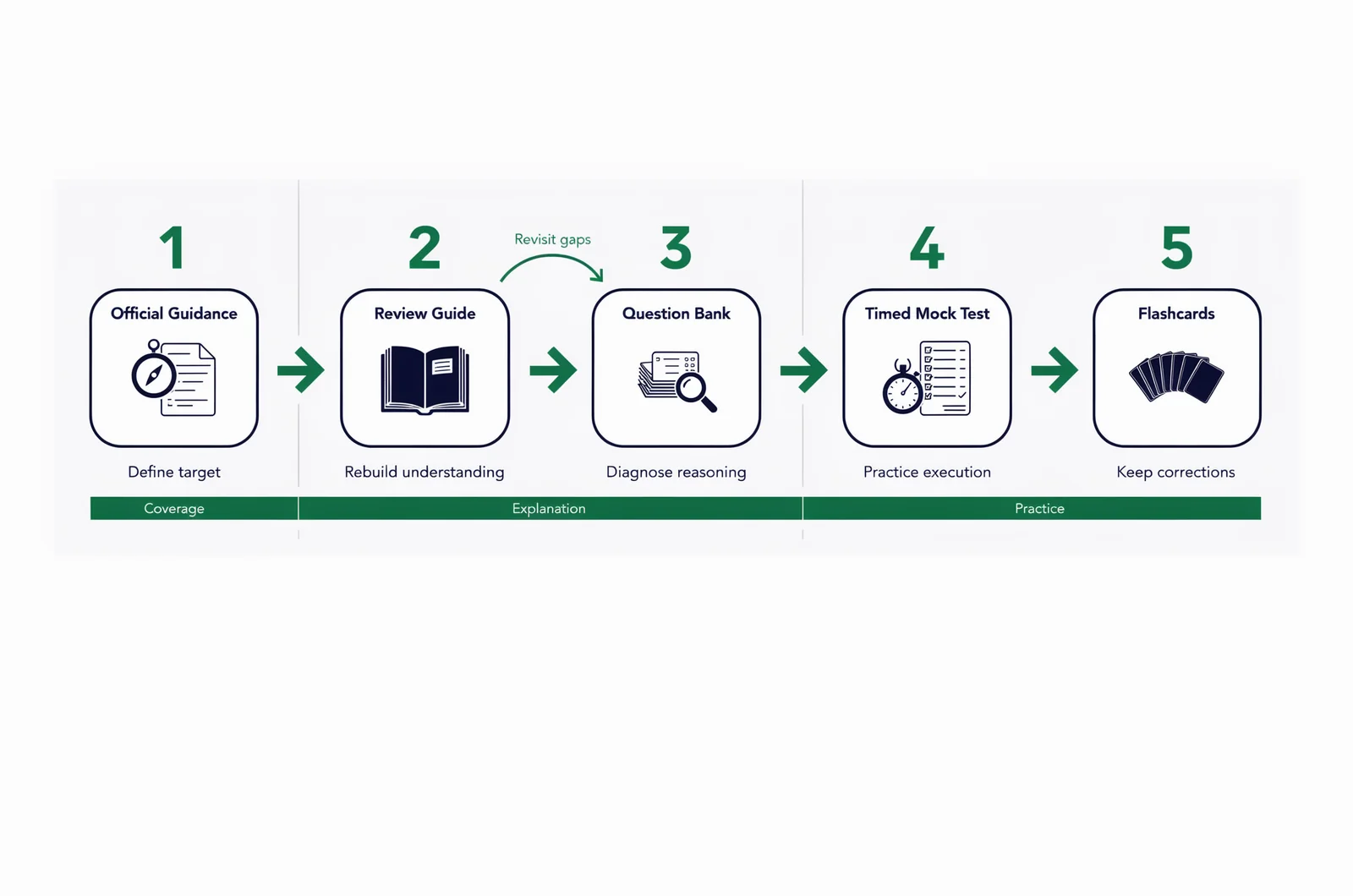
For either credential, prioritize coverage first, explanation second, and realistic practice after you have material worth practicing. The following order reflects that sequence; your diagnostic results may justify spending more time with one resource than another.
1. Official AHIMA exam guidance for defining the target
Official exam guidance belongs at the start because you need a reference for deciding what to study. Use the content outline and candidate instructions associated with your intended exam to establish your preparation boundaries.
This resource fits candidates choosing their credential, checking a book’s relevance, or rebuilding a scattered study plan. Its main strength is coverage control: you can compare a proposed purchase against the topics you need to address.
For the cost check, distinguish exam information from separately sold preparation products. Confirm the access terms for the particular document or item rather than assuming everything carrying the same organization’s name has identical terms.
Its limitation is depth. A topic heading does not necessarily explain the underlying concept or provide enough practice to apply it. You may recognize every heading and still struggle with a scenario.
The evidence to seek is a clear connection between the guidance, your credential, and the exam you intend to take. Start here, then turn each listed topic into a question you can explain or a task you can practice.
2. An exam-specific review guide for rebuilding understanding
A review guide earns its place when you need connected explanations rather than isolated answer rationales. It is especially suitable when a diagnostic session reveals unfamiliar terms or concepts across several topics.
Inspect the table of contents and a sample chapter. Look for explanations that move from a concept to an example and then to an application question. Check whether important terms are defined where you encounter them.
The buying check should cover the edition, included digital components, and whether those components require separate access. Compare the complete package you would actually use. A larger bundle has limited value if most of its material duplicates resources you already own.
The limitation is passive study. Finishing a chapter does not demonstrate that you can apply it without prompts. Close the book and explain the concept, then attempt a fresh question.
Choose this resource when understanding is the main gap. If you already explain the material accurately but misread scenarios, inspect an explanation-rich question bank before purchasing another broad review text.
3. A question bank with rationales for diagnosing weak reasoning
A question bank is most useful when you need repeated opportunities to apply concepts and examine mistakes. For a busy learner, it should also make it practical to complete a small set and return to its explanations later.
Judge a sample by the reasoning it exposes. A useful rationale identifies the decisive detail, explains the governing concept, and addresses plausible alternatives. An answer letter followed by a short definition gives you less evidence about why your decision was wrong.
Compare subscription options by access length and total planned use. Check whether explanations remain available throughout the subscription and whether the review workflow suits your device and schedule.
Its limitation is familiarity. Repeated questions can become recognizable, which makes later scores harder to interpret. Separate previously seen questions from fresh attempts when judging progress.
Choose this resource when you can reserve time for review after answering. For every missed or uncertain question, write the reasoning error in your own words before moving on. Include correct answers that you reached by guessing.
4. Timed mock tests for practicing execution
Timed mock tests fit candidates who have reviewed the material and want to examine pacing, sustained attention, and decision-making under a time limit.
Before using one as a simulation, compare its stated structure with AHIMA’s current instructions for your exam. Check question count, time allowance, and any relevant testing rules. A timed set with a different structure can still provide practice, but interpret its results within those limits.
For the purchase decision, inspect how many distinct forms are included and whether you can review explanations afterward. A reset may present previously seen questions; confirm what another attempt contains.
The main limitation is interpretation. A mock score cannot establish an official exam outcome, especially when its construction and scoring are unclear. Use it to investigate where your process failed.
After the attempt, separate content gaps from execution problems. Did you misunderstand a concept, overlook a qualifier, or spend too long on one item? Choose a mock test when you are ready to examine those patterns, then schedule a review session immediately afterward.
5. Focused flashcards for keeping corrections available
Flashcards fit short study windows and concepts that need repeated recall. They work best as a small supporting resource built around your actual errors.
For purchased sets, preview the wording, topic labels, and answer detail. Compare the price with what you would gain over making cards from your notes. Self-made cards have a time cost too, so keep them focused.
A useful card asks for one decision or distinction. Instead of copying a paragraph, write a short prompt that requires you to retrieve the idea. Add context where a term has little meaning on its own.
Their limitation is compression. A short card can leave out the conditions that make an answer appropriate. Preserve those conditions and return to a fuller explanation when necessary.
Choose flashcards after identifying specific recall gaps. For example, turn a misunderstood distinction into two contrasting prompts, then explain why the answers differ. Keep complex scenarios in your question practice, where you can work through the details rather than reduce them to a memorized phrase.
Use one scenario to inspect an explanation
For RHIA and RHIT preparation, a sample rationale can reveal more about a resource’s usefulness than a large advertised question total.
Consider a hypothetical question about conflicting values in two health records. Several answers might sound reasonable if read alone. The explanation should identify which details determine the choice and why the other proposed actions fit less well.
Inspect whether the rationale answers these questions:
- Which detail in the scenario changes the decision?
- What concept connects that detail to the preferred response?
- Why is a plausible competing answer less appropriate?
- What change to the scenario could make another answer suitable?
These are evaluation prompts, not claims about an actual exam question.
Then test your own understanding. Cover the answer and explain the decision aloud. Change one detail in the hypothetical scenario and reconsider the options. If you can repeat only the original answer, return to the explanation.
Use the same inspection process for free samples and paid materials. A familiar brand, polished interface, or extensive catalog does not answer these questions for you. Choose the resource whose sample gives you enough reasoning to make a defensible decision on a different scenario.
Build a study routine around your weakest areas
Your RHIA or RHIT resource mix should follow the problems your practice reveals. Start with the outline, one explanation source, and one way to attempt questions. Add another purchase only after identifying a gap.
Give each short session a complete purpose
A practical short session includes an attempt, review, and a recorded correction. Reduce the number of questions if that is what allows you to finish the review.
For example, try a small set without consulting notes. Mark answers that felt uncertain, including those you answered correctly. Review those items alongside your mistakes.
Record each issue in a brief error log: the topic, your reasoning, the correction, and what you will try later. Keep entries short enough to revisit before another practice session.
Let errors determine the next resource
If terminology is unfamiliar, return to the review guide. If the concept is clear but you choose the wrong action, work through scenario rationales. If performance changes under time pressure, examine a timed attempt.
Retest the concept with a fresh question when possible. Repeating the same item checks whether you remember its answer; a different scenario gives you another opportunity to explain the principle.
An interactive study checklist could help organize this process. It could take your credential, available study time, and weak topics, then assign each topic a review session and a later practice attempt.
Before renewing a subscription or buying another book, inspect your error log. Identify the unresolved problem and check whether your existing materials already contain a usable explanation.
Questions about choosing RHIA and RHIT materials
Choosing between RHIA and RHIT preparation materials raises practical questions about shared coverage, scores, and spending.
Can one book prepare me for both credentials?
Possibly, but inspect how it separates the two paths. Require enough detail to map its contents and practice questions to each intended exam.
Shared coverage may help you review a topic. It does not demonstrate that the book covers everything needed for either credential. Build a separate checklist for the exam you plan to take.
Is a high question-bank score enough to show readiness?
A score is one piece of information. Its meaning depends on whether the questions are unfamiliar, whether you can explain your answers, and how the material relates to your outline.
Review uncertain correct answers as well as errors. Ask whether you could defend the same decision if the question used different wording or changed one relevant detail.
What should I buy when my budget is limited?
First identify the problem that needs a paid resource. If you cannot explain foundational concepts, inspect a review guide. If you understand the content but struggle to apply it, compare question-bank rationales.
Use available samples before committing. Check access terms, avoid overlapping purchases, and leave time to review what you already have. Name the gap a new resource must address before comparing its price.
Study-set audits and healthcare scenario practice
- Auditing study sets against an exam
- Reasoning through healthcare case questions
- Red Hat Certification Exams Ranked By Career Value
Click through to browse exams and begin a practice session. Get started → |