Lean Six Sigma Green Belt Quizlet Sets, Audited Against the Exam

Search for lean six sigma green belt exam questions and answers quizlet and you will find dozens of flashcard decks, most of them free, many of them popular, and almost none of them documented. The decks rarely state which certification body they target, which exam version they reflect, or how their items were written. That gap matters because the Green Belt landscape is not one exam. ASQ's CSSGB and IASSC's Green Belt differ in structure, scoring, and the weight they place on statistical application, so a deck built for one can leave real holes for the other.
This audit treats those decks as a research subject rather than a study recommendation. It defines the evidence standard, codes the question types found in widely used sets, maps coverage against published exam objectives, and states plainly where term-level recall stops being enough. The goal is a decision you can act on: which parts of a Quizlet set are worth your study hours, and which parts you have to replace with something else.
The Research Question and Why It Keeps Coming Up
The recurring question behind this search is simple: do the popular Quizlet decks actually match the exam? The honest answer is that they match part of it, and the part they miss is the part that decides scores.
Three conditions create the mismatch. First, flashcard formats reward short answers. A card asks for a definition, a formula, or a term, and you either recall it or you do not. Second, Green Belt exams increasingly test judgment inside a scenario, where two answers are technically true and only one fits the phase, the data, or the constraint described. Third, the decks are community-built and rarely versioned, so a set created years ago can still rank well today even if the objectives underneath it have shifted.
The practical consequence is that a learner can score near-perfect on a deck and still miss a meaningful share of exam items, because the deck never asked them to choose between plausible options under a described condition.
Scope, Sources, and the Evidence Standard
This audit covers publicly visible Quizlet decks that surface for Green Belt search terms, plus the official objective documents and question-bank descriptions published by ASQ. Coverage claims rest on three source types only:
- Published exam outlines and certification pages from the certifying body
- The visible term lists, titles, and descriptions of the Quizlet decks themselves
- Publicly described question-bank structure from ASQ's own training materials
Anything not traceable to those sources is labeled as analysis rather than finding. No deck was credited with coverage it does not visibly claim, and no exam objective was assumed to be tested at a depth the outline does not state.
Two limits apply throughout. Quizlet decks are dynamic: owners edit, add, and delete cards, so a snapshot is a snapshot. And a visible term list is not the same as the full card content, which means coverage estimates are conservative lower bounds rather than exact counts.
How the Question Types Were Coded
Every item reviewed was sorted into one of four types. The taxonomy exists because the exam does not test one skill, and a deck's value depends on which types it contains.
| Question type | What it asks | Where it appears in study material |
|---|---|---|
| Term recall | Define a concept, acronym, or tool | Dominant in most Quizlet decks |
| Formula application | Compute DPMO, sigma level, Cp, Cpk, or cycle time | Present but often as isolated cards |
| Phase placement | Identify which DMAIC phase an activity belongs to | Common, usually as single-line prompts |
| Scenario judgment | Choose the best action given data, constraints, and phase | Rare in flashcard format |
The distribution matters more than the total card count. A 300-card deck that is 85 percent term recall gives you a strong vocabulary and weak decision practice. A 90-card deck with a third of its items in phase placement and formula application can outperform it on exam day, even though it looks thinner.
What the Decks Cover Well
Terminology coverage is genuinely strong. Across the decks reviewed, the vocabulary of Lean Six Sigma appears consistently and accurately: DMAIC phase names, the eight wastes, CTQ, VOC, FMEA, poka-yoke, control charts, and the basic statistics vocabulary all show up repeatedly. Sets such as the Lean Six Sigma Green Belt certification deck and the Green Belt exam questions set both lean heavily into this layer, and for a learner new to the method, that is real value.
Formula recall is better than expected in the stronger decks. Little's Law, defects per million opportunities, and the relationship between sigma level and yield appear as discrete cards, and the Green Belt exam practice questions deck includes items that ask for the primary purpose of the methodology rather than a bare definition, which nudges toward comprehension.
Phase placement also gets reasonable attention. Cards that ask which phase produces a charter, which phase validates a measurement system, or which phase confirms a gain are common, and they map cleanly onto the Define, Measure, Analyze, Improve, Control structure that both major bodies publish.
Where Term-Level Recall Breaks Down
The gap opens at the point where the exam stops asking what something is and starts asking what you should do.
Scenario items require you to read a described situation, hold several constraints at once, and select the best response. A flashcard cannot easily reproduce that, because the card format collapses the situation into a prompt and an answer. When a deck does include scenario-style cards, they tend to be short enough that the scenario is decorative rather than load-bearing.
Statistical application shows the same pattern. Knowing that Cpk measures capability relative to specification limits is recall. Being handed a process with a known mean, standard deviation, and specification and asked what the index tells you about the process is application. The first survives flashcard study. The second usually does not.
There is also a measurement-system thread that decks handle unevenly. Gauge R&R, attribute agreement analysis, and the logic of why a measurement system is validated before data collection appear in some sets and vanish from others, even though the topic carries real weight in the Measure phase.
Reading the Published Exam Structure
Coverage only means something against a stated structure. ASQ publishes its Certified Six Sigma Green Belt exam as a computer-delivered test of 110 multiple-choice questions with 4 hours and 18 minutes allowed, of which 100 are scored and 10 are unscored items used to evaluate future questions; the paper version runs 100 questions in 4 hours. The scored domains break down as Overview of Six Sigma and the Organization (11 questions), Define (20), Measure (20), Analyze (18), Improve (16), and Control (15), per the published outline summarized by Mometrix's CSSGB practice test overview.
That distribution is the audit's measuring stick. Define and Measure together account for 40 of the 100 scored items, which is why terminology-heavy decks feel productive: they are strongest exactly where the exam is densest. Analyze, Improve, and Control together account for 49 items, and those phases lean hardest on interpretation and judgment. ASQ also maintains its own Certified Six Sigma Green Belt question bank as a reference point for item style, and the Six Sigma Green Belt certification page carries the current eligibility and exam-format details if you need to confirm them before scheduling.
The arithmetic is uncomfortable for flashcard-only study. Roughly half the scored exam sits in phases where recall is necessary but not sufficient.
A Coverage Scorecard by DMAIC Phase
Scoring each phase on a simple three-level scale makes the pattern visible. "Strong" means most objectives in that phase appear in deck content at a usable depth. "Partial" means the vocabulary appears but application does not. "Thin" means the phase is underrepresented relative to its exam weight.
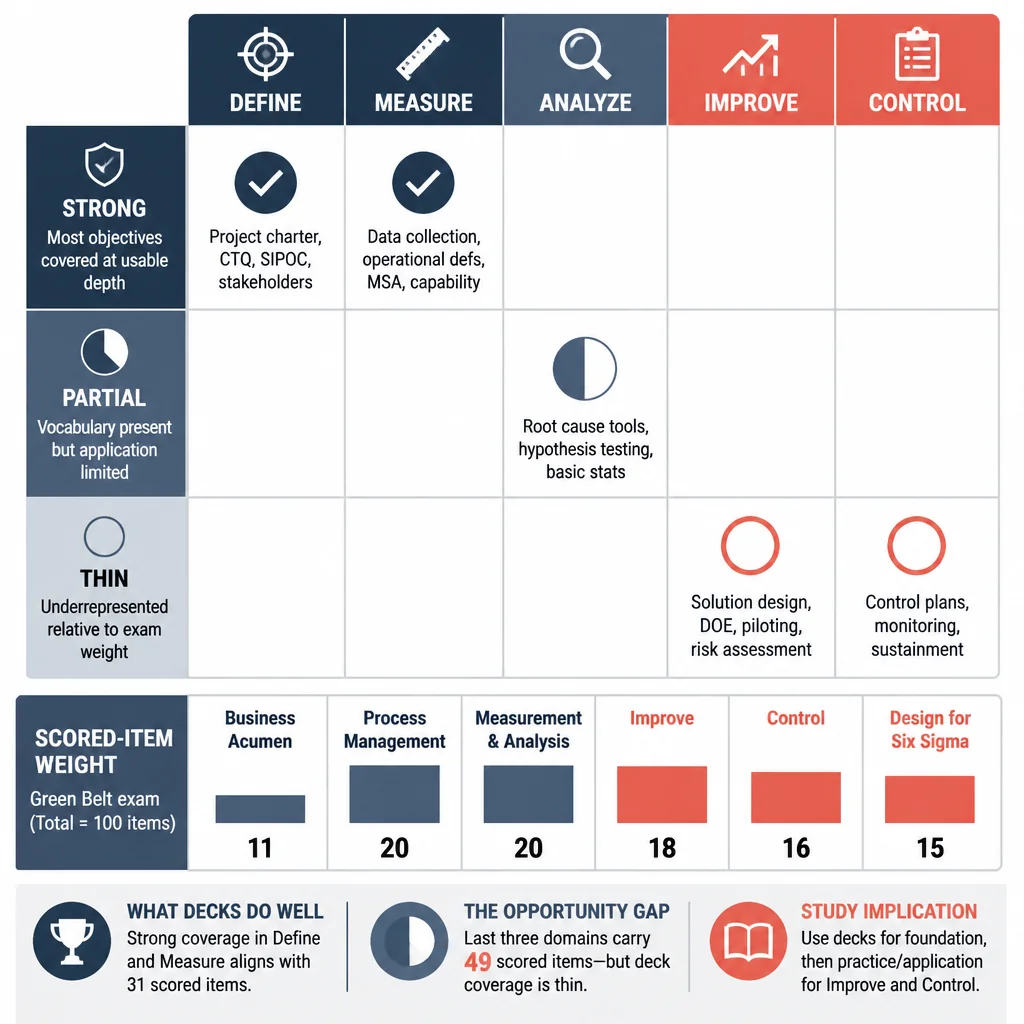
| Phase | Exam weight (scored items) | Deck coverage | What is missing |
|---|---|---|---|
| Overview and organization | 11 | Strong | Little; mostly definitional by design |
| Define | 20 | Strong | Charter elements occasionally conflated |
| Measure | 20 | Partial | MSA logic, sampling decisions, data types |
| Analyze | 18 | Partial | Test selection, hypothesis framing |
| Improve | 16 | Thin | Solution selection, pilot design, risk |
| Control | 15 | Thin | Control plan ownership, reaction rules |
Two conclusions follow. The first is that decks earn their reputation honestly in Define and Measure. The second is that the last three phases, which carry 49 scored items between them, need a different study method.
Turning Deck Study Into Exam-Ready Practice
The fix is not to abandon Quizlet. It is to use it for what it does well and to add application practice where it does not.
A workable sequence for a busy schedule:
- Run the deck in short sessions to build vocabulary, and stop when a card feels automatic.
- For every formula card, write one sentence describing when you would use that formula on a project.
- For every phase-placement card, add the question "what would I check next?" and answer it out loud.
- Move to scenario-style items once terminology stops slowing you down, and read the explanation for every wrong answer rather than just the correct one.
- Revisit missed items after a gap of several days, not the same session.
Step four is where the score moves. Scenario practice forces you to hold a described situation, a phase, and a set of data in mind at once, which is the actual cognitive demand of the Analyze, Improve, and Control items. A question bank that pairs each item with an explanation of why the other options fail does more for that skill than another pass through definitions.
If you want a rough sense of where you stand before committing study hours, a short self-assessment works better than a gut feeling. Score yourself on four dimensions, one to five: terminology fluency, formula recall, phase placement, and scenario judgment. If the first two are high and the last two are low, your study plan should be weighted toward application, regardless of how many cards you have mastered.
Limits of This Audit
Three constraints bound what these findings can support.
Deck contents change without notice, so coverage estimates describe a snapshot rather than a permanent state. Visible term lists are a proxy for full card content, which means the estimates understate coverage in decks that hide card bodies behind a study mode. And the audit compares decks against published objectives, not against live exam items, which no public source can provide.
One more caveat belongs here. Popularity is not evidence of alignment. A deck can rank first for a search term and still be built for a different certification body, a different belt level, or an older version of the objectives. Check the deck's stated source before you trust its scope.
Questions That Come Up Before Scheduling
Does a Quizlet deck alone prepare you for the Green Belt exam? No. It builds the vocabulary and formula recall that Define and Measure reward, but it does not reproduce the scenario judgment that Analyze, Improve, and Control test. Treat it as one component.
How many cards should a good deck have? Card count is a weak signal. A smaller deck with a meaningful share of phase-placement and application items beats a large deck of pure definitions.
Which body should the deck match? Whichever exam you are sitting. ASQ's CSSGB and IASSC's Green Belt differ in format and emphasis, so confirm the deck's stated target before relying on it.
How early should scenario practice start? As soon as terminology stops slowing your reading speed. Waiting until the final week leaves too little time to correct reasoning habits.
Are the free decks accurate? Terminology is generally accurate. Application items vary, and errors are more likely in statistical interpretation than in definitions.
Where to Take the Next Step
The audit points to one practical move: keep the deck for vocabulary, and add question sets that explain reasoning rather than just marking answers. Adjacent belt-level material helps too, since comparing how the same concept is tested at different levels sharpens your sense of what the Green Belt actually expects.
More on Lean Six Sigma Green Belt Exam Questions
- Yellow Belt practice quest
References
- [Asq — Certified Six Sigma Green Belt Question Bank - ASQ
- Quizlet — Lean Six Sigma Green Belt Certification Flashcards
- Quizlet — Green Belt - Exam Practice Questions Flashcards
- Asq — Six Sigma Green Belt Certification Apply & Get CSSGB Certified
- Quizlet — Green Belt Exam Questions Flashcards
ions](https://quizra.com/exams/six-sigma/LSSYB-lean-six-sigma-yellow-belt/questions)
- ASQ Master Black Belt questions
- ASQ Certified Quality Engineer questions
- CompTIA Security+ Practice Questions That Explain Every Wrong Answer
- CTFL v4 vs v3: What Changed in the ISTQB Foundation Exam
Click through to browse exams and begin a practice session. Get started → |