CompTIA Security+ Practice Questions That Explain Every Wrong Answer
Most people who fail Security+ do not fail because they never saw the material. They fail because they saw it, answered a question wrong, checked the correct letter, and moved on without ever finding out why their reasoning broke. The miss became a data point instead of a lesson. This guide walks through a repeatable review loop you can run on any set of CompTIA Security+ questions: attempt a short block, tag every miss to an exam domain, write out why the right answer wins, and finish with a ranked list of your weakest domains instead of a vague feeling that you "need to study more."
The loop takes about 45 minutes per cycle and works in shorter windows if you split it. You need a question set with explanations attached, a way to record misses, and the current SY0-701 domain weights in front of you. That's it.
What the SY0-701 exam actually asks you to do
Before you touch a question bank, get the constraints straight, because they shape how you should practice. The current Security+ exam is SY0-701, launched November 7, 2023. It runs 90 minutes, allows a maximum of 90 questions, mixes multiple-choice with performance-based items, and requires a 750 on a scale of 100–900 to pass. CompTIA's own certification page lists those figures alongside a recommended two years of IT administration experience with a security focus.
The five domains and their weights matter more than any other single fact for this review loop, because the weights tell you where a miss costs the most:
| Domain | Weight | Roughly how many of 90 questions |
|---|---|---|
| General Security Concepts | 12% | ~11 |
| Threats, Vulnerabilities, and Mitigations | 22% | ~20 |
| Security Architecture | 18% | ~16 |
| Security Operations | 28% | ~25 |
| Security Program Management and Oversight | 20% | ~18 |
Security Operations carries the heaviest weight, so a cluster of misses there deserves attention before a cluster of the same size in General Security Concepts. CompTIA notes that the exam objectives undergo regular review and that bulleted examples in the objectives document are not exhaustive, which is a polite way of saying the exam can reach past the literal wording of any objective. That is exactly why memorizing answer keys does not survive contact with the real test.
One scheduling note worth knowing: CompTIA has published draft V8 objectives and shared a target date of November 17, 2026 with its instructor community, with SY0-701 expected to remain bookable for roughly six months after a successor launches. If you are testing in the near term, you are studying for SY0-701 and the domain weights above are the ones that apply.
Set up your miss log before your first attempt
Create a simple table with five columns: date, question ID or stem topic, domain, why I chose wrong, why the correct answer wins. A spreadsheet works. So does a paper notebook, as long as you actually write the last two columns by hand rather than pasting the explanation.
The last two columns are the whole method. "Why I chose wrong" forces you to name the trap you fell for. "Why the correct answer wins" forces you to state the rule in your own words. If you can only paraphrase the vendor's explanation, you have not learned it yet.
Decide your block size
Use 15 to 20 questions per block, not 90. A full-length practice exam is a stamina test, and stamina tests belong in the last two weeks before your appointment. Early on, you want tight feedback loops. Fifteen questions is short enough that you still remember your reasoning when you review, and long enough to expose a pattern.
Run one review cycle from attempt to ranked weak domains
Here is the sequence. Each step has an action, a reason, and a check you can run to confirm it worked.
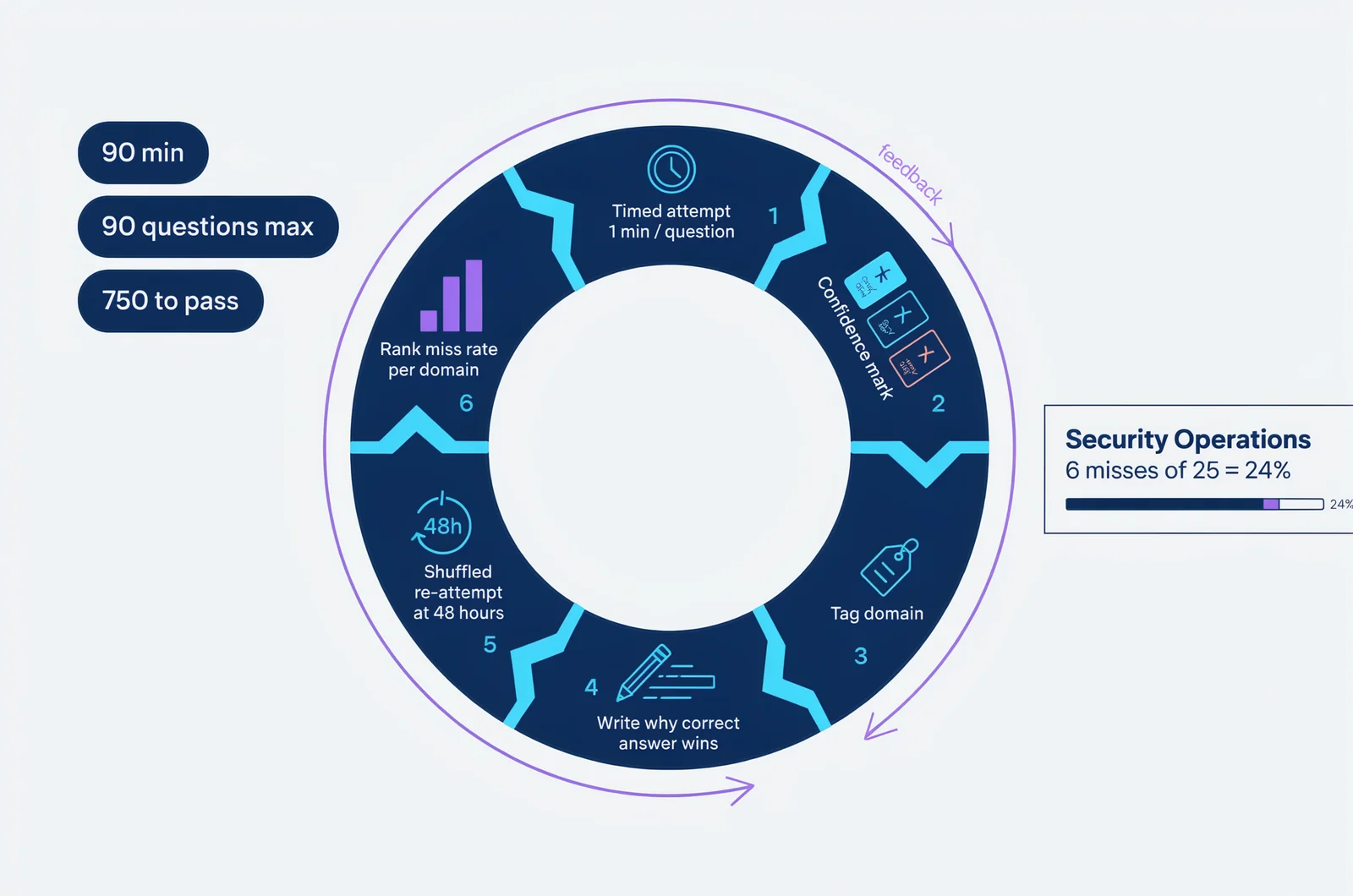
1. Attempt the block cold, timed, no notes. Give yourself roughly one minute per question, which mirrors the real 90-in-90 pace. Do not look anything up mid-block. The point is to capture your unaided reasoning, including the wrong parts.
2. Mark each question as confident-correct, guessed-correct, or wrong. Guessed-correct is the category most people throw away, and it is the most valuable one. A lucky guess on a question about inbound firewall rules is a miss you have not paid for yet.
3. Tag every non-confident item to a domain. Use the five SY0-701 domains. If a question about blocking a malicious IP address at the perimeter feels like it could sit in two domains, pick the one the objective language points to and note the ambiguity. Ambiguous tags are a signal that your domain map is still fuzzy.
4. Write the wrong-answer explanation in your own words. One or two sentences. Name the distractor you picked and the specific reason it fails. For example: "I chose the control that logs activity. Logging gives you evidence after the fact; the question asked for something that makes denial difficult, which is non-repudiation." That sentence is worth more than ten re-reads of the vendor's paragraph.
5. Re-attempt the missed items 48 hours later, shuffled. Not the next morning. The gap is what turns recognition into recall. If you miss the same item twice, it goes on a separate list for a third pass at day seven.
6. Count misses per domain and rank them. Divide misses in each domain by questions attempted in that domain. A raw count of 6 misses in Security Operations out of 25 attempted is a 24% miss rate; 3 misses in General Security Concepts out of 11 attempted is 27%. The rate, not the count, tells you where to spend the next block.
The verification cue that tells you the cycle worked
After two full cycles, you should be able to do one thing you could not do before: explain a missed question's correct answer to someone else without looking at the explanation. Pick three items from your log at random and say the rule out loud. If you stall, that domain's tag was optimistic.
A second cue is directional. Your miss rate in the heaviest domain should fall before your overall score moves much, because Security Operations is roughly a quarter of the exam. If your overall practice percentage is climbing but your Security Operations rate is flat, you are harvesting easy points in light domains and the exam will find you.
Where strong test-takers lose points anyway
The traps in Security+ questions are consistent, and naming them makes them easier to spot under time pressure.
Answering the question you expected instead of the one on screen. Scenario stems often bury the actual ask in the final clause. Read the last sentence first, then the scenario. You will catch questions that ask for the first step of incident response rather than the containment action.
Choosing the technically strongest control. Exam questions usually want the control that fits the stated constraint, not the most powerful one available. A question about compensating for a legacy system is not asking for a full replacement.
Ignoring cost, effort, and business context. Security Program Management and Oversight is 20% of the exam, and those items frequently hinge on risk acceptance, third-party assessment, and governance rather than tooling.
Treating performance-based questions as a different exam. They are not. A PBQ is the same domain knowledge expressed as a task. If your review loop only covers multiple-choice misses, add PBQs to the log with the same two explanation columns.
Studying the same comfortable domain repeatedly. This is the failure mode the ranked list exists to prevent. Your log will tell you that you keep returning to General Security Concepts because the questions feel good. That is not preparation.
Building the practice set so the loop has something to work with
The loop only functions if your questions come with real explanations. A bank that gives you a letter and a one-line restatement of the correct option starves the method. When you evaluate a question source, check three things: does the explanation address why each distractor fails, does it name the domain or objective, and is the content aligned to SY0-701 rather than an older series.
CompTIA publishes a free set of Security+ (V7) Practice Questions that shows the official question style, including scenario stems about missing files and ransom notes, blocking a malicious IP address at the firewall, and identifying which threat actor would use common hacking tools against a public web server. Those examples are useful for calibrating tone and difficulty. They are not a large enough pool to run six review cycles.
For volume, a question-first library such as Quizra's Security+ SY0-701 questions pairs each item with an explanation, which is the input the miss log needs. The CompTIA Security+ Certification Exam Objectives document is the other half of the setup: keep it open while you tag, so your domain labels match CompTIA's language rather than your own shorthand.
If you want a tool idea that fits this method, a domain-weighted miss tracker is the one worth building. It takes your block results, divides misses by attempts per domain, multiplies by the official weight, and outputs a single priority order. Twenty minutes in a spreadsheet, and it replaces the guesswork about what to study next.
Reading the ranked list and choosing your next block
Your ranked list is the output of the loop, and it should drive the next session directly. A workable rule: spend your next two blocks on the top-ranked domain, one block on the second, and keep one maintenance block per week cycling through everything so earlier gains do not decay.
Watch for two patterns in the ranking. First, a domain that stays at the top across three cycles usually means a concept gap rather than a question-reading problem. Go back to the objective text for that domain and study it before attempting more items. Second, a domain that jumps to the top after being clean is often a tagging error, not a regression. Re-check whether you filed those questions correctly.
When your top-ranked domain's miss rate drops below roughly 15% across two consecutive blocks, rotate it into maintenance and promote the next domain. That threshold is a working target, not a guarantee of anything on exam day.
Adjusting the loop for a short runway
If your exam is two to three weeks out, compress the cycle. Use 25-question blocks, review the same day, and re-attempt at 24 hours instead of 48. Reserve the final week for two full-length timed sittings so the 90-minute pace stops feeling foreign. Keep the miss log running through those full exams; a 90-question sitting produces the richest domain data you will get.
If your runway is longer, slow down and go deeper. Fewer questions, more written explanations, and a genuine re-read of the objective document for any domain that will not fall.
Questions that come up while running the loop
How many practice questions should I work through before the exam? There is no official number. What matters is coverage: you want at least two attempts logged in every domain, with the heaviest-weighted domains getting the most. A few hundred well-reviewed items with written explanations beats a thousand skimmed ones.
Should I use practice questions before I finish studying the material? Yes, earlier than feels comfortable. Attempting questions before you feel ready is how you find out which parts of the material you actually need. The miss log turns that discomfort into a study plan.
Do performance-based questions need a different review method? Same method, different output. Instead of writing why a distractor fails, write the sequence you should have executed and where your sequence broke. Tag it to a domain like any other item.
How do I know when I am ready to book? When your miss rate is under control in the two heaviest domains and you can explain missed answers out loud without the explanation in front of you. A practice exam score alone is a weaker signal than a stable, low miss rate in Security Operations and Threats, Vulnerabilities, and Mitigations.
Is SY0-701 still the right exam to study for? For now, yes. CompTIA has published draft V8 objectives and a target date of November 17, 2026 shared with instructors, but SY0-701 remains the bookable exam and typically stays available for about six months after a successor launches. Confirm the current status on CompTIA's certification page before you schedule.
Where the loop leads next
Once your Security+ domain ranking is stable, the same method transfers cleanly to the next certification in the security track. CySA+ practice questions reuse the tagging and explanation columns almost without modification, and Network+ practice questions are useful right now if your misses keep clustering around networking objectives that Security+ assumes you already know.
References
Security+ (V7) Practice Questions — Security+ (V7) Practice Questions | CompTIA Certifications Global ... # Security+ Practice Test (V7) ... ## Dive into practice questions ... Question 1 ... A business development
Click through to browse exams and begin a practice session. Get started → |