CTFL v4 vs v3: What Changed in the ISTQB Foundation Exam
CTFL v4 vs v3: What Changed in the ISTQB Foundation Exam
If you have a shelf of CTFL v3 study guides or a folder of v3.1 practice tests, you are probably wondering whether they still matter. The short answer is: some do, but not all. ISTQB released the CTFL v4.0 syllabus in April 2023 and made it mandatory for new exams in May 2024. The shift is not a simple rebrand. Chapters moved, new concepts entered, and several older topics were trimmed or redefined. This article maps what actually changed, what stayed useful, and how to decide whether your existing materials need replacing.
Why ISTQB Rebuilt the Foundation Syllabus
ISTQB has administered more than 1.5 million exams and issued over 1.1 million certifications across 130 countries since 2002. The Certified Tester Foundation Level (CTFL) remains the required first step for every advanced ISTQB track. By 2023, the organization saw two problems with v3.1.1: the syllabus had grown dense with learning objectives that overlapped with the separate Agile Tester extension, and modern delivery practices—DevOps pipelines, continuous testing, shift-left approaches—were underrepresented.
The v4.0 rewrite aimed to fold agile and risk-based thinking into the core rather than treating them as add-ons. The result is a leaner syllabus with fewer learning objectives overall but broader conceptual reach. According to the Czech and Slovak Quality Board, v4.0 draws on both the Foundation Level v3.1.1 and the Agile Tester 2014 syllabi, with every business outcome and learning objective either reworded, replaced, or newly added.
The Structural Overhaul: Six Chapters Become Five
CTFL v3.1.1 organized content into six chapters. v4.0 compresses this into five, with topics redistributed rather than simply deleted. The most visible change is the merger of test design techniques and test management concepts into a more integrated flow. Where v3.1.1 treated test levels and test types as separate catalogues, v4.0 weaves them into a single narrative about risk-appropriate testing.
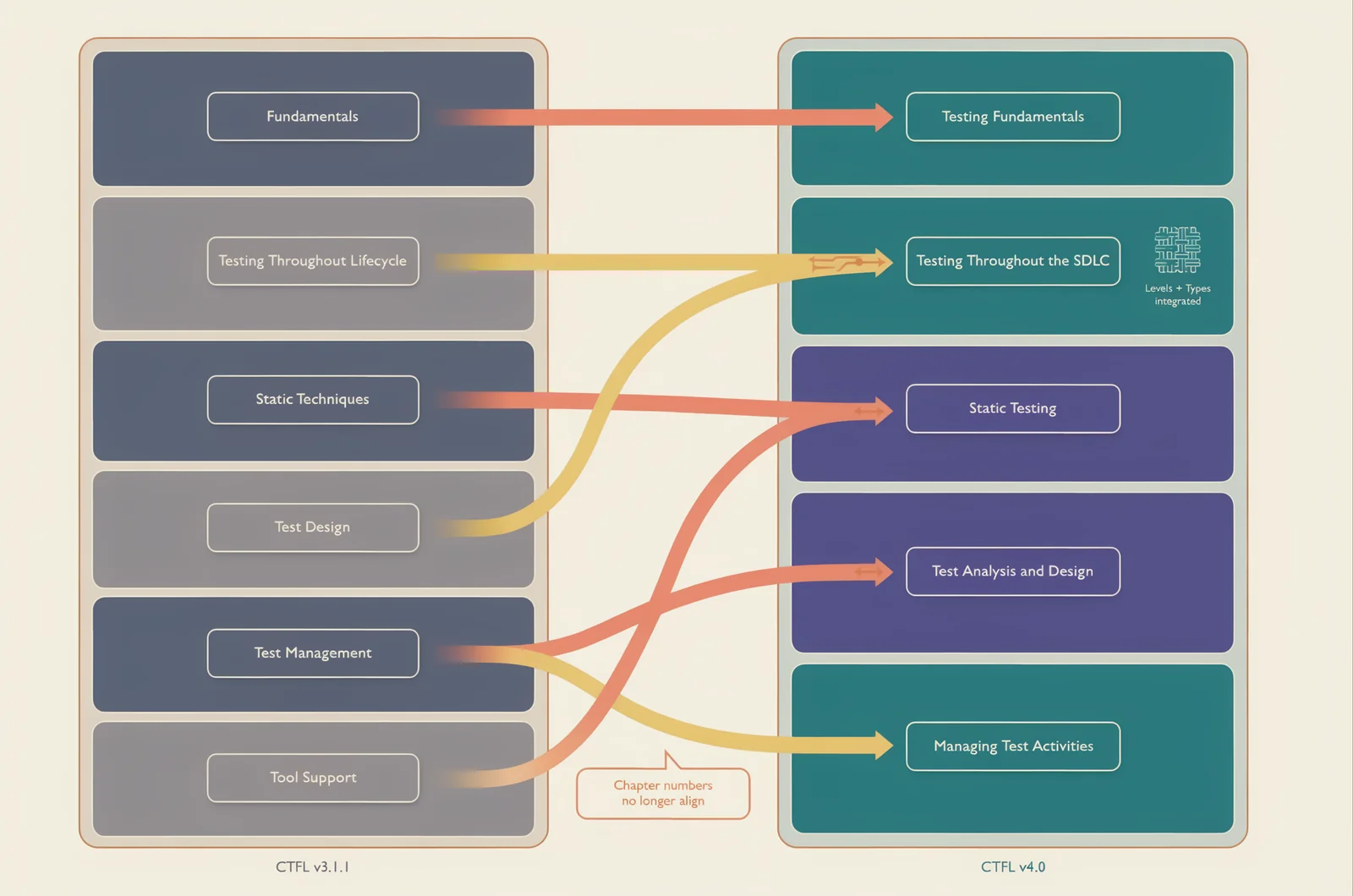
This matters for study planning. If your v3 materials are organized by chapter, you cannot assume chapter 3 in v3 maps to chapter 3 in v4. The Certified Tester Foundation Level (CTFL) v4.0 documentation from ISTQB lists the new structure, and accredited training providers now teach to this sequence. Self-study candidates using older books should cross-reference the v4 syllabus directly rather than following a v3 table of contents.
What Entered the Syllabus: Agile, Risk, and Usability
Three topic areas received significant new emphasis in v4.0:
Agile testing as core knowledge. In v3.1.1, agile appeared as a brief mention; the deep treatment lived in the separate Agile Tester extension. v4.0 makes agile terminology, sprint-level testing, and test-first approaches examinable at the foundation level. If your v3 materials never mention user stories, definition of done, or retrospectives from a testing angle, you have a gap.
Risk-based testing. While v3.1.1 introduced risk concepts, v4.0 elevates them. Candidates now need to apply risk analysis to test prioritization, coverage decisions, and effort allocation. This is not vocabulary memorization. The exam expects you to work through scenarios where risk level drives which tests run first and which can be reduced.
Usability testing. This was largely absent from v3.1.1 at foundation level. v4.0 adds it as a recognized test type with specific techniques and quality characteristics. If your practice questions only cover functional and non-functional categories without addressing user experience metrics, they are incomplete for v4.
What Left or Shrank: Tools, Standards, and Documentation
Not everything expanded. Several areas were trimmed to make room:
Test tool selection and acquisition processes. v3.1.1 dedicated noticeable space to tool evaluation, pilot projects, and organizational readiness. v4.0 keeps tool awareness but cuts the procedural depth. If your v3 book has a multi-page checklist for selecting a test management tool, that detail is now beyond foundation scope.
Some IEEE and ISO references. v3.1.1 leaned on specific standards documents for terminology. v4.0 uses ISTQB's own vocabulary as primary, with standards cited more loosely. This is a subtle change, but it means rote memorization of standard numbers is less useful.
Formal review process steps. While reviews remain in v4.0, the step-by-step rigor of formal inspections was reduced. The focus shifted to practical, lightweight review types that fit agile and continuous delivery contexts.
Terminology Shifts That Trip Up v3 Holders
Several terms changed meaning or naming between versions. "Confirmation testing" and "regression testing" are still present, but their relationship to iterative delivery is now emphasized. "Test basis" and "test oracle" appear with sharper definitions. Most significantly, v4.0 introduces "shift-left testing" and "continuous testing" as standard terms that v3.1.1 never formally defined.
If you learned v3 vocabulary by rote, you risk answering v4 questions incorrectly even when you understand the underlying concept. The Czech and Slovak Quality Board notes that some v3.1 terms were renamed or redefined to align with current industry usage. A practice approach that forces you to explain answers in your own words—rather than matching keywords—helps bridge this gap.
Exam Format and Scoring: Mostly Stable
The exam delivery mechanism did not change with v4.0. You still face 40 multiple-choice questions over 60 minutes, with 26 correct answers required to pass. The question style, however, has shifted subtly. v4.0 questions lean more heavily on scenario-based stems where you apply concepts rather than recall definitions. This rewards understanding over memorization, which is why practice that includes detailed explanations matters more than ever.
ISTQB does not publish a global exam fee; prices are set by local member boards and exam providers. The Certified Tester Foundation Level (CTFL) v4.0 page directs candidates to contact their national provider for current pricing.
Decision Framework: Keep, Supplement, or Replace Your v3 Materials
Here is how to audit your existing study investment:
| Your situation | Recommended action |
|---|---|
| You own a v3.1 textbook and have not started studying | Replace or supplement. The chapter misalignment and new topics will cost you time if you try to adapt. |
| You have v3.1 materials and are halfway through | Continue for foundational concepts (test principles, basic techniques), but add v4-specific coverage for agile, risk-based testing, and usability. Cross-reference the official v4 syllabus to identify gaps. |
| You have v3.1 practice questions only | Use them for core technique drill, but source v4-aligned questions for agile, risk, and scenario-based application. The legacy CTFL v3 exam remains useful for baseline concept checking, though v4 questions will differ in emphasis. |
| You are retaking after a v3 failure | Switch to v4 materials entirely. The exam you sit will be v4, and v3-prepared weak spots may not map cleanly. |
How to Study Efficiently for v4.0
With the syllabus leaner in total learning objectives but deeper in applied concepts, your study strategy should adjust:
Prioritize scenario practice over flashcards. The v4 exam rewards working through situations. For each concept, ask yourself how it would apply in an agile sprint, a DevOps pipeline, or a risk-prioritized test plan.
Build explicit connections between topics. v4.0's integrated structure means questions often combine test design with risk analysis, or agile practices with review techniques. Siloed chapter-by-chapter study leaves you unprepared for these cross-cutting items.
Use practice that explains why wrong answers are wrong. This is where many self-study candidates stall. A question bank that only gives correct answers leaves you vulnerable to plausible distractors. Look for explanations that trace back to syllabus concepts, not just assertion of the right choice.
For candidates expanding into the new v4 topic areas, the ISTQB performance testing exam and agile technical tester certification paths build on foundation knowledge with deeper specialization. Even if you are not pursuing those tracks, browsing their scope helps calibrate what "foundation" now means in context.
Common Pitfalls for v3 Holders Transitioning to v4
Three specific traps catch experienced testers:
Overweighting tool knowledge. If you work with test automation daily, you may assume the exam rewards that expertise. v4.0 keeps tools at awareness level for foundation. Deep tool knowledge can even mislead you into overthinking basic questions.
Underestimating the agile content. Professional testers in waterfall environments sometimes skim the agile sections, assuming they are peripheral. In v4.0, these sections carry exam weight comparable to traditional test levels.
Ignoring the syllabus itself. Third-party materials vary in update speed. The official ISTQB CTFL v4.0 syllabus PDF, available from national boards and the ISTQB exam vendors directory, is the only guaranteed current reference. Use it to verify that any course or book you purchase actually covers v4.0, not v3.1 with a new cover.
Looking Ahead: Maintenance Updates and Exam Longevity
ISTQB issued a maintenance update, v4.0.1, in September 2024. This refresh covers copyright notices and logos only; no examinable content changed. If you see training materials labeled v4.0.1, they are equivalent to v4.0 for study purposes. The core syllabus released in April 2023 remains valid for exams through 2026 and likely beyond, given ISTQB's typical multi-year syllabus lifecycle.
The Certified Tester Foundation Level (CTFL) certification continues to serve as prerequisite for all advanced ISTQB tracks, including Test Manager, Test Analyst, and Technical Test Analyst. Whether you pursue those paths or need the foundation credential for employment requirements, v4.0 is now the only active version.
When the Syllabus Change Affects Your Timeline
If you scheduled a v3.1 exam before the May 2024 cutoff and are now planning to retake or certify for the first time, you must prepare for v4.0. There is no grandfathering; previous v3.1 registration does not carry over. For employers requiring CTFL as a hiring condition, verify whether they specify v4.0 explicitly or simply accept current foundation certification. Most hiring managers in 2026 expect the current version.
Building Sustainable Study Habits for a Busy Schedule
The typical CTFL candidate is not a full-time student. You are fitting preparation around sprint deadlines, on-call rotations, or shift work. The v4.0 syllabus's scenario-heavy nature actually helps here: short, focused practice sessions that work through one realistic situation often teach more than long passive reading blocks. Ten minutes with a well-designed practice question and its explanation can cover a learning objective more durably than an hour of highlighting text.
This is where question-first study libraries earn their place. Rather than front-loading content and hoping it transfers to exam questions, you encounter the exam's logic immediately and build knowledge through correction and explanation. For candidates with fragmented schedules, this inversion often proves more efficient than traditional chapter-by-chapter progression.
Certification Paths Beyond the Foundation
CTFL v4.0 is not an endpoint. ISTQB's advanced certifications now expect the integrated perspective that v4.0 introduces. The Test Manager track assumes you can prioritize by risk. The Agile Technical Tester track builds on the agile foundations now embedded in CTFL. Even if your immediate goal is only the foundation credential, studying with these connections in mind deepens retention and prepares you for future advancement.
From Guessing to Understanding: The Core Shift in v4.0 Preparation
The v3.1 exam could be passed with strong memorization and pattern recognition. v4.0's emphasis on application, risk analysis, and agile context makes that approach risky. The candidates who succeed are those who can articulate why a testing decision makes sense in a specific situation—not merely which technique matches which definition.
This mirrors a broader truth about certification value. Employers request CTFL because it signals structured thinking about quality, not because it proves encyclopedic knowledge. v4.0's redesign pushes the exam closer to that real-world signal. Your preparation should follow: less time drilling isolated facts, more time explaining reasoning.
Exams and Certifications Worth Exploring Next
- SAP ABAP certification paths
- FINRA license comparison guide
- Official versus unofficial practice questions
Click through to browse exams and begin a practice session. Get started → |