C-ABAPD-2309 vs E-ABAP: Which SAP ABAP Path to Take

C-ABAPD-2309 vs E-ABAP: Which SAP ABAP Path to Take
Choosing between C-ABAPD-2309 and E-ABAP confuses many SAP newcomers. Both credentials sit in the ABAP development space, yet they target different platforms, skill sets, and employer expectations. If you are deciding which exam to book first, you need clarity on what each path actually validates — and which one aligns with the roles you want.
This comparison breaks down the scope, format, and career fit of each track. It also explains how SAP's certification numbering has shifted, why the older E-ABAP designation still appears in job posts, and what the newer C-ABAPD-2309 path demands of candidates today.
What C-ABAPD-2309 Actually Covers
C-ABAPD-2309 is the SAP Certified Associate — Back-End Developer — ABAP Cloud exam that was active through late 2024 and into 2025. SAP has since introduced C-ABAPD-2507 and the newer C-ABAPD-2601 as successors, but many study plans and employer requirements still reference the 2309 version.
The exam tests core ABAP language fundamentals, object-oriented design, database access through ABAP SQL and Core Data Services (CDS), and the RESTful Application Programming Model (RAP). It also covers Clean Core extensibility for SAP S/4HANA Cloud. Candidates work with scenarios that span both SAP BTP ABAP environment and on-premise S/4HANA systems, since the underlying skills carry across deployments.
The format is a traditional multiple-choice and multiple-response test delivered online through SAP's certification system. You have 180 minutes, and SAP recommends prior hands-on experience with ABAP programming before attempting it. The ABAP Development User Guide provides the authoritative reference for syntax and platform capabilities tested on this exam.
For anyone building foundational ABAP knowledge, C-ABAPD-2309 offers a structured, scenario-based assessment that feels familiar if you have taken other SAP associate exams. The C-ABAPD-2309 practice questions available through Quizra follow this same scenario-driven format, with explanations that connect each answer back to the underlying concept rather than simple memorization.
Understanding the E-ABAP Designation
E-ABAP is not a current SAP exam code. It refers to earlier SAP ABAP certification tracks — most commonly the SAP Certified Development Associate — ABAP with SAP NetWeaver exams that preceded the cloud-focused rebranding. You will still see "E-ABAP" or "E_ABAP" in legacy job descriptions, forum threads, and some training provider catalogs, where it functions as shorthand for "entry ABAP" or simply the older exam family.
The core difference is platform era. E-ABAP tracks emphasized classical ABAP development on SAP NetWeaver Application Server, with limited coverage of cloud-native patterns, RAP, or BTP. The certification validated that you could write reports, dialog programs, and enhancement implementations in traditional ECC or NetWeaver environments.
Employers maintaining older SAP estates still value this foundation. However, SAP's strategic push toward S/4HANA Cloud, Clean Core, and BTP extensibility means new hiring increasingly favors the C-ABAPD track. If you see a job posting requesting "E-ABAP," read carefully — it may mean "any ABAP associate certification" rather than the literal retired exam.
How the Exams Differ in Format and Focus
| Attribute | C-ABAPD-2309 | E-ABAP (legacy track) |
|---|---|---|
| Current status | Retired; succeeded by C-ABAPD-2507/2601 | Retired |
| Platform focus | ABAP Cloud, BTP, S/4HANA Cloud | SAP NetWeaver, ECC |
| Programming model | RAP, CDS, ABAP SQL | Classical ABAP, ALV, dialog programming |
| Exam format | Multiple choice / multiple response | Multiple choice |
| Delivery | Online proctored | Online proctored |
| Duration | 180 minutes | 180 minutes |
| Cut score | Varies by version | Varies by version |
The shift from E-ABAP to C-ABAPD reflects SAP's broader platform migration. Where E-ABAP asked you to build and debug traditional programs, C-ABAPD-2309 expects you to create cloud-ready extensions that follow SAP's Clean Core principles. This means fewer questions about custom code in the core and more about side-by-side extensions, APIs, and RAP business objects.
The newer C-ABAPD-2601 moves even further toward practical assessment. According to C-ABAPD-2507 vs C-ABAPD-2309: What's New, the latest versions emphasize system-based assessment — a hands-on task in a live ABAP environment rather than purely multiple-choice testing. This makes the credential harder to earn through memorization alone, which is why many candidates now seek practice environments that simulate real development scenarios.
Which Path Employers Actually Request
Job market signals favor the C-ABAPD family for new roles, but the transition is uneven. SAP's partner program requires certified staff, and partners updated their hiring criteria to match the newer exams as they became available. Large consultancies and implementation partners now list C-ABAPD-2507 or C-ABAPD-2601 as preferred or required credentials for junior ABAP developer roles.
That said, E-ABAP knowledge remains relevant in maintenance and support positions. Organizations running SAP ECC 6.0 or older S/4HANA releases need developers who understand classical ABAP, enhancement frameworks, and legacy data models. If your target employer operates in this space, the underlying skills matter more than the specific exam code on your profile.
One practical approach is to treat C-ABAPD-2309 or its successor as your primary target, while acknowledging that classical ABAP fluency helps in hybrid environments. The SAP Financial Accounting certification track offers a useful comparison point here — it shows how SAP's associate-level exams build domain expertise that employers recognize regardless of version number, provided you keep current with release changes.
Study Strategy for Each Track
Preparing for C-ABAPD-2309 (or Current Successors)
Start with the official SAP Learning Journey for Back-End Developer — ABAP Cloud. The curriculum is free and self-paced, with hands-on exercises in the BTP trial environment. Work through the RAP tutorials specifically, since this programming model confuses many candidates who learned classical ABAP first.
Supplement with practice questions that include detailed explanations. The value of practice is not in seeing the exact questions that appear on the exam — SAP changes these regularly — but in identifying which topics you misunderstand. Pay attention to CDS view types, RAP behavior definitions, and the distinction between managed and unmanaged scenarios. These appear frequently and trip up candidates who rely on rote memorization.
If you have access to an S/4HANA system or BTP ABAP environment, build a small extension end-to-end. The exam scenarios assume you have done this, and the newer system-based assessments require it.
Building E-ABAP Foundation Skills
Since E-ABAP exams are retired, you cannot sit for them through SAP directly. However, the knowledge base remains valuable if you support legacy systems. Study classical ABAP through the SAP Help Portal documentation and focus on report programming, screen painter, ALV grid controls, and enhancement techniques like user exits and BAdIs.
Consider whether your career goals require this depth. If you aim for new development roles in S/4HANA Cloud, time spent on classical ABAP yields diminishing returns compared to RAP and BTP skills. If you are already employed maintaining an ECC system, the knowledge pays immediate dividends.
Where Training Providers Fit
Several independent providers offer preparation materials for the ABAP certification paths. Understanding their positioning helps you choose resources that match your learning style.
Cremencing

abap certification course in 2026 emphasizes practical application over credential accumulation. Their analysis notes that C-ABAPD-2309 retains a traditional scenario-based format that suits candidates who want a structured written exam as a confidence baseline before tackling newer system-based assessments. They caution that certification alone does not secure employment — employers want developers who can apply knowledge in real SAP environments, not just pass exams. Their materials blend training with career guidance, which appeals to candidates making a mid-career transition into SAP development.
ERPPrep

ERPPrep frames certification as a stepping stone rather than a destination. Their guidance recommends choosing a first certification aligned with your existing domain — finance professionals start with Financial Accounting, HR professionals with SuccessFactors, developers with ABAP. They note that SAP's partner program requires certified staff, which gives associate credentials standing in the hiring market. Their preparation approach stresses finding visible next steps: an associate cert that leads toward professional exams or adjacent specializations.
ERP Q&A
abap cloud developer certification c provides detailed technical breakdowns of the modern C-ABAPD exam structure. They explain that the current version uses system-based assessment — one guided hands-on activity scored on task completion — with a cut score of 67 percent. Their coverage of the SAP BTP ABAP environment, CDS views, and Clean Core extensibility is precise, which helps candidates who want to understand exactly what skills the credential validates. They are particularly useful for candidates evaluating whether the newer assessment format matches their strengths.
Making the Decision: Which Path Suits You
Your choice depends on three factors: your current platform exposure, your target role, and your employer's system landscape.
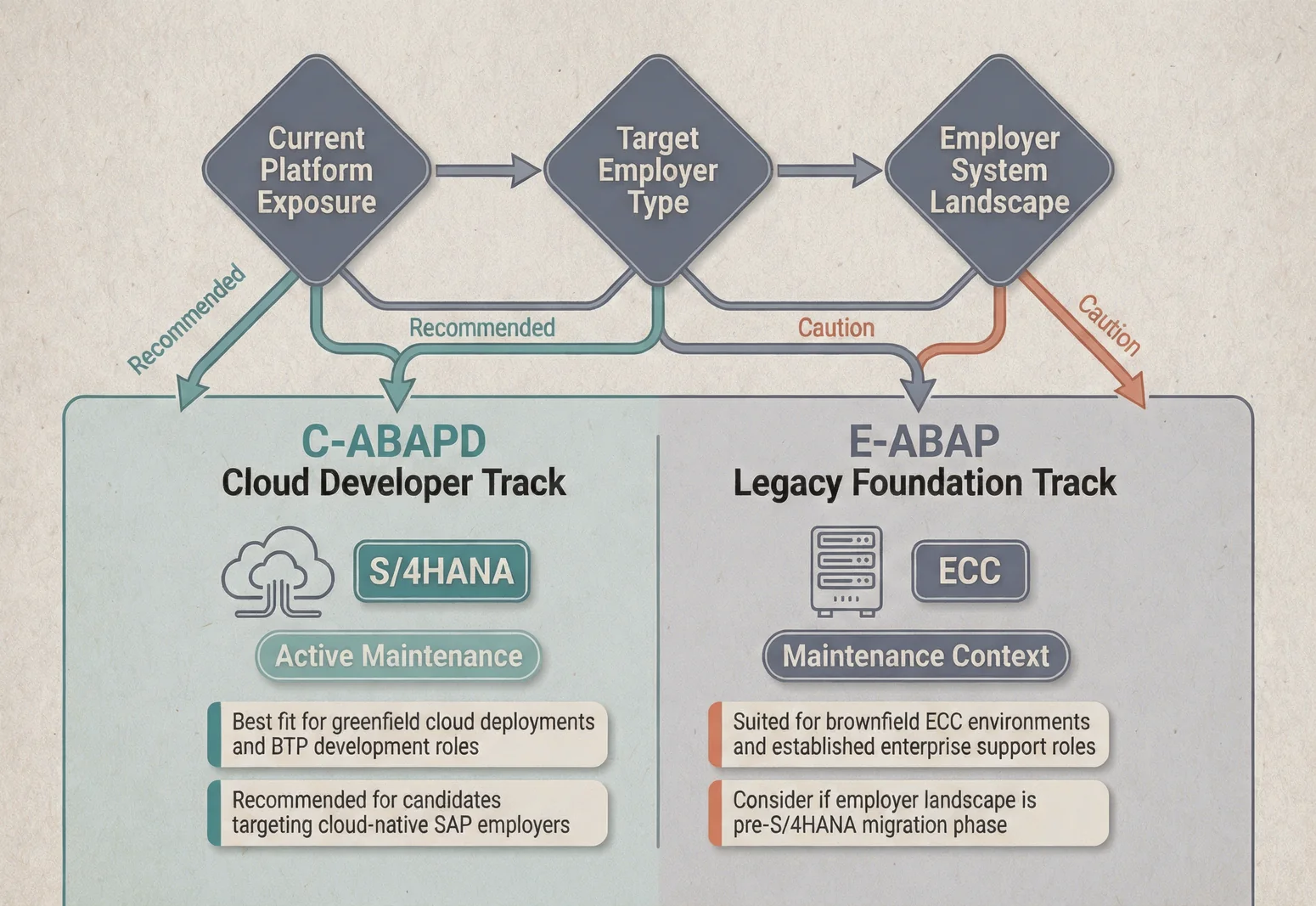
Choose the C-ABAPD track if:
- You are entering SAP development now or within the next two years
- Your target employers are S/4HANA Cloud or BTP implementation partners
- You want a credential that SAP actively maintains and updates
- You prefer structured exams with clear preparation pathways
Invest in E-ABAP foundation knowledge if:
- You already support ECC or older S/4HANA releases
- Your employer has no near-term cloud migration plan
- You need to maintain or enhance legacy custom code
- You plan to transition gradually, building classical skills before adding cloud patterns
The SAP Sales and Distribution exam illustrates another angle on this decision. Like ABAP, SAP's functional modules have migrated to new certification codes while older credentials retain value in specific contexts. The principle is consistent: match your credential to the systems you will actually work with, not just the newest available option.
What Changed with C-ABAPD-2601
SAP's certification evolution accelerated in 2025 and 2026. C-ABAPD-2309 is now retired, replaced first by C-ABAPD-2507 and then by C-ABAPD-2601. The newer exams increase emphasis on clean core extensibility, advanced RAP patterns, and integration with SAP Build and Joule AI capabilities.
This matters for your planning because study materials labeled for C-ABAPD-2309 may not cover the full scope of current exams. If you are scheduling a test now, verify the exact code with SAP Learning and ensure your preparation resources match. The Backend Developer page on SAP Learning lists the active certification version and its associated learning journey.
Some candidates deliberately seek out C-ABAPD-2309 practice materials as a gentler entry point, building confidence with the scenario-based format before advancing to system-based assessment. This is a defensible strategy if you treat the older exam as a study milestone rather than a credential goal.
Exam-Day Considerations
Both exam families use SAP's online proctored delivery. You need a stable internet connection, a private room, and a government-issued ID. The proctor checks your environment through your webcam before releasing the exam.
For C-ABAPD-2309 and its successors, time management matters more than raw knowledge. The 180-minute window sounds generous, but scenario-based questions with multiple correct answers consume time quickly. Flag uncertain questions and return to them rather than stalling on any single item.
If you face a system-based assessment in the newer C-ABAPD versions, the format changes entirely. You receive a development task and a live environment. Partial credit applies, so attempt every requirement even if you cannot complete the full solution.
Keeping Your Credential Current
SAP certifications do not expire automatically, but they become less relevant as platform versions advance. SAP recommends staying current through delta certifications or newer associate exams when significant platform changes occur.
For ABAP specifically, the shift from 2309 to 2507 to 2601 reflects rapid change in SAP's cloud and AI strategy. Plan to revisit your credential every two to three years if ABAP development is your primary career track. The SAP Security Administrator certification shows a parallel pattern — technical SAP credentials require ongoing attention to stay aligned with platform capabilities.
Questions Candidates Often Ask
Can I still take C-ABAPD-2309? No. SAP retired this exam. The current active versions are C-ABAPD-2507 and C-ABAPD-2601, with the latter representing the most recent platform alignment.
Will employers accept E-ABAP if I already have it? Existing E-ABAP certifications remain valid proof of foundational knowledge. However, new hiring increasingly specifies C-ABAPD or newer. Consider adding a current cloud-focused credential if you are actively job searching.
Is classical ABAP knowledge wasted time? Not entirely. Many S/4HANA implementations retain custom code that requires classical ABAP to understand and refactor. The skill becomes more valuable when combined with RAP and Clean Core knowledge, not when studied in isolation.
How long should I prepare? SAP recommends completing the full learning journey before attempting the exam. Most candidates need 8–12 weeks of part-time study, assuming some prior programming experience. Those new to both ABAP and SAP platform concepts may need 16–20 weeks.
Does the exam include ABAP AI or Joule integration? The C-ABAPD-2601 exam increases coverage of AI-assisted development and integration with SAP's Joule copilot. Earlier versions like 2309 touched on these only lightly, if at all.
Continuing Your SAP Certification Research
- certification comparison framework
- SAP Analytics Cloud certification
- SAP Integration Developer certification
Click through to browse exams and begin a practice session. Get started → |