Series 6 vs Series 7: Which FINRA License Fits Your Role

Series 6 vs Series 7: Which FINRA License Fits Your Role
Choosing between the Series 6 and Series 7 exams is one of the first major decisions for anyone entering financial services. Both are FINRA-required licenses for selling investment products, but they open different doors. The Series 6 qualifies you to sell mutual funds, variable annuities, and related products. The Series 7 lets you deal with almost any security a retail or professional investor would want. Your career goals—not just the exam difficulty—should drive the choice.
What Each License Actually Lets You Do
The practical difference between these credentials comes down to product scope. This is where many candidates start their research, and it is worth getting precise.
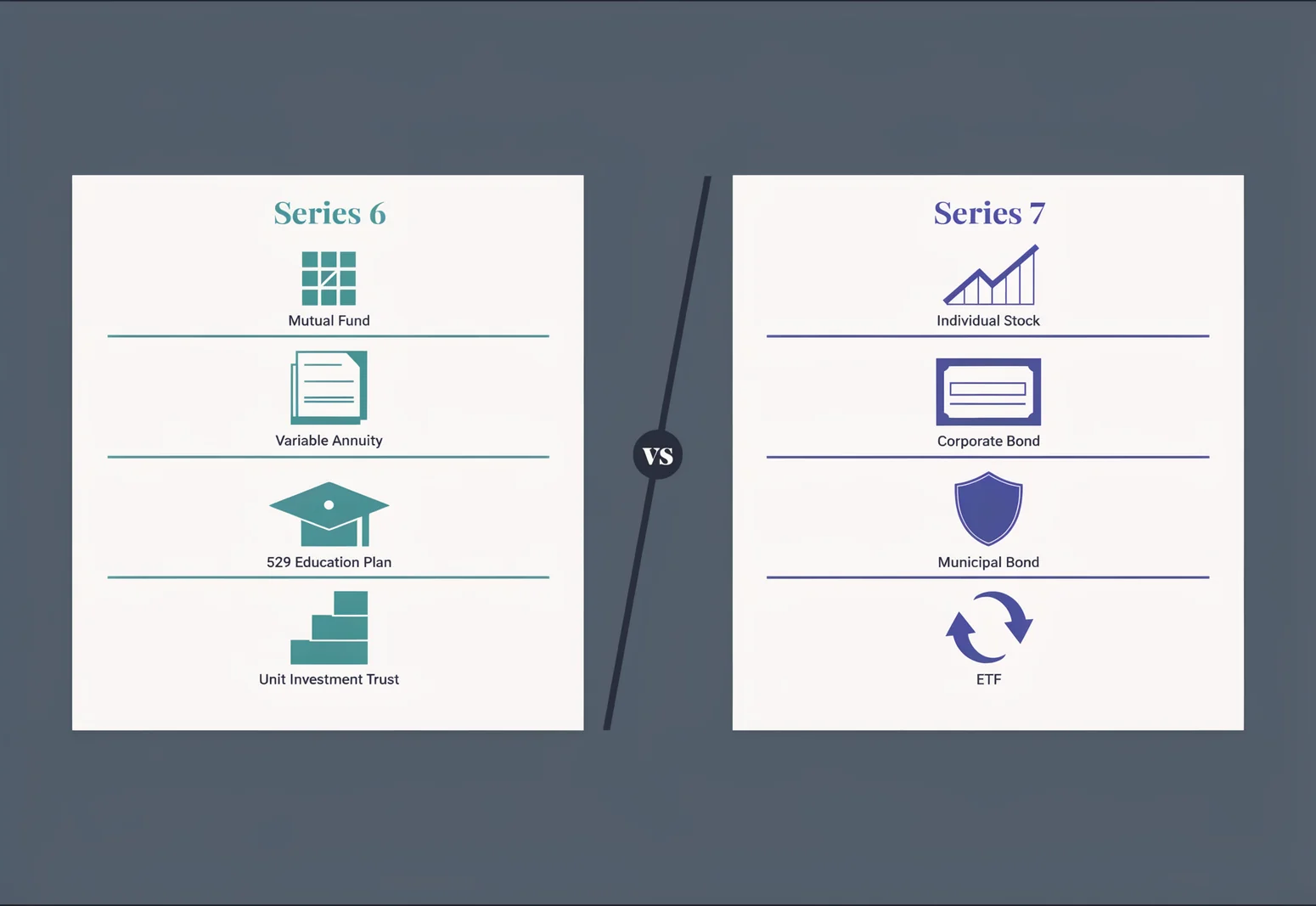
Series 6: Investment Products and Variable Contracts
The Series 6 license—officially the Investment Company and Variable Contracts Products Representative Qualification Examination—covers a defined, narrower set of products. Holders can sell mutual funds, variable annuities, variable life insurance, 529 education plans, and unit investment trusts (UITs). They cannot sell individual stocks, corporate bonds, municipal bonds, or exchange-traded funds (ETFs).
This limited scope makes the Series 6 a fit for roles tied to insurance agencies, bank brokerage programs, and firms that focus on packaged products rather than full brokerage services. Many representatives who hold the Series 6 pair it with the Series 63 for state-level agent registration.
The restriction on individual equities and bonds matters in practice. A Series 6 holder cannot execute a stock trade for a client, even if the client specifically requests it. This limitation shapes the daily work and the advisory conversations you can have. Your recommendations stay within the universe of packaged products, which suits some client relationships but frustrates others.
Series 7: The General Securities Representative
The Series 7 is the broader, more comprehensive credential. It authorizes holders to sell virtually all securities products: stocks, bonds, options, mutual funds, ETFs, municipal securities, and more. As Investopedia notes, "Just about all stockbrokers and money managers have the Series 7 license."
This breadth makes the Series 7 the standard for full-service broker-dealers, wealth management firms, and any role requiring comprehensive investment advice. It is also a prerequisite for additional specialized licenses.
The Series 7's comprehensive authority changes how you interact with clients. You can construct portfolios from individual securities, recommend options strategies, and handle complex fixed-income transactions. This flexibility appeals to candidates who want to build comprehensive advisory practices or move into portfolio management over time.
Exam Structure and What to Expect
The exams differ substantially in length, cost, and time commitment. Understanding these practical details helps with planning.
| Attribute | Series 6 | Series 7 |
|---|---|---|
| Scored questions | 50 | 125 |
| Time allowed | 1 hour 30 minutes | 3 hours 45 minutes |
| Exam fee | $100 | $395 |
| Passing score | 70% (35 correct) | 72% |
| Co-requisite | SIE exam required | SIE exam required |
| Firm sponsorship | Required | Required |
Both exams require passing the Securities Industry Essentials (SIE) exam either before or concurrently. The SIE covers foundational industry concepts and costs an additional $100. FINRA also charges a $125 CRD processing fee for initial Form U4 filings, scheduled to rise to $175 in 2028.
The Series 7's 125 questions and nearly four-hour duration make it a significantly larger commitment. Candidates should budget study time accordingly—typically 120-150 hours for the Series 7 versus 60-80 hours for the Series 6.
The cost difference also matters for candidates whose employers do not cover fees. The Series 7's $395 price tag, plus the SIE and processing fees, approaches $620 total before study materials. The Series 6 path runs closer to $325. For candidates paying out of pocket or seeking reimbursement, this gap influences timing and preparation choices.
Pass Rates and Difficulty in 2026
FINRA does not publish official pass rates, but prep providers and candidate surveys provide useful estimates. The Series 6 first-time pass rate sits in the 60-70% range, slightly below the SIE exam (65-72%) and roughly in line with the Series 7 (65-70%).
According to CertFuel's 2026 analysis, candidates who pass the SIE first and complete 90-100 hours of focused prep land in the 70%+ band most consistently. Those who struggle typically lose points on mutual-fund share-class math, variable-annuity suitability, and retirement-plan rules for the Series 6; the Series 7 adds complexity across options strategies, municipal bond analysis, and customer account management.
The 30-40% who miss on the first attempt face a 30-day waiting period before retaking either exam. This makes solid preparation essential, especially for candidates whose job offers depend on timely licensing.
The retake statistics reveal something important about preparation quality. Candidates who fail often report uneven study distribution—over-preparing on familiar topics while neglecting calculation-heavy areas. For the Series 6, share-class expense comparisons and surrender-charge schedules trip up candidates who rely on memorization rather than working practice problems. The Series 7's options questions require understanding multi-leg strategies and their risk profiles, not just recalling definitions.
Career Paths and Employer Requirements
Your target role often determines which exam you need, not just which you prefer.
Roles That Typically Require Series 6
- Bank investment representatives selling proprietary mutual funds
- Insurance agents offering variable annuities and variable life products
- 529 plan specialists
- Customer service representatives at fund companies
These positions emphasize product knowledge within a narrower scope. The Series 6 is sufficient when you are not providing comprehensive investment advice or trading individual securities.
Bank-based roles illustrate this well. A representative at a regional bank's investment program might offer clients a menu of proprietary mutual funds and annuities. The bank structures these programs to keep advice within the Series 6 scope deliberately, controlling regulatory risk and training costs. The representative builds relationships and gathers assets without needing full brokerage capabilities.
Roles That Typically Require Series 7
- Stockbrokers and registered representatives at broker-dealers
- Financial advisors in comprehensive wealth management
- Investment bankers (often paired with Series 79 or 63)
- Traders and portfolio managers at retail firms
The Series 7 is effectively mandatory for any role involving equity or fixed-income transactions. Many firms now treat it as a baseline credential, even for roles that do not immediately use all its permissions.
Wealth management firms increasingly expect the Series 7 at entry level. Even junior associates who spend their first year on administrative tasks may need it for regulatory coverage. The credential signals readiness for client-facing responsibilities and reduces compliance friction when advisors transition between product types.
Study Strategy and Preparation Timeline
Both exams reward structured preparation, but the approach differs by scope and depth.
For the Series 6, focus on mastering mutual fund share classes, annuity features, and suitability rules. The narrower content domain means you can drill specific question types repeatedly. Many candidates spread preparation across 4-6 weeks of part-time study.
The Series 7 demands broader content mastery. Options, municipal securities, and customer account handling each represent substantial sub-domains. Most successful candidates allow 8-12 weeks, with consistent daily practice rather than cramming.
Self-paced practice fits busy schedules well here. Short, focused sessions—reviewing explanations for missed questions, not just correct answers—build the understanding that transfers to exam day. For candidates juggling work commitments, this approach maintains continuity better than marathon study blocks.
The quality of practice matters as much as the quantity. Candidates who read explanations carefully, noting why each distractor is wrong, develop stronger pattern recognition than those who track only correct answers. This is particularly true for suitability questions, where the "best" answer depends on client circumstances rather than fixed rules.
For the Series 7, many candidates find municipal bonds the most time-consuming topic. The interplay of tax treatment, call features, and credit analysis requires sustained attention. Options questions demand comfort with payoff diagrams and strategy selection under various market conditions. Building these skills through repeated practice, not just reading, separates passing candidates from those who need retakes.
Recent Context: FINRA Exam Landscape in 2026
The licensing framework remains stable, but candidates should note current conditions. As of mid-2026, FINRA's exam catalog is mature, with no major restructuring announced. The SIE/Series 6/Series 7 pathway is well-established, and prep materials reflect current test specifications.
One practical consideration: employer sponsorship requirements mean you cannot sit for either exam independently. Your sponsoring firm files Form U4 and typically covers exam fees. This makes the Series 6 attractive for candidates entering through insurance or banking channels where firms may prefer the lower cost and faster licensing timeline.
The sponsorship requirement also creates timing constraints. Candidates who receive job offers contingent on licensing must coordinate with their firm's compliance department to schedule exams. This process can take several weeks, extending the total time from offer to productive work. Starting the conversation early—clarifying which exam the firm requires and their preferred prep resources—prevents last-minute scheduling conflicts.
Another 2026 consideration: remote proctoring options have stabilized after pandemic-era expansion. Most candidates now test at Prometric centers, but some firms allow online proctoring for the SIE. Check current FINRA and Prometric policies when planning, as these arrangements continue to evolve.
Deciding Which Exam to Take First
Some candidates face a genuine choice; others have their path determined by their employer. If you do have flexibility, consider these factors:
Take the Series 6 first if:
- Your role focuses on packaged products (mutual funds, annuities)
- You need faster licensing to start producing
- Your firm does not require full brokerage capabilities
Take the Series 7 first if:
- You want maximum career flexibility
- Your goal is comprehensive financial advising
- You plan to add specialized licenses later
Some professionals hold both. The Series 6 can serve as a stepping stone, though many firms now prefer the Series 7 alone for simplicity.
The stepping-stone path deserves closer examination. Candidates who take the Series 6 first, then add the Series 7, sometimes find the initial experience helpful. The Series 6 builds familiarity with FINRA's question style and the testing environment. However, this approach extends total study time and cost. Candidates with clear Series 7 requirements may do better committing to the larger exam from the start.
Career changers face a particular version of this decision. Someone transitioning from teaching, military service, or another field may value the Series 6's quicker path to a first role, then upgrade to the Series 7 after establishing industry footing. This phased approach reduces initial risk but delays full career mobility.
Questions Candidates Still Ask
Can I hold both licenses? Yes. Many representatives hold Series 6, 7, and 63 simultaneously, though your firm may not need both 6 and 7.
Does the Series 7 replace the Series 6? Not automatically. They are separate registrations. However, the Series 7's broader scope makes the Series 6 redundant for most full-service roles.
How long does each license stay active? Licenses remain active while you are associated with a FINRA-member firm. After leaving, you enter a two-year termination period during which you can reactivate without re-examination.
Is either exam harder than the CFA Level I? No. Both Series exams are narrower and shorter than CFA Level I, though the Series 7 approaches it in breadth. The CFA program demands deeper analytical skills across a wider curriculum.
What happens if I fail twice? FINRA imposes escalating waiting periods: 30 days after the first failure, 30 days after the second, and 180 days after the third. These delays can derail employment timelines, making thorough initial preparation critical.
Do I need college coursework to sit for these exams? No formal education requirement exists beyond passing the SIE. However, many employers prefer or require bachelor's degrees, and the knowledge base assumes familiarity with basic finance and math.
Where to Go From Here
The Series 6 vs Series 7 decision shapes your early career trajectory in financial services. Match the license to your role's actual product requirements, not just perceived prestige. The Series 7 offers more flexibility but demands more preparation time and cost. The Series 6 gets you licensed faster for specific product-focused roles.
Consider your five-year career vision when choosing. If you see yourself building comprehensive financial plans with individual securities, options, and complex fixed income, the Series 7 is the clear path. If your strength lies in relationship management within a defined product set—helping families with college savings plans or retirement annuities—the Series 6 may serve you well, especially if your employer structure supports it.
For structured, explanation-rich practice that builds understanding rather than memorization, consider how you will prepare. The right study approach—focused sessions with detailed feedback—matters as much as which exam you choose. Exam comparison strategies from other testing contexts can help you evaluate prep materials critically.
References
- Compare Apple Watch Models — Apple Watch Series 7 vs Apple Watch Series 6 - Apple ... Apple Watch Series 7 ... Apple Watch Series 6 ... S7 chip with 64-bit dual-core processor ... Power and Battery Life ...
- Apple Watch Series vs. Apple — The Apple Watch Series 7's larger display, sturdier design and fresh color options make it a modest but appreciated upgrade from the Series 6. The Series 7's bigger screen is
More on Exam Strategy and Career Licensing
Click through to browse exams and begin a practice session. Get started → |