Next Gen NCLEX Case Study Questions: Clinical Judgment Checklist

Next Gen NCLEX case study questions ask you to connect a changing client record with a defensible nursing decision. For nursing licensure candidates, the difficult part is often deciding which detail matters now. Use the six checks below to follow the evidence, choose a supported action, and judge the response. The worked example shows how to audit each decision during practice.
Read the unfolding record before answering
Clinical judgment case studies require you to keep the client’s situation and the current question connected. The National Council of State Boards of Nursing (NCSBN) designed NGN to assess clinical judgment and decision-making, as its NGN exam overview explains.
Start with the question’s task. Identifying concerning findings, choosing an intervention, and evaluating improvement require different decisions. Read the available record with that task in mind.
Check assessment notes, measurements, laboratory results, medication information, and orders when the case supplies them. Establish what happened first and what information is current. An earlier measurement provides a baseline; a later measurement may change the priority.
Separate three things in your notes: facts the case provides, interpretations those facts support, and information that remains unknown. This helps prevent an assumption from becoming part of your answer.
If you use Quizra’s exam practice library, confirm that the selected material matches your nursing exam and study goal. For case study practice, choose material that lets you review the reasoning behind your responses.
Before selecting an answer, be able to state the current task and identify the findings that directly affect it.
Run six clinical judgment checks
The University of Maryland’s NextGen case study library describes six-question cases organized around the NCSBN Clinical Judgment Measurement Model. Use those six steps as an audit of your reasoning.
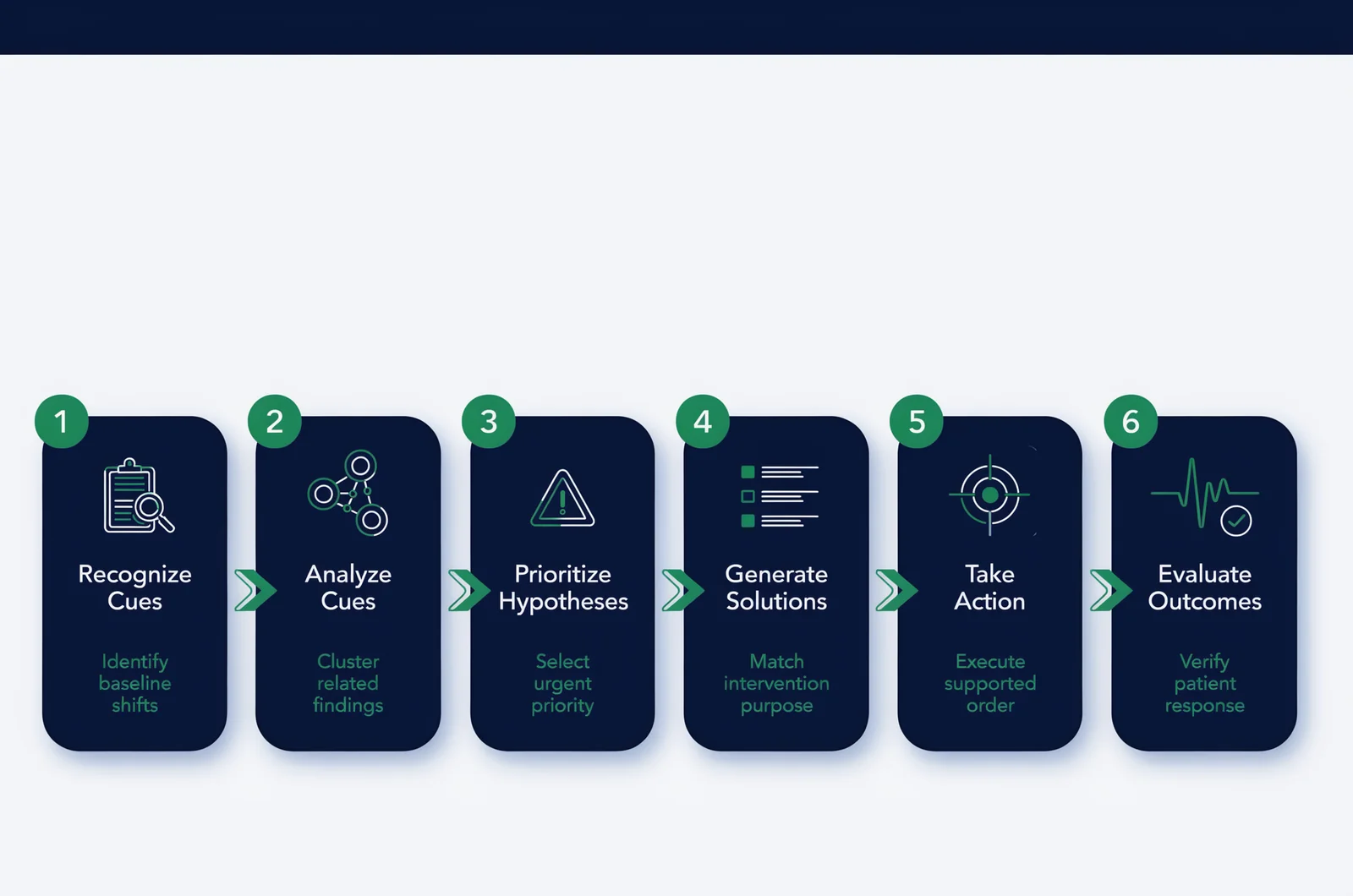
- Identify relevant findings and changes from the client’s baseline.
- Connect related findings and explain what they suggest.
- Choose the most urgent concern supported by the evidence.
- Match possible interventions to that concern and the case context.
- Select an action consistent with the stated role, orders, and immediate need.
- Compare follow-up findings with the response you expected.
Recognize cues: Find the evidence that affects this decision
A cue is a piece of information that helps you understand the client’s situation. Your first task is to identify relevant cues accurately.
Look for changes in symptoms, assessments, measurements, and behavior. Compare findings with the client’s baseline when one is available. A change can matter even when a single measurement looks less striking in isolation.
Keep objective findings separate from client reports, but consider both. New dizziness and a changing blood pressure may belong in the same review. Neither should disappear because the other seems more concrete.
Avoid treating every abnormal result as equally relevant. Ask whether each finding helps answer the current question. A chronic condition may explain background information without determining the immediate priority.
You have completed this check when you can point to the exact evidence behind each selected finding and explain why it matters now.
Analyze cues: Explain how the findings fit together
Once you identify relevant findings, connect them. Analysis requires an explanation of the pattern.
Group cues that may reflect the same problem. For example, a hypothetical client’s increasing respiratory rate, falling oxygen saturation, and new confusion deserve consideration together. Listing each finding separately leaves the relationship unexplained.
Then test your interpretation against the rest of the record. Does the history support it? Is there a finding that conflicts with it? Could a medication, existing condition, or recent intervention explain part of the pattern?
Preserve uncertainty when the information is incomplete. A suspected concern can guide further assessment without becoming a confirmed diagnosis.
Before moving on, write a brief explanation that connects the findings to a possible concern. If your explanation depends on a fact absent from the record, revise it.
Prioritize hypotheses: Choose what needs attention first
A hypothesis is a possible explanation or client concern. Prioritization means deciding which supported concern takes precedence.
Compare the seriousness of the possible consequences, the client’s current stability, and how quickly harm could develop. Use familiar priority frameworks to organize your thinking, then check the actual findings.
A diagnosis label alone cannot settle every priority question. The current presentation determines whether a concern is stable, worsening, or immediately threatening.
Also distinguish the first concern from other concerns that remain valid. A client may need education, symptom management, and urgent assessment within the same case. The question determines which decision you must make now.
Your reasoning should identify both the priority and its supporting cues. If two options remain plausible, compare what could happen if each concern were left unaddressed.
Generate solutions: Connect each intervention to a purpose
Generating solutions means identifying actions that could address the prioritized concern.
For each proposed intervention, name the intended effect. An assessment should resolve an uncertainty or detect a change. A treatment should address a supported problem. Monitoring should track a meaningful response.
Check the case details before accepting an otherwise familiar action. Review relevant allergies, restrictions, existing interventions, and orders. An intervention may be reasonable in another scenario yet unsupported in this one.
Consider whether the immediate goal is stabilization, additional assessment, communication, treatment, or prevention. These goals can overlap, but the question may ask for only one of them.
A complete solution has a clear relationship to the concern. You should be able to explain what the intervention is intended to accomplish and which finding would help you judge its effect.
Take action: Select the response the situation supports
Taking action requires choosing what to do at the point described in the case.
Read the timing language carefully. A question about the first action differs from one asking which actions belong in a broader plan. An appropriate later intervention may not address the immediate need.
Check whether an option requires information, an order, or authorization that the case has not established. Do not supply missing details from your own assumptions.
For a medication action, review the supplied order, allergies, route, and relevant assessment findings. For a communication action, identify what finding needs reporting and why the timing matters.
Keep your selected response specific enough to evaluate. Before submitting it, connect the action to the current concern, explain its timing, and identify what you would assess afterward.
Evaluate outcomes: Check whether the client responded
Evaluation compares the client’s actual response with the outcome you expected.
Return to the original concern. If the intervention addressed respiratory deterioration, review the subsequent respiratory findings and other relevant changes. Completion of the intervention alone does not establish improvement.
Compare measurements across time and look for agreement between them. One improved value may coexist with persistent symptoms or a new concern.
Avoid treating any movement toward the expected result as complete resolution. Ask what improved, what remains abnormal, and what requires further attention.
The expected response must also fit the intervention and the elapsed time described in the case. Do not assume an outcome that has not yet been assessed.
Finish by stating whether the response supports improvement, continued concern, or a need to reconsider the plan. Cite the follow-up findings behind that judgment.
Apply the checks to a changing respiratory case
This hypothetical practice case illustrates how the six checks work together. It is an educational example created for this checklist.
Identify the change and choose a priority
An adult hospitalized with pneumonia initially has an oxygen saturation of 95%, a respiratory rate of 20 breaths per minute, and normal orientation. Later, saturation is 89%, respiratory rate is 30, and the client has new confusion.
For a cue-recognition prompt, identify the falling saturation, increasing respiratory rate, and altered mental status. Include their relationship to the earlier assessment.
For an analysis prompt, explain that these changes support concern about worsening respiratory status. The case provides enough evidence to recognize deterioration without inventing an additional diagnosis.
For a priority prompt, the current respiratory concern takes precedence over routine discharge teaching. The explanation should name the changing findings that make the concern urgent.
Connect a proposed response to its purpose
Suppose the case supplies a prescribed oxygen intervention, reassessment instructions, and an escalation pathway.
For a solutions prompt, connect each proposed response to the concern. The prescribed intervention addresses the respiratory problem; reassessment checks the response; escalation communicates deterioration.
For an action prompt, use the timing and instructions supplied in that question. An option focused only on later teaching would leave the immediate change unaddressed.
A defensible response stays within the information provided. It does not invent a medication, dosage, or treatment order.
Evaluate improvement without overlooking persistent findings
After the prescribed intervention, suppose oxygen saturation is 94% and respiratory rate is 24. Confusion persists.
For an outcomes prompt, the respiratory measurements support improvement from the preceding assessment. Persistent confusion remains a concerning finding.
Describe the response precisely: some findings improved, while another concern remains unresolved. Carry that unresolved finding into the next assessment decision.
Match each response to the item’s instructions
In case study practice, response format can reveal a different kind of error from a gap in clinical reasoning.
When an item specifies a number of responses, follow that instruction. When it asks you to evaluate several options independently, check the evidence for each one. Avoid adding an option simply because it sounds sensible in general.
For a grid, read both the row label and the column meaning before responding. Confirm whether you are classifying a finding, choosing an intervention, or judging an outcome.
For a highlighting task, select the requested information precisely. A sentence may contain both relevant evidence and background details. Check which portion answers the prompt.
For a sequence or selection task, distinguish actions that are appropriate from actions that must occur at the requested point in time.
During review, record whether the mistake came from clinical interpretation or from reading the item incorrectly. Those errors need different corrections. Revisit the nursing concept for the first; rewrite the task in plain language for the second.
Review one case within a short study window
A focused case review can fit around work or other commitments when you give it a clear stopping point.
Record the reasoning before opening explanations
Complete the available case questions before reading their explanations. For each response, note the decisive cue and the reason you chose it.
If your study window ends, leave a restart note. Record the client’s current situation, the question you reached, and the reasoning issue you want to revisit.
When reviewing Quizra’s answer explanations, compare the stated rationale with the reason you wrote. A correct selection still needs review if your reasoning depended on an unsupported assumption.
Record the specific gap. Examples include overlooking a later assessment, confusing a possible concern with a confirmed diagnosis, or choosing a later action when the prompt asked what to do first.
Revisit the decision with a clear correction
Explain why your answer fits and why the strongest alternative fits less well. Use the case findings in both explanations.
On a later attempt, recall the relationship between the evidence and the decision before choosing an option. Remembering the answer’s position does not demonstrate that you can apply the reasoning to another case.
A useful interactive review checklist could store the missed cue, the clinical judgment step involved, and the correction. A view grouped by step could help you spot repeated errors.
End the session with one concrete study task, such as reviewing a nursing concept or practicing another outcome-evaluation question.
Resolve uncertainty during case study practice
Case study review becomes more useful when you identify exactly what remains uncertain.
What if two answers both seem reasonable?
Return to the requested decision and the current point in the case. Compare each answer’s supporting cues, timing, and intended effect.
An option can be broadly appropriate while fitting the current task less well. If you still cannot distinguish the answers, use the rationale to identify the deciding fact. Record that fact rather than memorizing the selected option.
Should you reread every part of the record?
Review what changed, then reopen earlier information when it affects the decision. An allergy, baseline assessment, or treatment sequence may require another look.
During practice, identify information you repeatedly overlook. Give that part of the record deliberate attention in the next case. Check that you are using the latest relevant findings.
What if the explanation uses unfamiliar nursing knowledge?
Identify the underlying concept and review it before repeating the case. The checklist depends on nursing knowledge to interpret findings and select appropriate responses.
Write the missing concept beside the clinical judgment step where it affected your answer. Then explain how that knowledge changes the decision. Reattempt the question after you can make that connection.
Practice reading exam prompts precisely
Click through to browse exams and begin a practice session. Get started → |