Reading ASVAB Test Questions for What They Actually Ask

Answering ASVAB test questions starts with identifying the task inside the wording. You can calculate correctly and still choose the wrong option if you find a discount instead of a final price. You can understand a passage and miss the question because you select a true detail instead of its main idea. This guide shows you how to restate the task, translate it into the required operation or meaning, predict an answer, and check the choices.
The worked examples below are hypothetical teaching items. Use scratch paper and cover the answer choices when practical. Your success check is simple: explain what the question asks and why your answer satisfies it before consulting the explanation.
Prepare for the CAT-ASVAB’s one-way questions
ASVAB practice should account for the answering rules of your test format. On the CAT-ASVAB, you cannot return to a previous question after submitting your response. Complete your reading and answer check before advancing. Consult the official ASVAB fact sheet for the exam’s computerized testing context.
Begin with untimed items so you can inspect your reasoning. Keep the stem, which is the part stating the problem or question, separate from the answer choices.
Use the official sample questions to see question styles across the subtests. This walkthrough concentrates on Arithmetic Reasoning, Word Knowledge, and Paragraph Comprehension.
For each practice item, write two short notes:
- The result you need to find.
- The operation, word meaning, or passage evidence that supports it.
These notes expose whether you understood the task before an option influenced you. Once you can make them consistently, rehearse the same checks mentally and add timing.
Turn the stem into a task before choosing
Use the same reading sequence across ASVAB subjects, then adapt the solving step to the material. The sequence should produce a specific task, a predicted answer, and a reason for rejecting the closest distractor. A distractor is an incorrect answer choice.
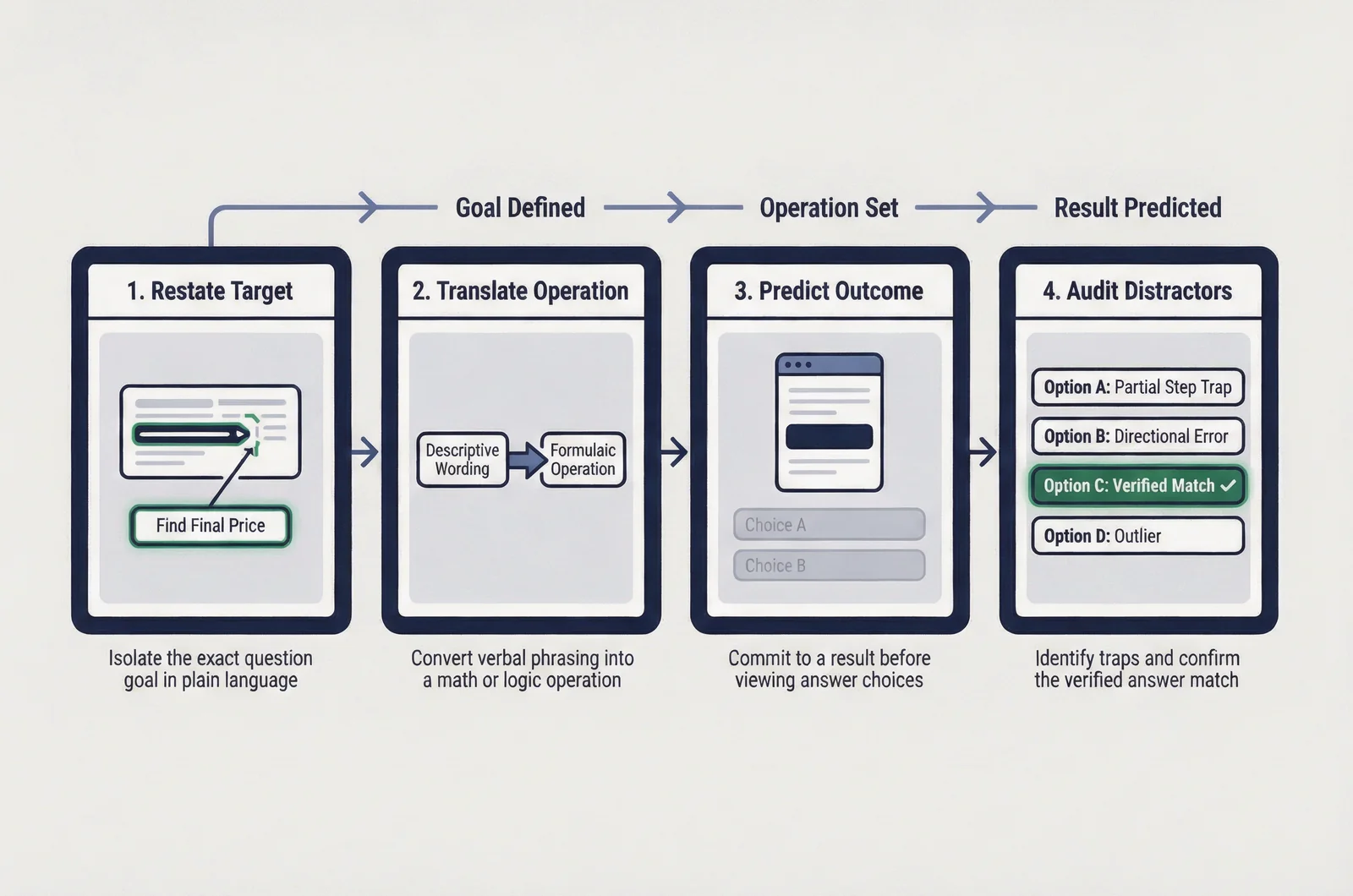
1. Restate the requested result
Read the complete stem and name the output in plain language. For a math problem, write selling price in dollars or distance in miles. For a passage question, identify whether you need a detail, a main idea, or an inference.
This prevents a related fact from becoming your answer. Check that your restatement preserves qualifiers such as remaining, least, or most nearly. If the question asks for an exception, keep that reversed task explicit.
2. Translate the wording into an operation or evidence requirement
Identify what connects the given information to the requested result. A percentage increase requires finding the increase and adding it to the original amount. A vocabulary item requires matching meaning. A passage inference requires evidence supporting something beyond a directly stated detail.
Avoid assigning operations from isolated words. More can describe a comparison or an increase. Verify your interpretation against the whole sentence, including what the percentage or comparison uses as its base.
3. Predict an answer before comparing options
Solve or estimate enough to know what the answer should resemble. Your prediction might be an exact number, a synonym, or a short statement about the passage.
This gives you a standard for judging the choices. It need not match their wording. For a calculation, check whether the result should be greater or smaller than the starting amount. For reading, identify the sentence that supports your prediction.
4. Check the closest distractor before submitting
Compare your prediction with every option. Then inspect the wrong answer that seems most plausible. Determine which part of the task it changes or leaves unfinished.
A distractor might give an intermediate calculation, an opposite meaning, or a passage detail that answers another question. Return briefly to the stem and check the requested result. For CAT-style practice, finish this check before submitting and moving forward.
Arithmetic Reasoning: identify the quantity and its base
Arithmetic Reasoning items require translating a situation into a calculation. Read the requested quantity first, then determine which numbers describe its starting point, change, and units.
Separate the increase from the selling price
Consider this hypothetical item:
A shop buys a tool for $48 and sells it for 25% more than its purchase cost. What is the selling price?
- A. $12
- B. $36
- C. $60
- D. $64
Restate the task as find the selling price after a 25% increase. The percentage applies to the $48 purchase cost.
Calculate the increase:
25% of $48 = 0.25 × $48 = $12.
Then complete the requested operation:
$48 + $12 = $60.
C is correct. Verify the direction: the selling price must exceed $48 because the problem specifies an increase. The increase is one-quarter of $48, which is $12.
Explain how each wrong answer changes the task
A gives the increase alone. The calculation is valid, but it stops before finding the selling price.
B subtracts the increase. It would fit a 25% reduction from $48.
D can result from treating $48 as 75% of the selling price: $48 ÷ 0.75 = $64. That calculation uses a different percentage base from the one stated.
When reviewing your answer, record the exact error. Stopped at the increase tells you what to check next time. Made a math mistake leaves the cause unclear.
If percentage calculations need separate work, Quizra’s GED practice questions can provide supplementary foundational practice.
Use units to check a rate problem
Try another hypothetical stem:
A vehicle travels 150 miles in 3 hours at a constant speed. How far does it travel in 2 hours?
The requested result is miles. First calculate 150 ÷ 3 = 50 miles per hour. Then multiply 50 × 2 = 100 miles.
An answer of 50 gives the speed rather than the distance. An answer of 300 multiplies the original distance by two without accounting for the original three hours. Write units beside intermediate results so you can see whether you have reached the requested quantity.
Word Knowledge: match meaning rather than association
Word Knowledge practice requires a precise meaning decision. A choice can remind you of the target word without being a suitable synonym.
Build a plain-language prediction
Consider this hypothetical item:
Reluctant most nearly means:
- A. Eager
- B. Unwilling
- C. Careless
- D. Delayed
Before weighing the options, place reluctant in a simple sentence: The worker was reluctant to volunteer.
The worker does not want to volunteer or is hesitant about doing so. That predicts unwilling, so B is the best match.
Check the replacement in the sentence. The worker was unwilling to volunteer preserves the central meaning. This substitution is a verification cue, rather than a reason to add details the question never supplied.
Distinguish a synonym from a possible consequence
A means nearly the opposite. C describes a lack of care, which the target word does not establish. D describes something happening late.
A reluctant person might delay acting, but delay is a possible consequence of reluctance. It does not define the word.
If you cannot make a confident prediction, eliminate options whose meanings you do know. Word parts may provide a clue when you recognize them, but do not force an unfamiliar word into a meaning based on spelling alone.
During review, write the correct meaning and a short example sentence. Also record why your chosen distractor seemed plausible. If you selected delayed, note that you confused a possible behavior with the word’s meaning. Recheck that distinction with a different vocabulary item.
Paragraph Comprehension: keep the answer inside the passage
Paragraph Comprehension questions require matching the requested kind of answer to passage evidence. Read the question sentence to identify the task, then read the whole passage before choosing.
Locate the sentence that answers why
Use this hypothetical passage:
A repair shop moved routine equipment inspections from Friday afternoon to Monday morning. Over the next month, it recorded fewer midweek equipment failures. The manager kept the new schedule but continued recording failures because one month of results was too little to establish a lasting pattern.
Why did the manager continue recording equipment failures?
- A. To determine whether the reduction continued over time.
- B. To demonstrate that Monday inspections prevented every failure.
- C. To compare Monday staffing levels with Friday staffing levels.
- D. To confirm that inspections took less time on Mondays.
Restate the task as find the reason for continued recordkeeping. The final sentence provides it: one month was insufficient to establish a lasting pattern.
Predict to see whether the improvement lasts. A matches that prediction.
Verify the answer against the passage’s stated reason. The manager needs more observations over time. The question does not ask why the inspection schedule changed or how inspections were performed.
Reject claims that exceed the evidence
B changes fewer failures into every failure prevented. It also treats the schedule change as proof of causation.
C introduces staffing levels. D introduces inspection duration. Neither detail appears in the passage.
The wrong options illustrate three reading errors: overstating the result, inventing a comparison, and adding an unmentioned measurement.
The question type also matters. If this passage asked for its main idea, an answer about recordkeeping alone would be too narrow. A suitable prediction would cover the schedule change, the observed reduction, and continued monitoring.
For supplementary passage work, Quizra’s reading comprehension practice questions provide another setting for practicing evidence-based answers. Identify a supporting sentence before checking each explanation.
Review the decision that produced each answer
ASVAB practice becomes more useful when your review identifies where the reasoning changed direction. Check both incorrect answers and correct answers you reached through uncertain reasoning.
Separate stem errors from knowledge gaps
For each reviewed item, record the requested result, your approach, and the first point where that approach failed.
A stem error occurs when you answer a different question. In the tool example, selecting $12 after calculating the increase is a stem error if you overlooked selling price.
A knowledge gap occurs when you understand the request but lack the required skill. Recognizing that you need a percentage increase while being unable to calculate 25% indicates a different problem.
An execution error occurs when the task and method are correct but a calculation or selection goes wrong.
Assign the repair accordingly. Reread the requested quantity for a stem error. Practice the missing operation for a knowledge gap. Recalculate or compare your written result with the selected option for an execution error.
Keep each review note specific enough to use on the next item.
Fit the routine into a short study window
Use a ten-minute session as a practical starting format:
- Spend two minutes reviewing one previous error and its correction.
- Spend five minutes answering a small set with the reading routine.
- Spend three minutes checking explanations and recording one repair to rehearse.
Adjust the number of questions to their length. Preserve time for reviewing the reasoning.
Quizra’s WorkKeys practice questions can supplement drills in workplace arithmetic and reading. Use these other exam resources for individual skills, then return to ASVAB-specific items for format practice.
A useful interactive checklist would ask learners to select the requested quantity or evidence type before revealing the choices. It could then compare that selection with the explanation. Use unfamiliar items afterward to check whether the corrected reading habit transfers.
Questions about timing and uncertain answers
Use these decisions to adapt the reading routine when an ASVAB practice item is unfamiliar or time is limited.
Should you always hide the answer choices?
Hide them during early practice when that helps you form an independent prediction. On the test, you can direct your attention to the stem before studying the options.
If you cannot predict an exact answer, predict its form: a final price, a synonym, or a passage-supported reason. Then compare the choices against that requirement.
What if two options both seem reasonable?
Identify the exact difference between them. One may answer the requested task while the other gives a related detail.
For a passage, compare both with the supporting sentence. For vocabulary, test both meanings without adding assumptions. For arithmetic, check the quantity, percentage base, and units. Reject the option that requires changing the stem.
How long should you spend rereading?
Reread to resolve a specific uncertainty. Check whether the question asks for the increase or the total, or whether a passage claim is stated or inferred.
If you understand the wording but lack the underlying skill, repeated reading has limited value. Use what you know to eliminate options, choose your best remaining answer, and continue within the test’s timing constraints.
How can you tell whether the routine is working?
Use unfamiliar questions and explain your choices before opening the answers. Look for fewer wrong-task answers and clearer reasons for eliminating distractors.
A repeated item can reveal whether you remember its explanation. A new item gives a better check of whether you can apply the method. Track the error type alongside the result.
Question analysis in another exam setting
Click through to browse exams and begin a practice session. Get started → |