BCBA Exam Practice Questions Ranked by What They Test
If you're hunting for BCBA exam practice questions, the real problem isn't finding them. It's figuring out which ones are worth your limited study hours. A 185-question bank means nothing if every item rewards memorized definitions, because the current exam scores something harder: applied reasoning across nine content domains. Below, the four main styles of practice questions are ranked by how well they build the reasoning the exam actually measures, using the BCBA Test Content Outline (6th ed.) as the scoring rubric.
The ranking assumes a specific reader: a working candidate, likely balancing supervision hours or a caseload, studying in windows of ten to forty minutes, with an exam date somewhere in the next two to six months. If that is you, the order below should hold. If your situation differs, the scoring criteria in the next section let you re-rank the styles yourself.
How this ranking scores each question style
Three criteria decide the order, and you can reuse them on any bank, app, or study group freebie you come across:
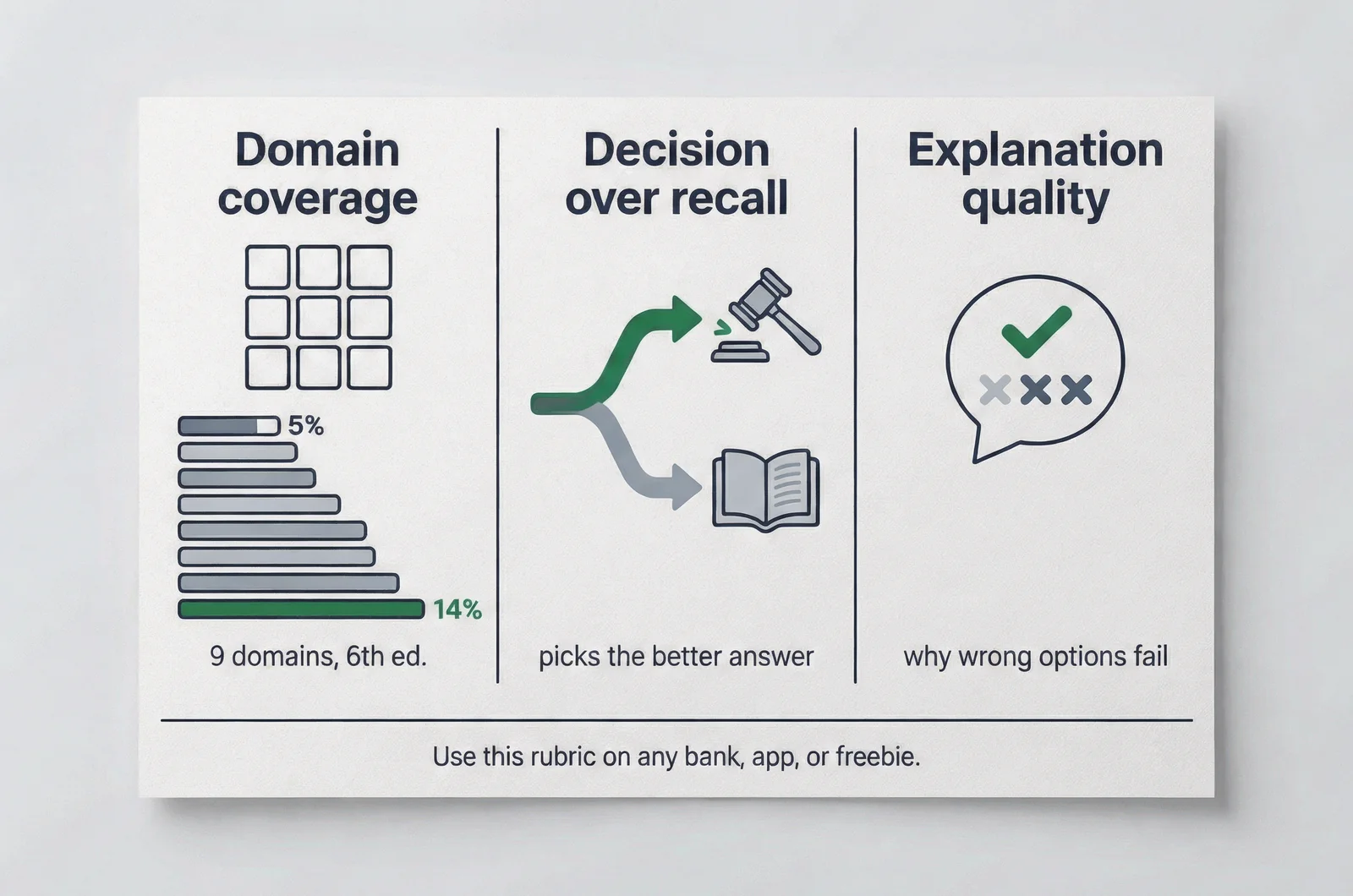
- Domain coverage. Does the question map cleanly to a 6th Edition content area, and do heavier domains show up in proportion? In 2026 the exam spans nine domains, with weights from 5% (Behaviorism and Philosophical Foundations) up to 14% (Concepts and Principles, and Behavior-Change Procedures).
- Decision over recall. Does the item force you to choose a course of action, or just identify a term? The BACB writes most items as applied vignettes, so practice that only drills vocabulary leaves the hardest part untrained.
- Explanation quality. Does the answer rationale show why the wrong options fail? A correct answer you can only defend by elimination of "that feels right" will not survive 175 scored items plus 10 pilot questions you can't tell apart.
Older material built on the retired BCBA/BCaBA Task List (5th ed.) can still be useful for core concepts, but anything labeled 5th Edition should be treated as a supplement, since testing moved fully to the 6th Edition outline on January 1, 2025. Core behavior-analytic principles have not changed between editions; the domain structure and weighting have. That distinction matters when you decide whether an old set is a liability or a bargain.
One more filter worth applying before any of the three: edition honesty. A bank that claims 6th Edition alignment but cannot show which outline task each question maps to is asking you to take alignment on faith. The better sources tag every item to a domain and often to the specific task, which is what makes domain-level score reporting possible in the first place.
1. Scenario questions: the style that earns the most study time
A scenario question drops you into a clinical situation: a client, a setting, some data, a constraint. Then it asks what you would do first, next, or not at all. These rank first because they mirror the exam's dominant format and force the exact skill that separates passing candidates from near-misses, which is discriminating between two defensible answers and picking the better one.
A strong scenario item earns its keep when the distractors are plausible. If you read a vignette about a learner whose tantrum behavior escalates after a token board is introduced, and the wrong options all involve clearly unethical or irrelevant actions, the question is too easy to teach you anything. The good ones make you weigh reinforcement schedules, measurement implications, and intervention fidelity at once. Ask yourself after each item: could a thoughtful colleague argue for one of the wrong answers? If yes, the question is doing its job. If no, it was a vocabulary check wearing a costume.
Best fit: Candidates two or more months into studying, once the vocabulary is mostly in place. Scenarios convert knowledge into judgment.
Limitation: A poorly written scenario can reward guessing patterns instead of analysis. Always read the rationale. If the explanation only restates the correct answer without explaining why each wrong option fails, the item trains confidence, not competence. Resources like the BCBA Question Bank and similar 6th Edition-aligned banks are worth checking against this standard before you commit hours to them.
Verdict: At least half of your weekly practice volume should be scenario-based. Nothing else comes close to replicating exam conditions.
2. Ethics and decision-making items: small domain, outsized damage
Ethics items ask you to apply the Ethics Code for Behavior Analysts to gray-area situations: dual relationships, scope of competence, supervision boundaries, client consent. They rank second for one reason. Candidates who are strong on concepts still bleed points here because ethical reasoning fails in a specific way — people pick the option that feels kind rather than the one the code requires.
A well-built ethics question tests decision hierarchy. Should you address the colleague's behavior directly, report it, or document it first? The exam loves this structure because the correct answer depends on sequence and severity, not on knowing a definition. When you miss one, write down which code section governed the answer. After a few weeks, your error log will show whether your misses cluster around supervision, billing, or client rights, and that pattern is worth more than any aggregate score.
Best fit: Everyone, from week one onward. Ethics questions are short enough for the brief study windows most working candidates actually get, and the domain repays repetition.
Limitation: Ethics items written before the code updates took effect can teach outdated standards. Check that your source states which code version it follows. Free sets such as the free BCBA practice questions mini mock are fine for a first pass, but verify alignment before making them your ethics backbone.
Verdict: Run ethics sets weekly, in short bursts, and track your misses by code section rather than by question.
3. Graphing and measurement items: the math of the exam
These questions show you a dataset, a visual display, or an experimental design, then ask you to interpret level, trend, and variability, choose a measurement procedure, or identify an experimental effect. They rank third because they are the most coachable style on the exam. Unlike ethics judgment, measurement skills respond quickly to targeted drilling, and Measurement, Data Display, and Experimental Design together carry enough domain weight to swing a borderline score.
A good graphing question forces a decision from the display itself. Given this reversal design with overlapping data paths, can you claim a functional relation? What measurement system fits this dimension of behavior? Practice that only asks "what is continuous measurement" misses the point; the exam shows you behavior and asks you to measure it correctly. A useful drill: cover the answer options and state your interpretation of the graph in one sentence before reading the choices. If your sentence matches the logic of the correct option, the skill is in place. If you needed the options to reason at all, keep drilling.
Best fit: Candidates whose diagnostic scores show weakness in the measurement and design domains, which is a large share of retakers. This style is where focused practice produces the fastest visible score movement.
Limitation: Graphs render badly in some question apps, and a blurry visual display teaches bad habits. Practice with clean, exam-style graphs whenever possible, and interpret them out loud: level, trend, variability, then conclusion.
Verdict: Non-negotiable if your baseline is below 70% on measurement domains. Two focused sessions a week here usually pays back within a month.
4. Concept-check and definition items: useful, but ranked last
Concept-check questions ask you to identify, define, or classify: which schedule of reinforcement, which verbal operant, which type of motivating operation. They rank last not because they are worthless but because they are the floor, not the ceiling. They build the vocabulary that scenario questions assume, and they are the fastest style to fit into a ten-minute gap between work commitments.
Their ranking drops because of the memorization trap. If your entire question diet is concept-check items, you can reach 85% accuracy in practice and still fail, because the exam rarely asks you to name a concept without embedding it in a case. The BACB outline frames domains as applied tasks, and items are written accordingly.
Best fit: The first four to six weeks of study, and anyone rebuilding fundamentals after a long gap. Also useful as maintenance once scenario work dominates.
Limitation: Easy items inflate confidence. A bank that is 90% concept-checks will report flattering accuracy numbers while leaving your weakest skill untouched. Updated sets like BCBA practice exam questions and answers typically mix styles, so check the ratio before judging your readiness by a single score.
Verdict: Treat concept-checks as warm-up reps, not the workout. Cap them at roughly a quarter of your practice volume once fundamentals are solid.
Where full-length mocks fit in the ranking
A full-length, timed mock exam is not a fifth question style. It is the delivery mechanism that tests whether the other four worked. The real exam is 185 multiple-choice questions in a single four-hour Pearson VUE appointment, and stamina plus pacing are trainable skills that short quizzes never touch. Four hours of sustained discrimination is a physical demand as much as a cognitive one; candidates who have never sat that long often fade somewhere around question 130, and fading looks exactly like a content weakness on the score report.
Take one early as a diagnostic, before your plan hardens. Free options exist for exactly this purpose, including a free BCBA mock exam with instant feedback and a free BCBA practice exam, and a dedicated BCBA practice exam for another baseline point. Score it by domain, not by total. The output you want is a ranked list of weak content areas, which then decides how you split your time across the four question styles above.
Then take a mock every three to four weeks under timed, no-notes conditions. If your scores plateau across two consecutive mocks, the problem is almost always question-style balance: too many concept-checks, not enough scenarios and ethics.
A practical note on study continuity: if your week is fragmented, front-load the short styles (concept-checks, ethics) into weekday gaps and reserve scenario sets and mocks for longer weekend blocks. This is the pattern question-first platforms are built around — Quizra, for instance, organizes its libraries by exam so you can run a focused ten-minute set on a single domain, the same way candidates use GED test practice questions or TEAS-7 practice questions in other fields. The habit transfers across exams, whether you are working through cloud practitioner practice questions, Agile Scrum foundation questions, or security administrator practice questions: short aligned sets, explanations read every time, weak domains revisited first.
One tool idea worth building into your routine: a simple domain-weight calculator. Enter your last mock's per-domain percentages and the 6th Edition weights, and it returns how many practice questions each domain deserves this week. Ten minutes of spreadsheet work replaces the guesswork most candidates use to allocate study time.
Reader questions about BCBA practice
How many practice questions should I complete before the exam? Volume matters less than coverage and review. Candidates commonly report working through 1,500 to 3,000 items, but the meaningful metric is whether every domain has been practiced to stable accuracy with rationales read. Three thousand concept-checks lose to fifteen hundred well-balanced scenarios.
Are free practice questions reliable enough? Free sets are good for diagnostics and early exposure. Their risk is edition drift: anything written against the 5th Edition task list predates January 2025 and may misweight domains. Cross-check any free source against the current 6th Edition outline before trusting its proportions.
When should I take my first full-length mock? Earlier than feels comfortable, ideally in week two or three. A baseline mock changes how you study everything afterward, because it replaces assumed weaknesses with measured ones.
Should I memorize the task list? Understand it, don't recite it. A useful self-test from study guides: explain each task to someone with no ABA background. If you can teach it, you can answer a scenario about it.
Keep building your question habit
Click through to browse exams and begin a practice session. Get started → |