PMP Practice Test Scores as a Predictor of Exam Readiness
Candidates preparing for the Project Management Professional exam usually want one thing from a practice test: a number that tells them whether they are ready to book. That number is useful, but only if you know what it measures, how much noise sits inside it, and which score bands actually correspond to first-attempt success. This review examines the evidence behind practice-test scores as a readiness signal, sets out a defensible method for interpreting them, and gives you thresholds you can apply to your own results before you spend $405 on a member exam seat.
The argument here is narrow. A practice score is a measurement, not a verdict. Treated as a measurement, it can tell you which domains are weak, whether your pacing holds under a timer, and whether your trend line is flat or rising. Treated as a verdict, it produces the two most common failure modes in PMP exam prep: booking too early on a single lucky result, and delaying indefinitely because no score ever feels high enough.
The research question and why the 2026 exam changes the answer
The question this review addresses: how strongly does performance on a timed, exam-aligned practice test predict first-attempt pass likelihood on the current PMP exam?
That question has a different answer in 2026 than it did in 2024, because the exam itself changed. PMI launched the updated PMP exam on 9 July 2026, and the domain weighting shifted substantially. People moved from 42% to 33%, Process from 50% to 41%, and Business Environment from 8% to 26%. PMI describes the update as a sharper focus on the skills and mindsets that drive results in current practice, with AI, sustainability, and stakeholder engagement appearing inside project-based scenarios.
The weighting shift matters for score interpretation in a way that is easy to miss. If you are still practicing against pre-2026 question sets, your domain-level breakdown is measuring the wrong distribution. A candidate who scores 78% on an outdated bank may be strong in Process and weak in Business Environment, which was worth 8% of the old exam and is now worth roughly a quarter of the new one. The overall percentage hides that exposure. The PMP Examination Content Outline is the authoritative statement of what the current exam covers, and any practice instrument you use should be traceable to it.
Two structural features of the exam are unchanged and both affect how you should read a practice score. The exam runs 240 minutes with 180 questions, and it opens with a case-study section. Practice instruments that present 50 isolated scenario questions in 65 minutes, like the free PMP practice test from Training Camp, a PMI Authorized Training Partner, test domain knowledge at exam pace but do not replicate the case-study opening or the full-length endurance demand. That is a scope limitation, not a flaw, and it changes which claims the resulting score can support.
The evidence standard applied in this review
Not all practice data deserves the same weight. This review applies four criteria before treating a score as a readiness signal.
Alignment. The question bank must be written to the current Examination Content Outline, with the 2026 domain weights. A bank built to the previous outline produces a score that is internally consistent but externally miscalibrated.
Explanation quality. Every answer choice needs a written rationale, including the distractors. The testing effect, the well-documented finding that retrieving an answer strengthens retention more than re-reading material, depends on corrective feedback. A score from a bank that reports right and wrong without explaining why is a weaker predictor because the underlying learning loop is incomplete. Practice sets that explain every wrong answer, rather than only the correct one, close that loop more reliably.
Timing conditions. An untimed score overstates readiness. Pacing is a scored constraint on the real exam, and candidates who know the material but run out of time in the final 40 questions fail for reasons that an untimed practice run cannot detect.
Sample size. A single 50-question attempt carries enough sampling error that a swing of several percentage points between attempts is normal. Trends across three or more attempts carry more information than any individual result.
PMI's own position is that exam prep is essential even for experienced practitioners, and that candidates should study the PMI standards directly. The PMP and CAPM exam prep resources PMI publishes are the primary-source baseline against which third-party question banks should be judged. PMI also notes that it does not endorse or control third-party training providers, which is why the alignment criterion above has to be checked by the candidate rather than assumed from a logo.
How practice performance maps to readiness bands
The bands below are analytical guidance derived from the criteria above, not a published PMI threshold. PMI does not publish a passing score, and any source claiming a fixed cut score is guessing. What follows is a decision framework, and it should be applied to a trend line rather than a single attempt.
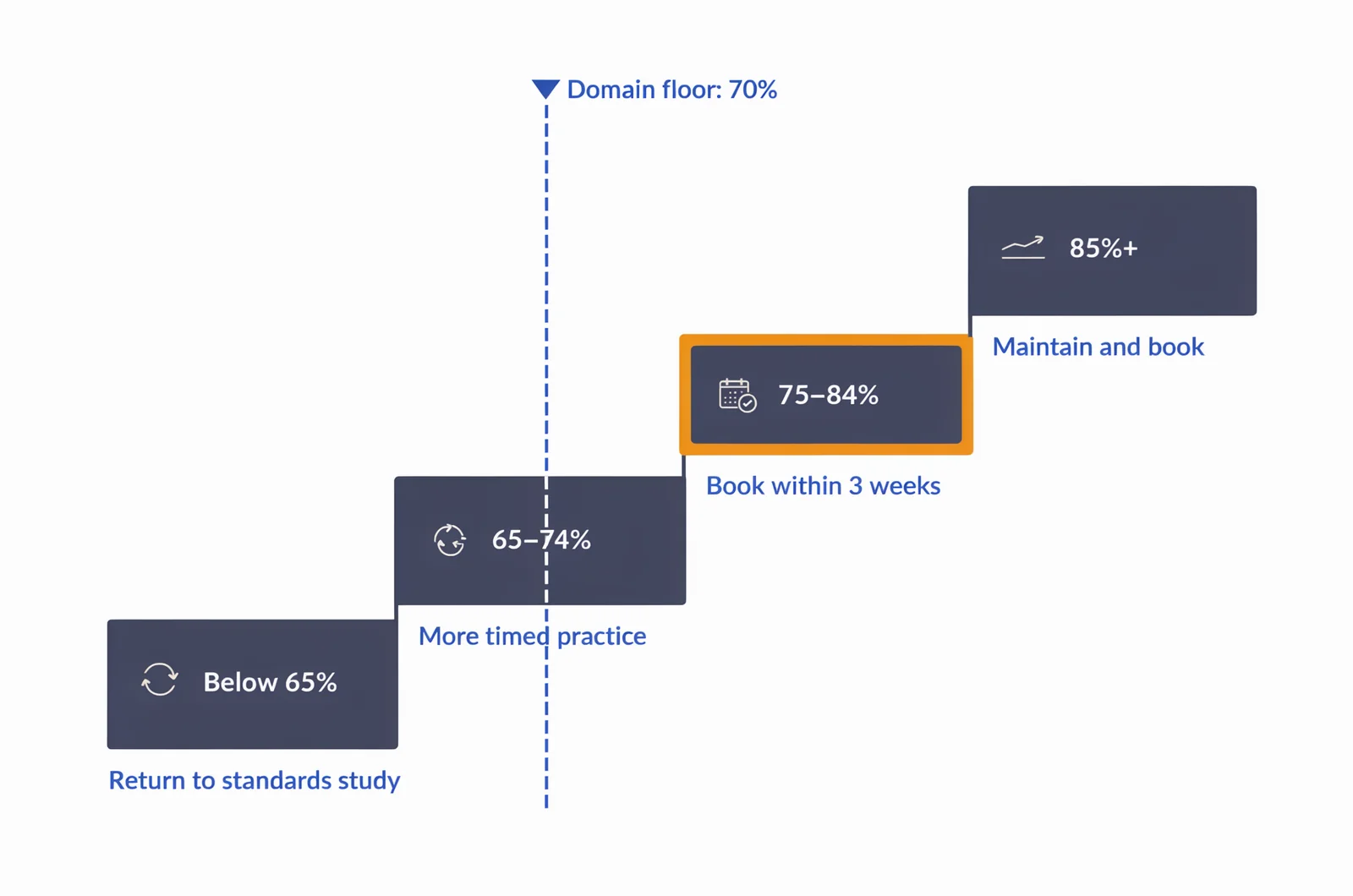
| Practice score band (timed, 2026-aligned) | Domain spread | Readiness signal | Recommended action |
|---|---|---|---|
| Below 65% | Any | Not yet predictive of a pass | Return to standards study; do not book |
| 65–74% | Two or more domains below 70% | Weak signal | Targeted domain work, then retest in 7–10 days |
| 65–74% | All domains at or above 70% | Mixed signal | Review pacing and case-study handling before retesting |
| 75–84% | No domain below 70% | Moderate signal | Book within 2–3 weeks while retention is fresh |
| 85%+ | No domain below 75%, stable across two attempts | Strong signal | Book; shift remaining time to maintenance practice |
Three rules govern how to use the table.
First, the domain floor matters more than the average. A 79% overall score with Business Environment at 58% is a weaker position than a 76% overall score with every domain at or above 72%, because the first profile has a concentrated exposure in the domain that grew from 8% to 26% of the exam.
Second, require stability. Two consecutive attempts in the same band, taken under the same timed conditions, is the minimum evidence for treating a band as your current level. One attempt is a data point.
Third, treat a falling score across attempts as information about fatigue or burnout, not about knowledge. Candidates who drill intensively for three weeks often see scores plateau or dip before they recover. If your explanations review is going well but your scores are flat, the constraint is likely recovery time rather than content coverage.
Reading a score report the way an analyst would
A percentage is the least informative number on a practice score report. The useful output is the error taxonomy, and building one takes about twenty minutes per attempt.
Sort every missed question into one of four buckets:
- Knowledge gap. You did not know the concept. Fix: return to the relevant PMI standard or the PMBOK Guide section.
- Misread. You knew the concept but answered a different question than the one asked. Fix: slow down on the stem, not the options.
- Distractor trap. You eliminated two options and chose the plausible-but-wrong one. Fix: study why the distractor was built, which is usually a real technique applied to the wrong process group.
- Pacing loss. You ran short on time and guessed. Fix: timed sets, not content review.
The distribution across these four buckets determines your next two weeks. A profile heavy in knowledge gaps calls for standards study. A profile heavy in misreads and distractor traps calls for more timed practice with explanation review, which is where a structured practice question bank with integrated rationales does more work than a stack of notes. A profile heavy in pacing loss calls for full-length timed simulations and nothing else.
Track the bucket distribution across attempts. When knowledge gaps shrink and misreads dominate, you have moved from learning to execution, and the remaining work is precision rather than coverage.
When to book, and when to wait
Booking decisions should follow the evidence, not the calendar. Three conditions support booking:
- Two consecutive timed attempts at 75% or above.
- No domain below 70% on the most recent attempt.
- A case-study section handled without a pacing collapse in the final third of the set.
If all three hold, book within two to three weeks. Retention decays, and a long gap between peak practice performance and the exam date converts readiness into re-learning.
Wait if any of the following is true: your most recent attempt is your only strong one; a single domain sits below 65%; or your scores are rising but you have not yet tested under full 240-minute conditions. In the last case, one full-length simulation resolves the uncertainty faster than another week of domain drills.
There is a real cost to waiting past readiness. The exam fee is $405 for PMI members and $555–675 for non-members, and renewal runs roughly $60 for members and $150 for non-members. Delaying a month past genuine readiness does not improve your odds enough to justify the drift in retention, and it extends the period during which you are paying attention to material you already know.
For candidates who want a lower-stakes instrument before committing to a full-length simulation, a shorter domain-focused set such as the PMI practice test questions format is useful for isolating a single weak area. It is not a substitute for a full-length readiness check, and its score should not be used to make a booking decision on its own.
Limitations of score-based readiness models
Four limitations bound every conclusion in this review.
No published cut score. PMI does not disclose a passing threshold. Every band in this article is an analytical construct. It is calibrated to be conservative, which means it will occasionally tell a ready candidate to wait.
Practice banks vary in alignment. A bank's stated alignment to the 2026 outline is a claim, not a verified fact, unless the provider is a PMI Authorized Training Partner or publishes its mapping. Verify before you trust a domain breakdown.
Self-selected practice conditions inflate scores. Taking practice questions in short, untimed sessions around work produces a comfortable score that does not transfer to a 240-minute proctored setting. The band table assumes timed conditions; applied to untimed results, it overstates readiness.
The testing effect has a ceiling. Retrieval practice improves retention and diagnostic accuracy, but it does not substitute for learning material you have never encountered. A candidate who has never studied stakeholder engagement will not test their way to competence in it, no matter how many questions they attempt.
An interactive readiness estimator would help here: a small tool that takes your last two timed scores, your lowest domain percentage, and your days-until-target-date, then returns a book-or-wait recommendation against the bands above. Until something like that exists, the table and the three booking conditions do the same work manually.
Questions candidates ask about practice scores
Does a high practice score guarantee I will pass? No. A score above 85% with stable results across two timed attempts is a strong readiness signal, but it is a probability statement, not a guarantee. No practice instrument can promise an outcome on a proctored exam.
How many practice tests should I take before booking? Two consecutive timed attempts in the same band is the minimum. Three or more gives you a trend line, which is more useful than any single result. Beyond four full-length attempts, additional tests tend to produce diminishing diagnostic value unless your error taxonomy is still changing.
My scores are high but I keep missing Business Environment questions. Should I book? Not yet. Business Environment grew from 8% to 26% of the exam in the July 2026 update, so a concentrated weakness there carries more weight than the same weakness did previously. Bring that domain to at least 70% before booking.
Are free practice tests accurate enough to base a decision on? It depends on alignment and explanation quality, not price. A free set written to the current outline with explanations for every answer choice can support a readiness judgment. A free set built to a retired outline cannot, regardless of how it scores you. The same vetting logic that applies to a practice test quality checklist for any certification exam applies here.
Should I retake the same practice test or use a new one? Use a new set for readiness measurement and the same set for explanation review. Retaking a test you have already seen inflates your score through item recognition, which contaminates the readiness signal. Reviewing your missed items on a familiar set is still valuable because the explanations for wrong answers are where the learning happens.
Applying the model to your next two weeks
The practical sequence: take one timed, 2026-aligned practice set under exam-like conditions. Build the four-bucket error taxonomy. Compare your domain spread against the band table. If you land in the 75–84% band with no domain below 70%, book within three weeks and shift to maintenance practice. If you land below 65%, return to the PMI standards and the content outline before spending another practice attempt.
The official vs unofficial questions distinction is worth keeping in mind throughout, because it applies across certification programs: the source and construction of a question determine how much weight its result deserves. A score is only as good as the instrument that produced it.
Where to take the next practice set
Click through to browse exams and begin a practice session. Get started → |