Red Hat Certification Exams Ranked by Career Value

Choosing between Red Hat certification exams starts with the work you want to do. Linux administration, automation, and OpenShift operations require different preparation, and the most advanced credential may sit several steps beyond your immediate goal. For an intermediate Linux practitioner, this guide prioritizes RHCSA, the relevant RHCE path, OpenShift administration, targeted automation specialization, and eventually RHCA. The order changes when your responsibilities change. Each recommendation below explains its practical value, preparation burden, and limitations so you can choose an exam that supports your next role.
What career value means for a Linux practitioner
A useful Red Hat credential should connect your study effort to a responsibility you want to handle. That might mean maintaining servers independently, automating configuration, or supporting an application platform.
This ranking uses four criteria:
- How closely the assessed skills match your current work or target role.
- Whether the preparation builds a foundation for later technical responsibilities.
- Whether you can access an appropriate practice environment.
- How much additional study the credential requires beyond your existing skills.
The starting assumption is an intermediate Linux practitioner seeking broader enterprise responsibilities. Under that assumption, foundational administration comes first. A candidate already supporting OpenShift should use a different order.
Employer recognition also needs context. A hiring manager responsible for Linux servers and one recruiting an automation platform administrator may value different evidence. This guide makes an editorial judgment about technical fit and preparation effort; it does not assign salary premiums or estimate hiring demand.
Before choosing, examine several job descriptions you would realistically pursue. Record the recurring responsibilities, required platforms, and named credentials. Compare those requirements with the practical work you can already demonstrate.
The Red Hat paths worth prioritizing
Red Hat’s certification framework update, effective May 11, 2026, organizes credentials by specialization and level. RHCE now needs its specialization attached to make the intended path clear. RHCA is a credential assembled through qualifying exams rather than a single exam booking.
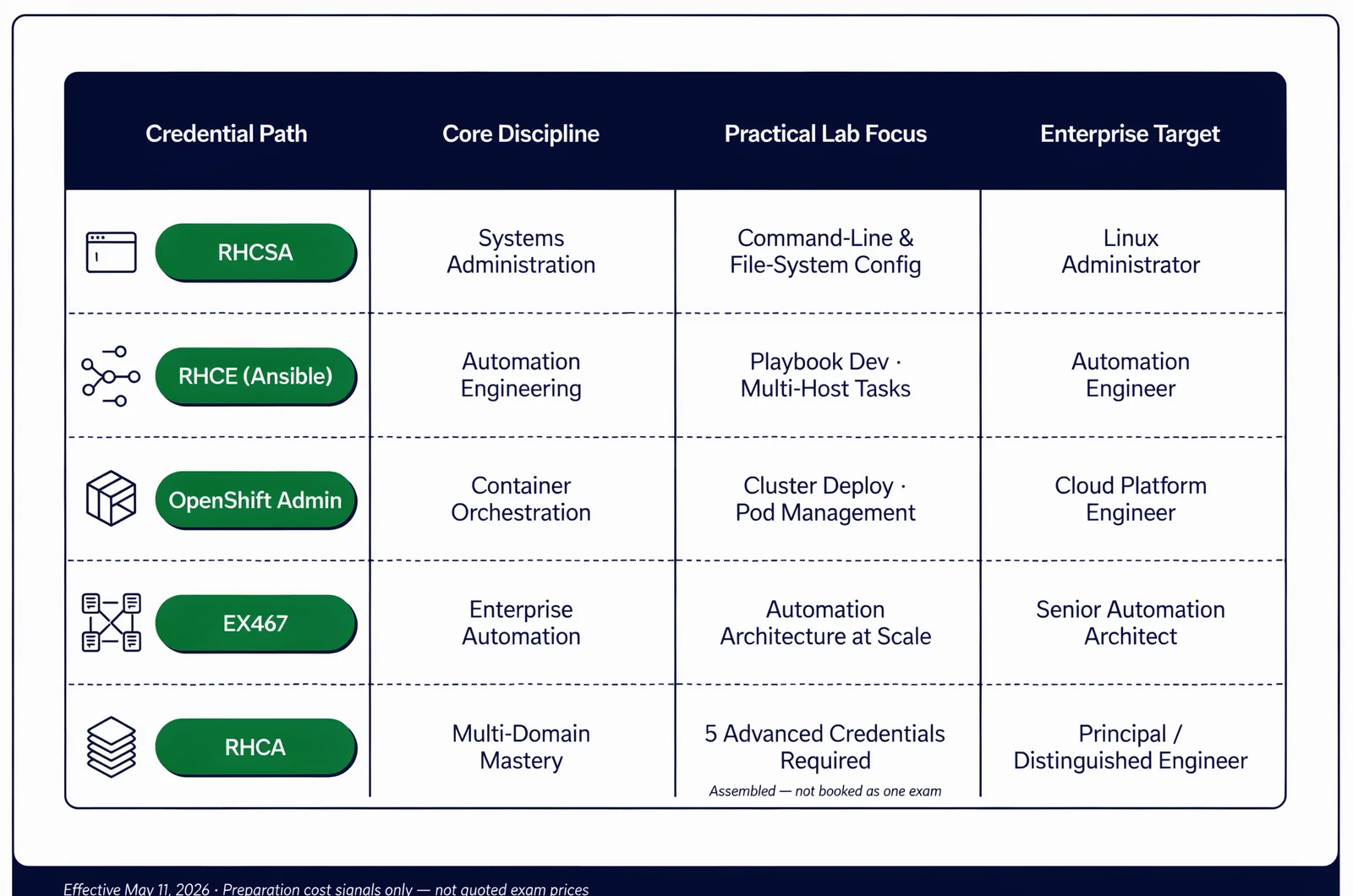
The following order reflects career progression for the general Linux practitioner described above. The exam combinations follow Red Hat’s published certification paths.
| Default priority | Credential or path | Strongest fit | Main preparation cost driver |
|---|---|---|---|
| 1 | RHCSA, EX200 | Core Linux administration | Repeated practice across administration tasks |
| 2 | RHCE in Ansible or Enterprise Linux | Automation or advanced Linux operations | Developing depth beyond foundational administration |
| 3 | OpenShift administration, EX280 | Operating an OpenShift environment | Access to a suitable cluster |
| 4 | Automation platform specialization, EX467 | Managing shared enterprise automation | Access to platform components and realistic workflows |
| 5 | RHCA in a relevant specialization | Sustained breadth within a technical track | Several qualifying exams and continued practice |
These are preparation cost signals, not quoted exam prices. Use a current regional quote when comparing the financial commitment.
RHCSA: the strongest foundation for Linux administration
RHCSA is the first recommendation for someone who wants to take responsibility for Linux servers and still has gaps across routine administration.
The EX200 exam objectives cover practical administration, including command-line work, software management, users, security, storage, and services. The assessment requires hands-on task completion.
Its value in this ranking comes from that breadth. Preparation can expose uneven skills that daily work leaves hidden. Someone comfortable with accounts and permissions may need more practice with storage or service configuration.
Budget for a repeatable Linux lab and enough time to rebuild tasks from a clean starting point. For a personal readiness exercise, configure a service, apply the required access controls, restart the system, and verify the result.
The limitation is scope. An administration foundation leaves substantial work before you can demonstrate advanced automation or cluster operations.
Choose RHCSA first when you need a dependable administration baseline. If you already hold it, use its objectives to identify weaknesses before starting the next specialization.
RHCE: choose between automation and advanced Linux operations
RHCE ranks next for practitioners who already have a foundation and want greater responsibility. The specialization determines which work you should practice.
The Ansible path combines EX200 with EX294. Red Hat’s EX294 exam objectives center on writing and running playbooks to configure systems. A playbook describes automation tasks and the state those tasks should produce.
The Enterprise Linux path combines EX200 with EX342. Its EX342 troubleshooting objectives focus on diagnosing and resolving system problems, including startup, storage, networking, and application issues.
These paths answer different career needs. Choose Ansible when your next responsibility involves repeatable changes across systems. Choose Enterprise Linux when you need deeper diagnostic responsibility.
The preparation burden also differs. For Ansible, budget time to build automation, run it against fresh systems, and verify its results. For advanced Linux operations, practice investigating unfamiliar failures with incomplete information.
The limitation is that either path can become a distraction if it does not match your intended work. An engineer title alone gives little direction to a study plan.
Select the specialization first. Then write a lab task that resembles the responsibility you want to take on, such as applying a consistent configuration or diagnosing a failed service.
OpenShift administration: prioritize it when the platform is your destination
OpenShift administration can move ahead of RHCE when you already work with OpenShift or have a clear route into a platform operations role.
EX280 leads to the Red Hat Certified System Administrator in OpenShift credential. The EX280 exam objectives include managing cluster resources, application deployments, authentication, network security, and troubleshooting.
The distinction is the operating environment. Your practice needs to include application and cluster behavior, alongside the commands used to manage them.
For example, a hypothetical practice task could require deploying an application, controlling access, and investigating why an expected connection fails. Define the expected result before beginning, then verify each part.
Cluster access is the main preparation cost signal. Before booking, confirm that your lab can support the objectives for your selected exam version.
The limitation is platform fit. A candidate pursuing conventional Linux server administration may get more immediate value from strengthening that foundation.
Choose this path when OpenShift responsibilities appear clearly in your work or target roles. Build your study plan around the selected version’s objectives.
EX467: a focused choice for enterprise automation ownership
EX467 belongs on the shortlist for practitioners who need to manage an automation platform shared by teams.
The EX467 platform objectives address automation controller, automation hub, and automation mesh. They include access management, inventories, credentials, projects, workflows, maintenance, and scaling.
Its strongest use case is a defined operational responsibility. A team may need someone to manage how automation runs, who can launch it, and which systems it reaches.
Preparation requires access to the relevant platform components. Plan exercises that combine several tasks, such as configuring access, connecting a project, and running a controlled workflow.
The limitation is its narrow fit. If your immediate goal is learning to automate Linux tasks, establish that ability before committing to platform administration.
Resources such as EX467 practice questions can supplement your review. Check their coverage against your selected objectives and reproduce the relevant actions in a lab.
Choose EX467 when you can name the platform responsibilities you want to own. Confirm that your practice environment supports those responsibilities before paying for preparation.
RHCA: a longer-term plan for relevant technical breadth
RHCA sits last in this starting-point ranking because it represents a broader commitment across a specialization. It becomes more attractive when several qualifying areas already match your responsibilities.
For example, the RHCA in Ansible requirements combine a current RHCE in Ansible with three qualifying specialist credentials. The available choices address different automation domains.
The practical question is whether those domains belong in your career plan. A coherent set of specializations can support broader responsibility across an environment you understand.
The cost signal is cumulative: exam fees, preparation materials, lab access, and time across several subjects. Assess each additional credential separately.
The limitation is opportunity cost. A specialist exam may have little immediate use if you lack access to the technology or responsibility for its operation.
Choose RHCA when you can explain how each planned specialization supports work you expect to perform. Write that explanation beside every proposed exam before committing to the full path.
Match the next exam to work you can demonstrate
The next Red Hat credential should close an identifiable gap between your current ability and a useful responsibility.
If you handle support tickets but struggle to configure a Linux system independently, prioritize foundational administration. Choose several tasks you currently escalate and turn them into practice exercises.
If routine administration is comfortable, examine the work you want next. Repeated configuration across systems points toward Ansible. Diagnosing unfamiliar server failures points toward advanced Linux operations. Supporting applications on OpenShift points toward cluster administration.
For someone already managing shared automation, EX467 may address a more immediate need than another broad credential. RHCA becomes a planning question once several relevant specialist areas are already in view.
A useful interactive exam selector would ask about your target responsibilities, existing credentials, and available lab environment. It would return a suggested path plus the practical gaps to resolve before booking.
Keep a written decision record even without a selector. Name the responsibility, the supporting exam, and one lab result that would demonstrate progress.
Budget for practice access alongside the exam fee
A Red Hat exam budget should include the environment needed to prepare properly. A low initial purchase price can still lead to substantial preparation costs.
Separate your estimate into the exam booking, learning materials, lab access, and time away from other priorities. Check what an employer or existing training arrangement already covers.
For each shortlisted option, ask:
- Can the available lab reproduce the relevant objectives?
- Can you reset it after an exercise?
- Will access continue through your planned study period?
- Which materials match the version you intend to book?
Avoid setting a preparation deadline from someone else’s completion story. Your starting skills and access constraints determine how much work remains.
Use the Red Hat preparation catalog to organize the credentials you are considering. Keep a separate record of the selected exam version, current booking terms, and practice resources you intend to use.
Build preparation around results you can repeat
Preparation for a Red Hat credential should produce observable work. Question practice can help reveal weak reasoning, while lab exercises let you check whether you can complete the associated task.
Use a short cycle: identify an objective, explain the task, perform it, verify the result, and record the mistake or uncertainty.
A hypothetical study session might begin with reviewing access-control concepts. The lab portion could then require configuring access and testing it from the intended account. Finish by recording which check proved the configuration worked.
For a busy schedule, give brief and longer sessions different purposes. Use short windows to review explanations, examine an error, or plan a task. Reserve longer sessions for exercises that require setup and investigation.
Keep notes that make restarting easy. Record the lab state, the last verified result, and the next action. This reduces the time spent reconstructing an interrupted session.
As confidence grows, change the starting conditions. Use different names, permissions, or failure symptoms. Repeat the objective without copying a previous command sequence.
Before booking, complete representative tasks from a clean environment. Include verification in your own readiness check, and record every task that still requires step-by-step help.
Questions that affect your certification choice
Red Hat candidates often need to resolve practical planning questions before choosing a booking date.
Should I choose the highest credential I can afford?
Choose the credential that addresses your next useful responsibility. Money covers only part of the commitment. Consider lab access, study time, and whether you will use the skills afterward. List the work each candidate credential would help you pursue.
How much experience should I have before preparing?
Use task performance to judge your starting point. Attempt a representative exercise, record where you need help, and estimate the preparation gap. Review formal requirements separately from this personal readiness assessment.
Does a strong question-practice score mean I am ready?
Treat it as evidence that you understand the material covered by those questions. Add a separate practical check: complete relevant tasks, investigate failures, and verify the results. Schedule the exam after reviewing both forms of evidence.
Apply the same study discipline to ISO 27001
Click through to browse exams and begin a practice session. Get started → |