How to Pass the ISO 27001 Exam With a Focused Study Plan
Preparing for an ISO 27001 certification exam starts with identifying the personal credential you want and the decisions its syllabus expects you to make. From there, build a study plan that connects requirements, controls, and practice questions. Your goal is to explain why an answer fits a scenario before you rely on a practice score.
First, distinguish your goal: an individual professional credential or certification of an organization’s information security management system (ISMS). This walkthrough covers individual exam preparation. Your chosen provider’s syllabus and candidate guidance should determine the content and exam conditions you prepare for.
Start with those documents, suitable study material, and a realistic weekly time budget. Measure progress through explanations you can reproduce, unfamiliar scenarios you can solve, and practice completed under the permitted conditions.
1. Confirm your credential and exam rules
Write the full credential name at the top of your study plan. “ISO 27001 exam” is too broad to define your preparation. A foundation, implementation, or auditing pathway can require a different emphasis, so use the specific syllabus for your chosen qualification.
Before paying for training or an exam booking, check whether eligibility, experience, or other credential requirements apply. Establish what passing the exam completes and what additional steps, if any, remain.
Create a one-page exam brief from the provider’s published guidance. Record:
- The credential name and standard edition covered.
- The syllabus areas and any published weighting.
- The question format, exam duration, and scoring information.
- Whether reference materials are permitted.
- Delivery requirements and booking or rescheduling terms.
Keep unknown details marked as unresolved. Do not fill gaps with rules borrowed from another qualification or an old discussion thread.
Use this brief to choose materials. Compare their stated coverage with your syllabus, especially where terminology, editions, or role expectations differ. An implementation example may support your understanding while leaving an auditing objective unaddressed.
Finish this step by explaining, in two sentences, which credential you are preparing for and how its exam is administered. Resolve any missing information before designing timed practice.
2. Turn the syllabus into a working study map
Convert your chosen exam syllabus into a list of tasks you can perform. This gives each study session a purpose and prevents familiar subjects from absorbing all your available time.
For each syllabus area, write an observable outcome. Replace “understand risk assessment” with something more useful: “explain how a stated risk leads to a treatment decision.” Replace “review auditing” with “identify what evidence would support a finding.”
Add a baseline rating beside each outcome:
- You can explain it without notes and apply it to a new example.
- You recognize the terminology but struggle to apply it.
- You need to learn or rebuild the concept.
Use a short diagnostic practice session to challenge those ratings. Attempt questions before reviewing the corresponding material, then record where your reasoning failed.
Separate unfamiliar terminology from faulty decisions. Forgetting a definition calls for a different review task than misunderstanding which action comes first in a scenario.
Assign your next sessions using the published syllabus emphasis, where available, alongside your demonstrated weaknesses. Avoid inventing exam weightings when none are supplied.
Your study map is usable when every weak area has a specific task attached. “Study controls” is unfinished planning. “Explain how access approval and access review address different problems” gives you something to complete and verify.
3. Connect requirements and Annex A controls to decisions
Study ISO 27001 material through the relationship between a requirement, an organization’s circumstances, and the evidence of what it does. Keep your prescribed materials nearby so your explanations remain anchored to the content your exam covers.
Explain the management decision
For each requirement in your study material, ask what decision an organization must make and how it could demonstrate that decision.
For example, when reviewing scope, explain what is included, where the boundaries sit, and why those boundaries matter. When reviewing risk treatment, trace the reasoning from the identified risk to the chosen response.
Write short explanations in your own words. Then compare them with the prescribed material and correct missing conditions or distinctions.
Avoid turning every requirement into a document name. A scenario may require you to reason about responsibility, implementation, or evidence. Practice explaining what the organization actually does.
Give each control a purpose and an example
Break Annex A review into manageable groups around subjects such as access, people, facilities, suppliers, and technology. Follow your materials for the formal organization and required detail.
For each control you study, record:
- The problem it addresses.
- A hypothetical situation where it could apply.
- Evidence you would examine to understand its implementation.
- A nearby concept you might confuse with it.
Suppose, as a study exercise, a department cannot explain who can access sensitive files. Identify the information, access needs, existing approvals, and risk before choosing a technical response.
If the exercise asks you to assess an existing process, identify the evidence you would need before reaching a finding. If it asks you to implement an improvement, explain the proposed action and its purpose.
Verify your understanding by changing one fact in the example. Explain whether your reasoning still holds and which additional information you need.
4. Build a schedule around repeatable study sessions
Allocate your ISO 27001 study time according to the work your study map reveals. Choose sessions you can maintain around employment and other commitments, then reserve time for reviewing errors.
Use a sample week as a starting point
As an example, five 25-minute sessions and one 50-minute session provide 175 minutes of weekly study. Treat that as a scheduling model, not a preparation requirement.
You could organize an initial four-week cycle this way:
- In week 1, confirm the syllabus, complete a diagnostic session, and rebuild unfamiliar concepts.
- In week 2, connect requirements and controls to short scenarios.
- In week 3, mix syllabus areas and revisit recurring reasoning errors.
- In week 4, complete representative practice and repair the weaknesses it reveals.
Extend or repeat the cycle where your results show gaps. If the diagnostic reveals substantial unfamiliar material, allow more learning time before emphasizing timed work.
Give each session one deliverable
For a 25-minute session, try five minutes of recall, ten minutes of focused study, and ten minutes of application. Adjust those blocks to suit the task.
A deliverable might be one explanation written from memory, one corrected misconception, or several reviewed questions with reasons recorded.
Keep a short continuation note: what you completed, what remains uncertain, and where to resume. This makes the next session easier to start after a busy day.
A simple interactive planner could accept your available minutes, exam date, and weakest syllabus areas, then allocate review sessions with a catch-up buffer.
At the end of each week, compare planned work with completed work. Move unfinished tasks into named sessions instead of leaving them on an expanding backlog.
5. Use practice questions to examine your reasoning
Make ISO 27001 practice a cycle of answering, explaining, checking, and revisiting. The useful output is a clearer decision process you can apply when the wording changes.
Answer before opening the explanation
Choose a small question set that matches the syllabus area you are studying. For a relevant implementation pathway, Quizra’s ISO 27001 practice questions can provide material for this exercise. Check the stated credential and coverage against your own exam brief.
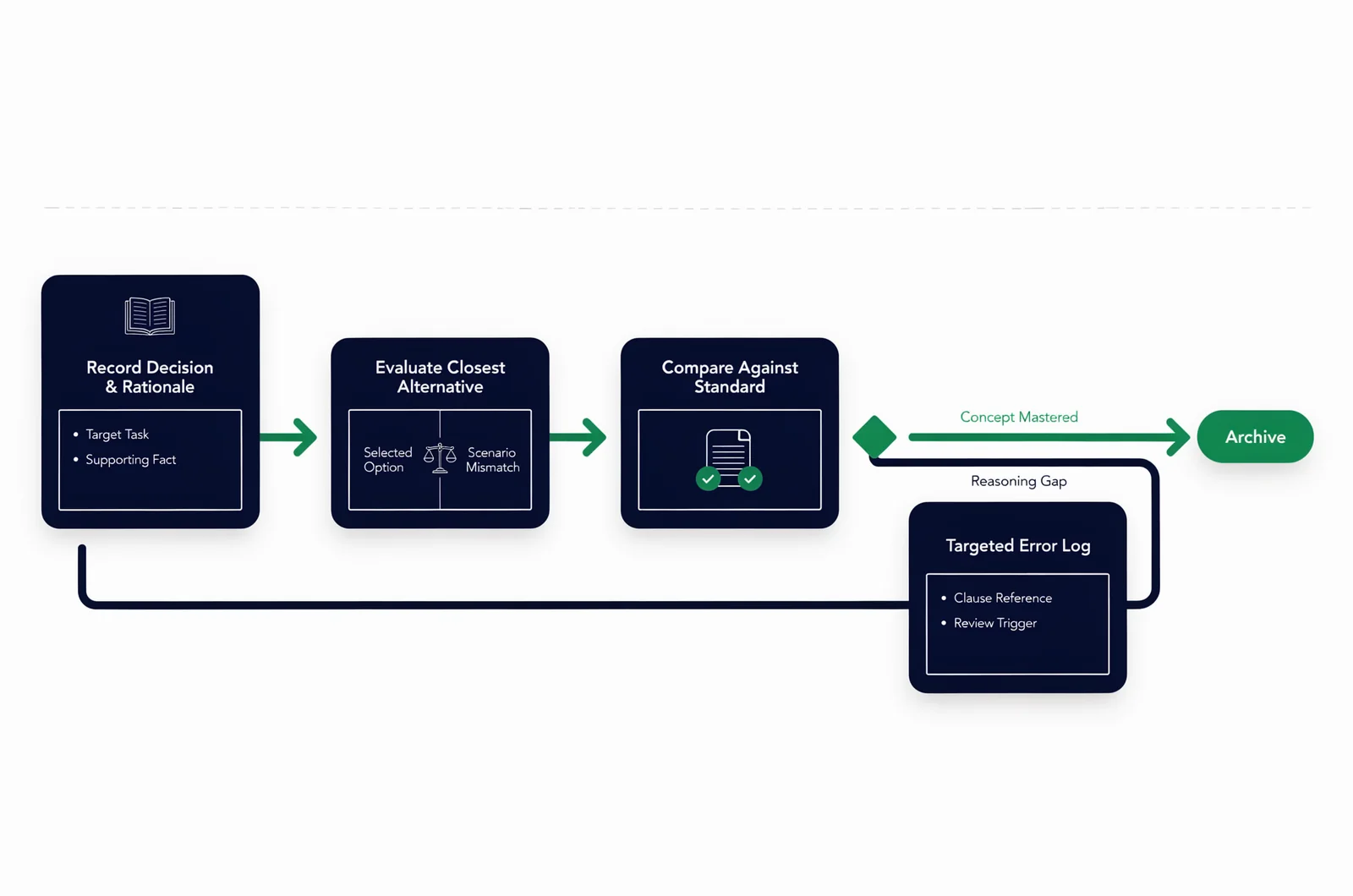
Before viewing an explanation, record your answer and a brief reason. Identify the fact in the scenario that drove your choice.
During review, ask:
- What task does the question ask me to perform?
- Which detail supports the selected answer?
- Why does the closest alternative fit less well?
- What change in the scenario could make that alternative suitable?
Treat an unsupported correct answer as a review item. You still need to establish whether your reasoning was sound.
Keep an error log you can act on
Record errors by cause rather than copying whole questions. Useful categories include a missing concept, confused terminology, overlooked wording, an incorrect sequence, or an assumption the scenario never supplied.
Write a correction that changes your next attempt. “Read carefully” is too vague. “Identify whether the question asks for evidence or an implementation action before choosing” is specific enough to use.
When reviewing an explanation in Quizra, close it and reconstruct the reasoning in your own words. Then check the relevant prescribed material where a concept remains uncertain.
Revisit the concept in a later session through a different example. Repeating the same question immediately can show that you remember its answer without establishing whether you understand the decision.
End each practice session by assigning one repair task to your study map. Keep the task small enough to complete in your next available session.
6. Check readiness with unfamiliar scenarios
Assess your exam readiness through practice that reduces the advantage of familiar wording. Reserve some unused material for this stage, or create clearly labeled hypothetical variations on concepts you have already studied.
Match the conditions to your exam brief. If reference materials are permitted, practice locating relevant information under those conditions. If they are restricted, use those restrictions during rehearsal.
Review accuracy, reasoning, and pace separately. A correct response reached through a faulty assumption still needs attention. A well-explained response that takes too long creates a different task: identify where you lose time.
Use any published passing requirement as context, while recognizing that an independent practice score cannot establish an official exam outcome.
Look for evidence across more than one session:
- You can explain choices without repeating memorized wording.
- You can handle mixed syllabus areas and changed scenarios.
- Recurring errors become less frequent after targeted review.
- Your pace leaves time for the permitted completion or review process.
If one area remains weak, give it a defined repair block before attempting another broad practice session. Repeated full-length attempts are less useful when they keep revealing the same unresolved misconception.
Record the remaining gaps and the study task attached to each one before deciding whether your preparation schedule needs adjustment.
7. Rehearse the exam-day routine
Prepare the practical side of your ISO 27001 exam using the instructions for your actual booking. Check identification, arrival or login requirements, permitted materials, and any rules about breaks.
For remote delivery, complete the provider’s required technical checks. For a test-center appointment, confirm the location and travel arrangements.
Use the confirmed duration and question format to establish pacing checkpoints during rehearsal. Avoid borrowing a timing strategy from a different exam.
Practice a short response routine: identify the task, identify the relevant facts, choose an answer, and move on. If review is permitted, decide how you will mark uncertain responses without disrupting your pace.
During the final study session, revisit your exam brief and recurring error patterns. Prepare the materials allowed for your sitting and write down any unresolved logistical question for the provider.
Check rescheduling terms before making a booking change. Keep your confirmation and required documents accessible for exam day.
Questions about personal credentials and study readiness
Use these distinctions to keep your preparation aligned with the credential you selected.
Does passing an exam certify my organization?
Keep the two goals separate. A personal credential concerns your qualification; organizational certification concerns an organization’s ISMS. Check what your chosen credential requires beyond the exam, and avoid presenting an individual result as organizational certification.
How long should I spend preparing?
Set the schedule from your baseline, syllabus coverage, and available time. The four-week cycle above is an example you can extend.
After each week, reassess unfinished learning tasks and repeated errors. Add time where you still cannot explain or apply the material, rather than treating the calendar as proof of readiness.
Should I memorize every Annex A control?
Use your syllabus to determine the required recall and application detail. Build understanding around each control’s purpose, the circumstances where it may apply, and the evidence you would examine.
Then test recall at the level your materials require. If you recognize a control’s name but cannot explain its purpose in a scenario, assign that gap a separate review task.
Credentials for adjacent compliance roles
Click through to browse exams and begin a practice session. Get started → |