Should You Get CAMS or CFCS Certification for Compliance Roles?

For an anti-money laundering role, CAMS is the more direct starting point to consider. For work across several financial-crime areas, consider CFCS. Your CAMS vs CFCS certification decision should follow the responsibilities you want, your target employers’ requirements, and a realistic study budget. These questions will help you judge career fit, check application requirements, and choose a preparation approach before paying.
What is the main difference between CAMS and CFCS?
The main distinction is their professional emphasis: CAMS centers on anti-money laundering, while CFCS takes a broader financial-crime focus.
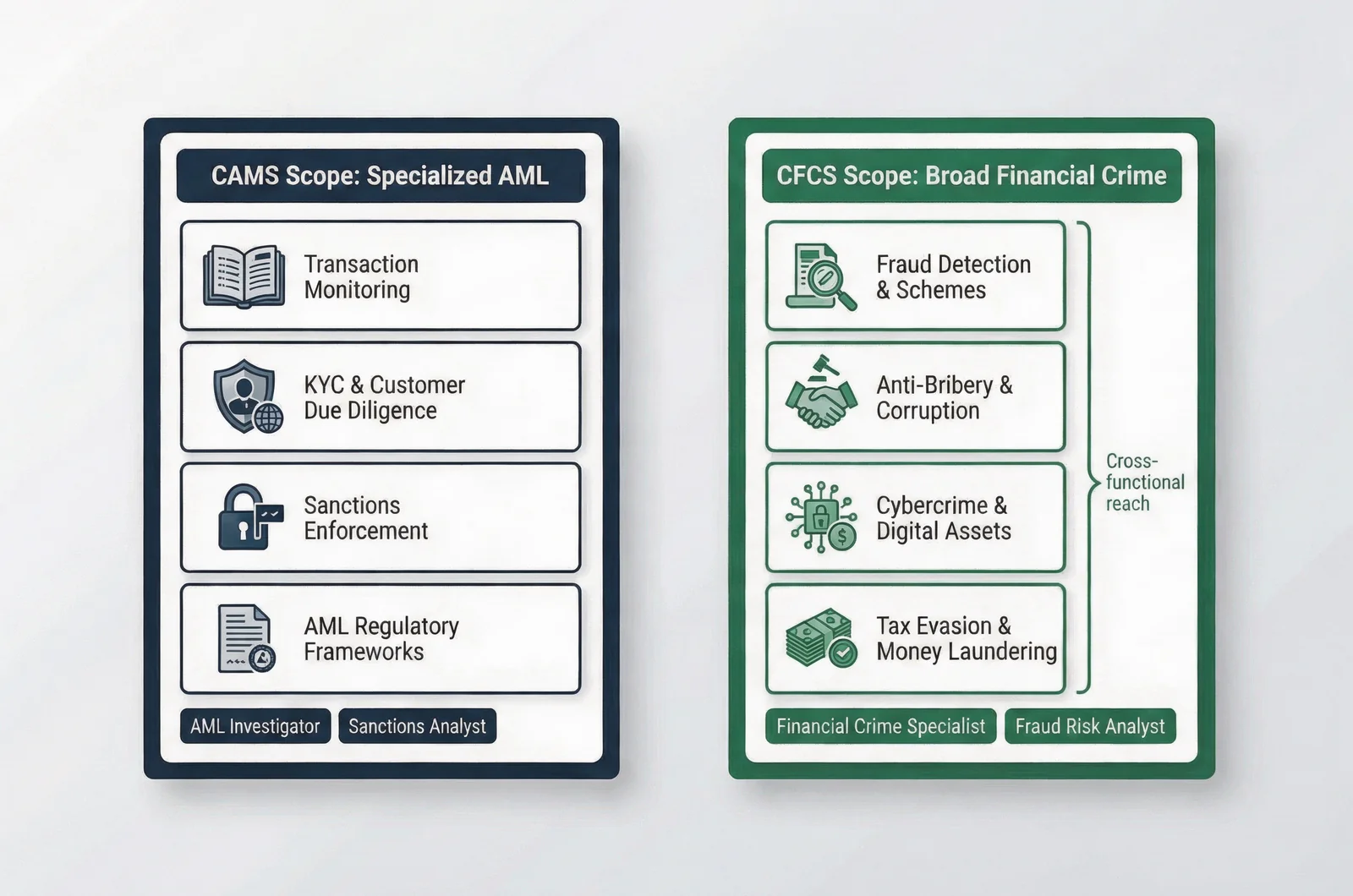
CAMS means Certified Anti-Money Laundering Specialist and is associated with ACAMS. CFCS means Certified Financial Crime Specialist and is associated with ACFCS. Keep those organization names separate from the credentials themselves when reviewing job advertisements and training materials.
The practical question is how each emphasis connects to your intended work. If your next role concentrates on identifying and responding to money-laundering risk, an AML specialization gives your choice a clear purpose. If you want responsibilities that connect different financial-crime concerns, broader preparation may better match that direction.
Breadth and specialization solve different learning problems. A broader credential can introduce unfamiliar subjects, but it does not automatically provide greater depth in every subject. A focused credential can strengthen a particular professional direction without covering every responsibility in a compliance department.
Start with the work rather than the initials. Write down the responsibilities you want in your next role, then compare those responsibilities with each certification’s current exam outline.
When should an AML professional choose CAMS?
Consider CAMS first when your intended role is clearly centered on anti-money laundering and the employers you want recognize that credential.
For example, imagine you already review customer activity and want to move into a role with more responsibility for AML investigations. The relevant question is whether CAMS preparation addresses the knowledge gaps between your current work and that next position.
Job titles alone can mislead. A “compliance analyst” position might involve transaction review, policy administration, regulatory change, or several unrelated duties. Read the responsibilities beneath the title before deciding that an AML credential fits.
Look for specific tasks you expect to perform. You might need to assess unusual activity, explain an escalation, or document why an investigation should continue. These are examples of work to map against the current syllabus, rather than a substitute for checking its contents.
CAMS also deserves consideration when your employer explicitly names it in a development plan or promotion requirement. Confirm whether that wording represents a firm requirement or a preference.
Before enrolling, identify one target role and three responsibilities that make an AML specialization useful. If that connection is difficult to explain, investigate the role further.
When does CFCS make more sense?
Consider CFCS when your intended responsibilities span multiple financial-crime areas and you want a credential that reflects that broader direction.
Say you want to help assess cases where suspected fraud and suspicious financial activity overlap. Your learning needs may extend beyond one specialist function. A broader financial-crime focus is worth examining against that work.
The same reasoning can apply to a career change. Someone moving from a narrow operational role into wider investigative responsibilities may want structured exposure to unfamiliar subjects. The value depends on what the target position actually requires.
Avoid choosing breadth simply because you have not decided what to do next. A broad credential still requires time, money, and sustained preparation. It cannot resolve an unclear career goal by itself.
Read several relevant job descriptions and identify where responsibilities cross functional boundaries. Then check whether the current CFCS outline addresses the subjects you need to learn.
If your intended job remains predominantly AML work, compare the benefit of broader exposure with the benefit of focused preparation. Name the additional responsibilities that justify choosing CFCS before making the investment.
Which certification do employers recognize?
Give the most weight to the credential your target employers explicitly request; recognition depends on the role, organization, and hiring market.
A universal claim that one certification wins everywhere would be a poor basis for spending your money. You need evidence from the jobs you would realistically pursue.
Review a small set of suitable vacancies. Record the exact certification wording, the responsibilities, and whether the credential is required or preferred. Keep location, seniority, and employer type reasonably consistent so you can compare similar opportunities.
A listing that specifically requires CAMS gives you a concrete reason to prioritize it for that application. A listing that accepts several credentials leaves more room to choose by subject fit. A listing with no certification requirement may place greater emphasis on experience or other qualifications.
Distinguish employer demand from certification-provider marketing. A provider can explain its credential, but your intended employer decides how to assess applicants.
If you already work in compliance, ask your manager which qualification supports a specific promotion or internal move. Ask whether the company funds preparation and whether reimbursement has conditions.
Neither credential promises a job or a salary increase. Use the actual wording in hiring requirements and development plans to support your decision.
How do you check eligibility before paying?
Check each provider’s current candidate requirements and confirm how your own background satisfies them before buying a package.
Do not assume that a degree, job title, or years of employment automatically establishes eligibility. Your interpretation needs to match the provider’s definitions and documentation rules.
For each credential, review whether the application considers education, professional experience, training, membership, or other criteria. Where a requirement applies, identify what evidence you must submit. Do not transfer an eligibility calculation from one program to the other.
Keep a simple record of the requirement, your supporting evidence, and any unresolved question. This makes it easier to spot an assumption before it becomes a payment problem.
If your experience crosses several functions, describe your actual duties when seeking clarification. “Operations specialist” may reveal less than a short explanation of the investigations or reviews you perform.
Also establish the order of application, payment, approval, and exam scheduling. If approval or scheduling has a time limit, check that it fits your availability.
Use the requirements in effect when you apply, rather than relying on an older discussion post or a colleague’s recollection. Resolve unclear eligibility directly with the certifying organization before making a nonrefundable purchase.
Is CAMS harder than CFCS?
Neither credential is automatically easier for every candidate; your knowledge gaps and ability to apply concepts provide a better guide than its reputation.
Someone with substantial AML experience may find focused AML material more familiar. A candidate accustomed to working across financial-crime subjects may feel more comfortable with broader coverage. Familiarity still needs to survive careful questioning.
Separate difficulty into three practical concerns:
- How much of the current outline is unfamiliar?
- Can you reason through scenarios rather than recognize definitions?
- Can you maintain concentration under the applicable exam conditions?
Use the current candidate handbook to confirm exam length, question format, scoring information, and testing rules. Those details can change, so older comparisons should not determine your preparation plan.
Practice results need interpretation too. A high score on repeated questions may reflect recognition rather than readiness. Explain why the correct answer fits and what makes each alternative less suitable.
When using Quizra’s independently authored practice questions, review the explanations and note the distinction you missed. Confirm that any practice set matches the credential you are preparing for.
Estimate your study needs from those knowledge gaps. A candidate who can explain decisions consistently has more useful evidence of progress than one who has memorized familiar answer positions.
What should you include in the total cost?
Compare the full cost of earning and maintaining each credential, rather than judging either option by an advertised exam price alone.
Build your comparison from current, itemized information. Depending on the package and applicable requirements, relevant expenses may include application charges, exam access, membership, preparation materials, taxes, and testing-related costs.
Check what the purchase actually includes. A package containing preparation and an exam attempt should be compared with a similarly complete alternative. Otherwise, an apparently cheaper option may leave expenses outside your calculation.
Consider the cost of disruption as well. Review the rules for rescheduling, cancellation, and another attempt if needed. Check any deadline attached to exam access before assuming you can study indefinitely.
Maintenance deserves a separate line in your budget. Verify renewal requirements, continuing education obligations, membership conditions, and fees for each credential you are considering.
Employer funding can change the calculation. Establish which expenses qualify, whether you must pass before reimbursement, and whether repayment conditions apply if you leave.
Your time is another cost, even when an employer pays the invoice. Estimate weekly study hours alongside your existing commitments. Record the date of each price check and compare complete totals before choosing.
How should you study around a full-time job?
Use short, repeatable study sessions tied to the current exam outline, with enough review time to understand your errors.
Begin by dividing the outline into manageable subjects. Mark what you know, what you partly understand, and what you have not studied. This gives each session a purpose and reduces time spent repeatedly reviewing comfortable material.
A short session can follow a simple sequence: answer a few relevant questions, examine the reasoning, and write one correction to your understanding. Return to that correction later without looking at the original answer.
For a hypothetical investigation scenario, identify the facts that matter before selecting a response. Explain why your chosen action follows from those facts and what additional information could change it.
Quizra’s question-first library can support this explanation-based routine, but select materials by their exact credential label. For example, its CAFS practice questions concern a different credential; they should not be treated as a CAMS or CFCS practice set.
Use the official outline to organize your preparation, then add suitable independent resources where they address a specific gap. Reconcile conflicting explanations against authoritative material rather than collecting more sources.
Protect one longer review session when possible. Use it to connect subjects, revisit persistent errors, and assess readiness under the current exam conditions.
Should you earn both certifications?
Earn both only when the second credential supports a distinct career need that the first does not adequately address.
Collecting overlapping credentials can consume money and study time without solving your immediate problem. A second qualification needs its own reason.
For example, imagine you complete an AML-focused credential and later move toward broader financial-crime responsibilities. At that point, CFCS may deserve a fresh comparison against your new duties. The decision should follow the changed role.
The reverse can also apply. After broader financial-crime preparation, you might pursue an AML specialization because a particular employer or position values it. Confirm that requirement before committing to another exam.
Consider alternative uses of the same time. Supervised investigation work, clearer case writing, relevant technical skills, or a documented work project may address a more immediate gap. Assess those options against the position you want.
Budget for maintaining both credentials before deciding to hold both. Verify whether any continuing education can count toward more than one requirement rather than assuming it will.
Finish the first qualification, apply what you learned, and identify the remaining gap. Put a second certification on your plan only when you can describe the additional work it will help you pursue.
How do you make the final choice between CAMS and CFCS?
Choose the credential with the clearest connection to your intended responsibilities, supported by employer requirements, verified eligibility, and an achievable preparation plan.
Use four checks to make the decision concrete:
- Name the role you want and the work you expect to perform.
- Record what relevant employers say about certification.
- Confirm eligibility and the complete financial commitment.
- Identify when and how you will study the unfamiliar subjects.
If those checks point toward AML specialization, CAMS is a reasonable priority. If they point toward broader financial-crime responsibilities, CFCS deserves closer consideration. Where an employer specifies a credential, include that requirement explicitly in your reasoning.
If the evidence remains mixed, gather the missing information. You may need a clearer job description, an eligibility response, or an itemized price. Delay the purchase until that uncertainty is resolved.
A useful interactive selector could collect your target responsibilities, employer wording, confirmed eligibility, budget, and weekly study hours. Its result should show which choice has stronger support and which questions remain unanswered.
Write a one-sentence justification before enrolling: “I am choosing this credential because it matches these responsibilities and this employer requirement.” Add the study hours you can protect each week and the total amount you are prepared to spend.
Where can you explore CFE exam preparation?
Click through to browse exams and begin a practice session. Get started → |