CFE Exam Practice Questions: What the 2026 ACFE Update Changed

The ACFE Certified Fraud Examiner exam changed in June 2026, replacing its four-section structure with three sections. For candidates choosing CFE exam practice questions, the immediate consequence is clear: practice materials need to match the revised organization of the exam. Kaplan’s current CFE exam overview dates the transition to June 2, 2026, and identifies the three current sections. Candidates already studying should check their coverage against those sections before treating an older question bank’s scores as evidence of readiness.
The update also requires care with claims about changed topic weights. Question counts reveal the distribution of questions across sections. They do not establish which individual objectives gained weight, disappeared, or became newly examinable.
Three sections replace the former four
The revised CFE structure changes how candidates should organize their practice and review progress. The current sections are Fraud Schemes and Financial Crimes, Fraud Investigations and Legal Issues, and Fraud Prevention and Deterrence.
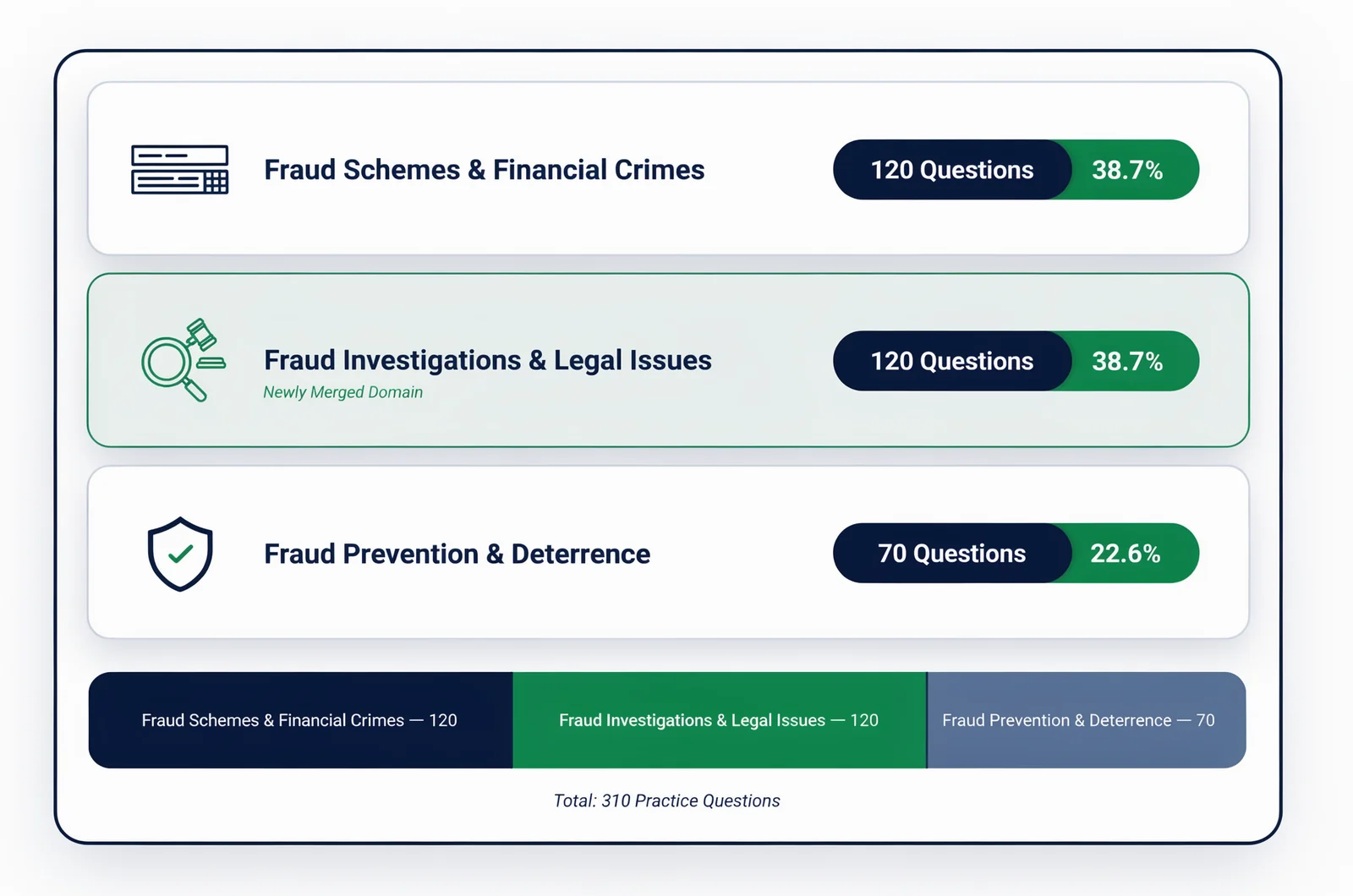
The published section counts
Kaplan’s three-section exam description lists the following question counts. The percentages below are calculated from those counts, rather than presented as official objective weightings.
| Current exam section | Published question count | Calculated share of 310 questions |
|---|---|---|
| Fraud Schemes and Financial Crimes | 120 | 38.7% |
| Fraud Investigations and Legal Issues | 120 | 38.7% |
| Fraud Prevention and Deterrence | 70 | 22.6% |
The counts total 310 questions. The two larger sections contain the same number of questions, while Fraud Prevention and Deterrence contains fewer.
ACFE describes the current exam as three separate timed assessments, using multiple-choice and true/false questions to test practical knowledge and application. Candidates should use the CFE exam candidate handbook to confirm the rules that apply to their examination.
What those percentages can tell you
The calculated distribution gives candidates a starting point for reviewing a practice bank. A collection concentrated heavily in one section deserves closer attention, even if its total question count looks substantial.
However, these percentages should not become a rigid study schedule. Someone with strong financial-crime knowledge and weak investigative reasoning may need more time in the second section. Personal knowledge gaps still matter.
The distribution also cannot establish a historical increase or decrease in a particular topic’s importance. That requires comparable objectives and weighting information from the previous and current outlines.
A smaller section should remain visible in a candidate’s progress record. Combining every practice result into one average can conceal a weak area. Track accuracy, unanswered questions, and explanation quality separately for each of the three current sections.
Updated ACFE materials require an objective-level check
The structure change is confirmed, but candidates need a more detailed comparison to establish what changed inside each section. ACFE’s release announcement says its official preparation materials were revised alongside the exam.
Official preparation materials changed with the exam
ACFE identifies the Fraud Examiners Manual, CFE Exam Review Course, and CFE Exam Prep Course among the materials updated for the revised examination. That matters for candidates working from an older edition or course.
An older explanation may remain useful when it addresses an objective that continues in the current outline. Its usefulness depends on the underlying concept and its present exam relevance.
Candidates should therefore distinguish between a resource’s publication date and its content alignment. A newly dated page may still organize questions around an earlier structure. An older resource may contain sound explanations that need to be mapped to current objectives.
Record the edition or revision date of each main resource. Then identify the current section and objective it supports.
Specific additions need specific evidence
Claims that a topic was added, expanded, or removed require an identifiable change in the detailed outline. A broad announcement about a revised exam cannot establish every such change.
For example, a practice question involving cryptocurrency, digital records, or data analysis does not establish that its subject first became examinable in 2026. The relevant question is whether the current outline includes the concept and how the item addresses it.
The same care applies to claims about topic weight. A section containing 120 questions does not reveal how those questions are divided among every subject within it.
Candidates comparing editions should look for changed objective wording, newly listed tasks, and removed objectives. Where a provider cannot identify the relevant objective, treat the question’s alignment as uncertain until that connection is established.
Question banks are responding, but update labels need scrutiny
The preparation market already contains materials presented for the revised CFE examination. The useful distinction is how clearly a provider connects its questions, explanations, and practice tests to the current structure.
Kaplan identifies the revised sections explicitly
Kaplan’s published preparation package describes coverage of all three sections under the June 2, 2026 structure. It also lists a 750-question bank, two practice tests, and 300 flashcards.
Those details establish what Kaplan says its package contains. They do not independently establish the quality of every explanation or a candidate’s likely exam result.
For someone comparing materials, the explicit section mapping is more informative than a year appearing in a product title. It gives the reader a concrete alignment claim to examine.
A candidate can then ask whether practice results remain visible by section, whether explanations identify the tested concept, and whether full-length practice reflects the current organization. These are useful checks for any preparation package.
A current section name is a starting point
An ITExams page is labeled for fraud investigations and legal issues, which corresponds to a current section name. That label alone cannot establish objective coverage, editorial review, or explanation accuracy.
Likewise, OpenExamPrep’s CFE practice page advertises a free 2026 practice resource with more than 200 questions. Access terms and question volume answer different questions from exam alignment.
When assessing a bank, look for evidence beyond its headline:
- Section labels that match the revised examination.
- A revision date tied to content changes.
- Objective references or another clear coverage map.
- Explanations that connect the answer to the tested concept.
A useful interactive alignment checklist could accept a resource’s section labels, revision date, and objective references. It could flag missing coverage and unresolved mappings without presenting its result as an exam-readiness score.
Until those checks are complete, a large collection remains a large collection. Its size cannot show whether an important current objective is absent.
Candidates already studying need to remap their practice
Candidates who began preparing before June 2026 should reassess how their existing materials fit the revised exam. The practical task is to preserve useful work while identifying coverage that needs attention.
Reassign questions to the current sections
Start with the questions already completed. Assign each to a current section and, where possible, a specific objective.
Some items may map cleanly. Others may need closer review because their labels belong to an earlier edition, their explanations lack context, or their subject no longer matches the current outline.
Keep unresolved items separate. Counting them as completed coverage can make a progress dashboard look stronger than the evidence supports.
For each retained question, record the reason for a wrong answer. Confusing terminology, overlooking a scenario detail, and misunderstanding a principle call for different follow-up work.
This remapping also makes short study sessions easier to resume. A candidate returning after several busy days can see the current section, the unresolved concept, and the explanation that needs another reading.
Choose the next session from that record rather than repeating whichever questions feel most familiar.
Keep supplementary credentials separate
Related practice can help candidates explore a narrow skill, but it should remain separate from their CFE coverage record.
On Quizra, the Practice Questions That Build Understanding library includes fraud-related interviewing questions for a separate interviewing certificate program. Candidates using them as supplementary exercises should connect each relevant concept to a current CFE objective.
Quizra’s anti-fraud specialist practice questions belong to another credential. Similar subject matter can provide additional practice, but the credential’s title does not establish equivalence with the CFE outline.
Maintain a clear distinction between supplementary learning and verified exam coverage. A useful interviewing exercise may improve understanding while leaving another current objective untouched.
Reset scores after confirming coverage
A high score on a familiar older set can reflect recognition of its wording. After remapping the material, use a fresh diagnostic organized around the three current sections.
Review uncertain answers as carefully as incorrect ones. A correct response reached by guessing should remain on the study list.
For the first diagnostic after the update, record section results separately and note any objectives the question bank does not cover.
The combined investigations section makes connected explanations more useful
The current Fraud Investigations and Legal Issues section brings those subjects together in the exam structure. For practice selection, that makes it useful to examine whether explanations connect investigative decisions with the relevant legal considerations.
Scenario reasoning should connect the facts
ACFE describes the revised examination as testing application in realistic scenarios. A useful practice explanation should therefore show which facts determine the answer.
Consider a hypothetical exercise involving suspected invoice fraud and company records. An explanation might connect the suspected scheme, the information an investigator needs, and the authorization relevant to accessing those records.
This is an illustration of practice reasoning, not an official exam item or legal instruction. Its purpose is to show why an isolated answer letter provides limited learning.
The explanation should identify what the question establishes and what it leaves unknown. If jurisdiction or authorization matters, the item needs enough context to support a defensible answer.
Candidates should be able to explain why a tempting alternative does not fit the stated facts. If that reasoning depends on assumptions absent from the question, flag the item for review.
Short sessions still need continuity
The revised structure gives busy candidates a practical way to maintain continuity: keep each study session attached to a current section and objective.
A short session can focus on a small set of questions, followed by explanation review. The follow-up session can revisit the same concept through different wording or a changed scenario.
For each difficult item, write one sentence explaining the decisive fact. This keeps the review specific and makes later repetition more useful.
Repeatedly selecting the correct answer to an unchanged question provides little evidence of broader understanding. Try explaining the principle before viewing the options again.
End the session with a record of the objective reviewed, the reasoning error corrected, and the question that still needs attention.
Answers for candidates studying through the 2026 change
The revised examination creates several immediate decisions for candidates who already own materials or are comparing new practice resources. These answers follow from the confirmed structure change and the limits of what a product description can establish.
Can an older question bank still help?
Yes, when its questions accurately address current objectives and its explanations remain valid. Age alone does not settle relevance.
The limitation is coverage. A useful older set may omit objectives, use obsolete section labels, or produce progress reports that do not match the current structure.
Retain questions after mapping them. Keep uncertain items outside the completed-coverage total.
Does a 2026 label confirm that a bank was revised?
No. A year in the title establishes how the resource is presented, rather than the extent of its revision.
Look for current section names, a dated explanation of the update, and a clear connection between questions and objectives. A provider should be able to explain what changed in its materials.
Check the coverage map before relying on the revision label.
Do question counts establish official topic weights?
No. The published counts support the calculated section shares shown above. They do not establish the weight of every topic within a section.
Use those shares to inspect the broad distribution of practice questions. Set study priorities through objective coverage and diagnostic results.
Which document should settle conflicting exam advice?
Use ACFE’s official candidate handbook for candidate rules, together with the current exam content outline for coverage.
Confirm timing, permitted materials, scheduling, and other examination requirements before booking or taking a practice simulation as representative of exam conditions.
The immediate adjustment is concrete: organize preparation around three current sections, map retained questions to current objectives, and verify unresolved coverage before relying on a practice score.
How another 2026 exam revision affected practice
Click through to browse exams and begin a practice session. Get started → |