CFA Level 2 Exam Changes for 2026 Reshape the Question Bank
CFA Institute's 2026 curriculum cycle is now underway, and the practical consequence for candidates is straightforward: any CFA Level 2 questions you practiced against the 2025 syllabus need to be re-checked before you rely on them for the current exam year. Topic weights shift, readings are retired and replaced, and item sets increasingly reward applied valuation work over definitional recall. This update lays out what is confirmed about the 2026 sitting, what the changes mean for how you should practice, and where the gaps in published information still sit as of early October 2026.
The readers most affected are candidates registered for the 2026 exam windows and those holding over notes or question banks from a prior attempt. If that is you, the sections below separate verified format facts from the analysis of how to adapt your study plan.
What is confirmed about the 2026 Level 2 exam
Start with the structure, because the structure did not change. The CFA Level 2 exam remains a computer-based test built entirely around item sets: short case vignettes, typically one to two pages of scenario text, each followed by a set of multiple-choice questions tied to that vignette. The exam runs across two sessions in a single day, and the total sitting time is roughly four and a half hours split across the sessions.
What that means in practice: every question you answer at Level 2 is contextual. You do not get isolated one-line prompts the way you largely did at Level 1. You read a scenario about a company, a portfolio, a bond issue, or a financial reporting situation, and then you answer several questions that all depend on how well you parsed that scenario.
The confirmed points for the 2026 cycle, drawn from CFA Institute's published curriculum materials and corroborated by prep providers tracking the 2026 exam, are:
- The item-set format stays in place, with 88 total questions across the two sessions (44 per session) grouped around vignettes.
- The ten topic areas of the CFA Program curriculum all remain represented, but weights are expressed as ranges rather than fixed percentages, and the mix you see on any given exam form varies within those ranges.
- The curriculum readings for 2026 include revised content in areas CFA Institute refreshes most actively, particularly around financial statement analysis, equity valuation methods, and the growing integration of data and technology topics across the program.
- Third-party providers updated their 2026 materials accordingly. UWorld's CFA Level 2 practice questions for the 2026 cycle, for example, were re-aligned to the current curriculum, which is itself a signal that the underlying readings moved enough to require a content refresh.
One caution on sourcing: CFA Institute is the only authoritative voice on curriculum content, and its official learning ecosystem materials are the reference standard. Provider updates, including the UWorld 2026 alignment above, are useful corroboration but should never substitute for reading the current curriculum's learning outcome statements yourself.
Which topic areas moved and why it matters
This is where confirmed fact ends and careful analysis begins. CFA Institute does not publish a simple "these topics gained weight" table, because weights are stated as ranges. What candidates can verify is the published topic-weight ranges for the 2026 exam and the set of curriculum readings that were added, revised, or removed relative to 2025.
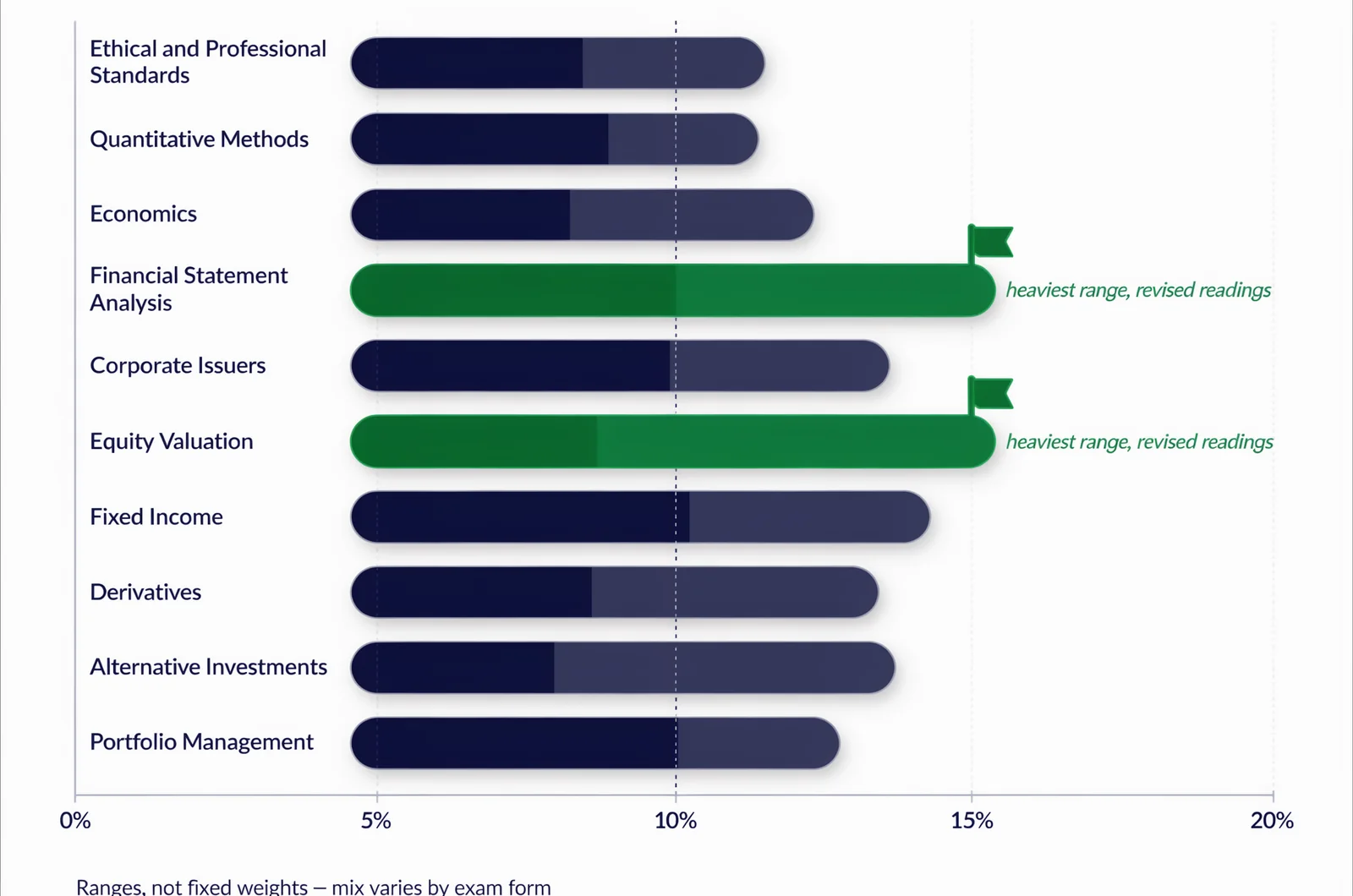
The areas worth your closest attention in 2026:
Financial statement analysis and equity. These two areas have historically carried the heaviest weight at Level 2, and the curriculum's continued emphasis on valuation modeling keeps them at the center of the exam. The 2026 readings continue the drift toward integrated scenarios: a single vignette may ask you to adjust reported earnings, then feed those adjustments into a valuation output. Practicing ratio memorization alone will not carry those items.
Fixed income and derivatives. Level 2 is where fixed income becomes genuinely quantitative, with term structure models and credit analysis, and where derivatives move from definitions to pricing and valuation. Candidates consistently report these as the steepest jump in difficulty from Level 1, and the item-set format makes partial knowledge expensive: misread the vignette's setup and you can lose several questions at once.
Portfolio management and the smaller topics. Quantitative methods, economics, corporate issuers, alternative investments, and ethics round out the mix. Ethics at Level 2 is tested through the same item-set format, which surprises some candidates who expected a repeat of the Level 1 standalone style.
The practical read: because weights are ranges, you cannot safely skip a "small" topic. A 5–10% range can still produce a full vignette set on your exam form. The candidates who get hurt are the ones who treat the low end of a range as a zero.
How the 2026 changes affect the way you should practice
Here is the part most news coverage of exam changes skips: the format of the questions matters more than the topic list. Because every Level 2 item hangs off a vignette, the skill being tested is applied reading plus calculation under time pressure. That has three direct consequences for your practice sessions.
First, practice in item sets, not in isolated questions. If your study material drills single standalone questions, it is training a Level 1 skill. Free resources show what the real format looks like: the free CFA Level 2 mock exam published by 300hours, for instance, is structured as 44 questions in the vignette style, which mirrors one exam session. Working a full session under timed conditions tells you far more about readiness than scattered drills.
Second, re-validate any inherited materials. Question banks carry curriculum-year labels for a reason. A bank written for the 2024 or 2025 syllabus can contain items tied to readings that no longer exist, and worse, items whose "correct" answer reflects a standard or treatment the curriculum has since revised. Free repositories such as the CFA Level 2 practice sets at ITExams are useful for volume practice, but check the curriculum year against the current learning outcome statements before treating any answer explanation as authoritative.
Third, use mocks as diagnostics, not just as scores. A timed mock tells you two things: whether your pacing works (88 questions across two sessions leaves a little over three minutes per question, but vignettes consume reading time before you answer anything), and which topic areas collapse under exam conditions. StateRequirement's CFA mock exam guidance for Level 2 makes a similar point: the mock's value is the review pass afterward, where you trace every wrong answer back to either a reading failure or a content failure. Those two failures need different fixes.
One more note on a pattern worth avoiding: search results for exam-year questions surface a growing number of PDF "actual exam" files, such as the free CFA Level II question PDFs circulating on file-sharing prep sites. Beyond the obvious quality and accuracy problems, using actual recalled exam content violates CFA Institute's testing policies and can end a candidacy. Independently authored practice questions, the kind built to teach the concept rather than replicate a remembered item, are the safer and more effective route. That is the model Quizra's question library follows across its certification catalogs: original items aligned to current objectives, with explanations written to build understanding rather than pattern-match a leaked answer.
What the changes mean for different candidate situations
The impact of the 2026 cycle is not uniform. Where you sit in the program changes what you should do now.
First-time Level 2 candidates. Your main risk is underweighting the format shift from Level 1. Build item-set practice into your routine from week one rather than saving it for the final month. A reasonable split: roughly 60% of study time on curriculum content, 40% on question practice, with the question share rising as the exam window approaches. If you study in short windows around work, structure sessions around one vignette at a time; a single item set with full review fits into 20 minutes.
Retakers. Audit your existing materials against the 2026 learning outcome statements before resuming. Anything from a prior attempt year should be treated as suspect until checked. Your advantage is familiarity with the format; spend it on the topic areas where your previous score report showed weakness, not on re-reading the sections you already know.
Candidates planning beyond Level 2. The Level 2 pass moves you to the constructed-response world of Level 3, which is a different writing and time-management problem entirely. If you are thinking ahead, Quizra's CFA Level 3 questions give you a preview of how the final level's practice differs. Candidates comparing finance credentials more broadly sometimes also weigh wealth-management designations; the CWM Level 1 questions in the same library show how that curriculum's emphasis differs from the CFA track.
A useful adjacent tool idea for this stage: a simple study-hours estimator that takes your exam date, available weekly hours, and self-rated topic confidence, then allocates hours across the ten topic areas proportional to their weight ranges. It converts "I should study more fixed income" into a number you can put on a calendar.
Timeline and what to watch next
CFA Institute releases curriculum updates on an annual cycle, with the curriculum for a given exam year published well ahead of the first testing window so candidates can plan. Registration, scheduling, and any fee or policy adjustments are announced through CFA Institute's official candidate resources, and those announcements are the dates that matter; third-party blogs frequently lag or misreport them.
For the remainder of the 2026 cycle, the items worth monitoring are:
- Any mid-cycle errata to the 2026 curriculum readings. CFA Institute publishes corrections between cycles, and a corrected reading can change what a "correct" answer looks like on a practiced item.
- Updates to the topic-weight ranges or exam policies published in candidate bulletins. These are infrequent within a cycle but not unheard of.
- The release schedule of official mock exams in the CFA Institute learning ecosystem, which historically appear in the months before each window and are the closest available approximation of the real interface and difficulty.
If CFA Institute publishes further 2026-specific clarifications, this article's analysis sections should be revisited against the new statements. The confirmed-format facts above are stable; the weight-range interpretation is only as current as the latest published ranges.
Questions candidates are asking about the 2026 Level 2 exam
Are Level 2 questions harder than Level 1? Most candidates find them harder, but for a specific reason: the vignette format means one misread scenario can sink four to six questions at once. The content is deeper, but the format amplifies every content gap.
How many practice questions should I complete before the exam? There is no official number. A common working target among candidates is 2,000 to 3,000 practice items plus at least two full timed mocks, but quality of review matters more than raw count. Tracing every miss back to its cause is where the learning happens.
Can I use 2025 materials for the 2026 exam? Only after checking them against the 2026 learning outcome statements. Format practice (pacing, vignette reading) transfers fine. Content-specific items need re-validation because readings and treatments change between cycles.
What is the best free way to experience the real format? A full timed mock built in the vignette style. The 44-question mock from 300hours linked above mirrors one session's length and structure, and CFA Institute's own ecosystem materials are the authoritative version.
Keep studying with these pages
Click through to browse exams and begin a practice session. Get started → |