Green Belt vs Black Belt: Which Exam Questions Should You Tackle First
If you are weighing green belt vs black belt certification, the question that actually decides it is simpler than the belt chart suggests: which exam questions can you answer today, and which ones would you need a year of project work to answer honestly? Six Sigma Green Belt test questions and answers sit at the application level — you read a scenario, pick a tool, and interpret a result. Black Belt questions assume you have already led that work and can defend the statistics behind it.
This list ranks the certification paths by how well their question sets match different readers, not by prestige. Each entry covers why it earns its position, who it fits, where it falls short, and what to do about it.
How We Ranked These Certification Paths
The ranking principle is question-readiness. A path ranks higher when the exam questions it demands line up with the experience you already have, so your study time converts into correct answers instead of catch-up.
Four criteria drove the order:
- Question complexity. Does the exam ask you to recall a definition, apply a tool, or interpret output from a real project?
- Statistical depth. How much of the scored exam depends on hypothesis tests, control charts, capability indices, and regression?
- Study time to readiness. How long a working professional needs before practice scores stabilize.
- Career payoff per hour invested. What the credential unlocks relative to the effort it costs.
Two structural facts shape everything below. The ASQ Certified Six Sigma Green Belt (CSSGB) is a lifetime certification with no recertification requirement, while the Certified Six Sigma Black Belt (CSSBB) is maintained on a three-year cycle by earning 18 recertification units or retaking the exam, according to From Six Sigma Green Belt. That difference alone changes the total cost of each path.
1. ASQ CSSGB: The Best First Target for Most Candidates
The ASQ Green Belt exam is the most sensible starting point because its question format rewards understanding rather than tenure. The computer-delivered version contains 110 multiple-choice questions, 100 of which are scored, with a total appointment time of four and a half hours. A paper-and-pencil version runs 100 questions in four hours. Passing requires a scaled score of at least 550 out of 750.
The domain weighting tells you where the questions cluster. Define and Measure each carry about 20 scored questions, Analyze carries 18, Improve 16, Control 15, and the introductory Overview of Six Sigma and the Organization 11. Define and Measure together account for roughly 40% of the scored exam, which is why candidates who skip project-charter and measurement-system material lose points fast.
What the questions actually look like matters more than the count. A representative Analyze-phase item gives you a two-sample t-test comparing mean cycle times across two shifts with a p-value of 0.04 and asks which conclusion holds at 95% confidence. You do not need to run the math. You need to know that 0.04 falls below 0.05 and what that means for the null hypothesis. That is the level the whole exam operates at.
Who it fits: professionals newer to Lean Six Sigma, or anyone who wants to improve processes inside their current role without changing jobs. Villanova University's guidance puts it plainly: Green Belt may be the better starting point if you are newer to Lean Six Sigma or want a practical way to strengthen your current work.
Limitation: the credential does not authorize you to lead enterprise-wide projects, and some employers treat it as a supporting credential rather than a leadership one. It also never expires, which cuts both ways — there is no renewal pressure, but no forced refresh either.
Verdict: if you are deciding where to spend the next eight to twelve weeks, start here. Build fluency on the ASQ Green Belt questions before you commit to anything larger.
2. IASSC ICGB: The Lean-Heavy Alternative
IASSC structures its Green Belt exam around the same DMAIC spine but leans harder into Lean tools and waste analysis, and it does not require a project affidavit the way ASQ does. For candidates whose day job is process flow, takt time, and value-stream mapping rather than statistics, the question mix feels more familiar.
The tradeoff is recognition. ASQ is the body most often named in job postings, and its question bank is built from the same Body of Knowledge that shapes the exam. IASSC carries weight in manufacturing and continuous-improvement circles, less so in regulated industries that name ASQ explicitly.
Who it fits: operations and manufacturing professionals in Lean-mature organizations, or anyone whose employer already sponsors IASSC training.
Limitation: fewer employers list it by name, so you may need to explain the equivalence in interviews.
Verdict: a strong second choice, and a reasonable first if your employer's training program already points there. Sample the IASSC Green Belt questions to see whether the phrasing matches how you think about process work.
3. ASQ CSSBB: The Right Move Only After a Real Project
Black Belt questions change category, not just difficulty. Where Green Belt asks you to interpret a single test result, Black Belt asks you to design the study, choose between competing designs, and defend the tradeoffs. Expect heavier coverage of design of experiments, multiple regression, measurement systems analysis, and the organizational side of deploying improvement across functions.
There is also a gate. The CSSBB application requires an affidavit attesting to years of full-time, paid work experience in areas of the Black Belt Body of Knowledge, and that affidavit confirms a real project happened with a real result verified by someone accountable. You cannot study your way past that requirement.
The maintenance obligation compounds it. Because the CSSBB sits on a three-year recertification cycle, an employer may reasonably ask whether a listed Black Belt is still active. That is a fair question and you should have an answer ready.
Who it fits: professionals who already hold a Green Belt, have led improvement projects end to end, and are moving into roles where they coach other belts.
Limitation: the highest study investment on this list, plus an experience requirement that no course can satisfy. Booking the exam before you have the project is the most common sequencing error.
Verdict: pursue it after the project, not before. Use ASQ Black Belt questions as a readiness check — if the experimental-design items read like a foreign language, you have your answer about timing.
4. IASSC ICBB: Lean Leadership With Lighter Paperwork
IASSC's Black Belt track mirrors its Green Belt philosophy: DMAIC depth, Lean emphasis, and no formal project affidavit. Candidates who already lead improvement work but lack the documentation trail ASQ wants often find this path faster to complete.
The statistical ceiling is comparable, so do not treat it as an easier exam. The difference is administrative, not intellectual.
Who it fits: experienced improvement leads in Lean-centric organizations, particularly those who have been doing Black Belt work without the title.
Limitation: the same recognition gap as ICGB, amplified at a more senior level where hiring managers scrutinize credentials.
Verdict: a legitimate route when your project history is real but poorly documented. Test the water with IASSC Black Belt questions.
5. Lean Six Sigma Green Belt: The Blended Entry Point
Lean Six Sigma Green Belt programs merge waste elimination with variation reduction, and the exam questions reflect both. You will see value-stream mapping next to control charts, and 5S next to process capability. For organizations that never separated the two methodologies, this framing matches the job.
Quality varies widely across providers, which is the main risk. Some programs are rigorous; others are a certificate and a quiz. Check the question count, whether explanations accompany answers, and whether the blueprint maps to a published Body of Knowledge before you enroll.
Who it fits: candidates in organizations that use the combined Lean Six Sigma vocabulary, or anyone who wants one credential covering both toolkits.
Limitation: inconsistent provider quality makes the credential's signal weaker than ASQ's or IASSC's.
Verdict: solid if your employer uses the blended language. Compare the item style against the Lean Six Sigma Green Belt exam before committing.
6. Lean Six Sigma Black Belt: For Scaled Deployment Roles
The Lean Six Sigma Black Belt path targets people who deploy improvement across sites, not just within one process. Questions push toward portfolio selection, benefits tracking, and change management alongside the advanced statistics.
This is the least standardized entry on the list. Without a single accrediting body behind the title, the exam you sit depends entirely on the provider.
Who it fits: multi-site operations leaders and internal consultants.
Limitation: recognition depends on the provider's reputation, and you may need to justify the credential more than an ASQ or IASSC holder would.
Verdict: choose it when your employer's program requires it. Preview the depth with Lean Six Sigma Black Belt questions.
What Green Belt and Black Belt Questions Actually Ask You to Do
The cleanest way to choose is to compare the cognitive demand, not the topic list. Both exams cover DMAIC. They ask different things about it.
| Dimension | Green Belt (CSSGB) | Black Belt (CSSBB) |
|---|---|---|
| Scored questions | 100 of 110 | Higher, with project affidavit required |
| Typical question task | Interpret a given result | Design the study and defend tradeoffs |
| Statistics emphasis | Capability, basic tests, control charts | DOE, regression, advanced MSA |
| Project requirement | Not required for ASQ exam | Affidavit attesting real project results |
| Recertification | None (lifetime) | 18 units every three years or retake |
| Typical study window | 8–12 weeks alongside work | Several months plus project experience |
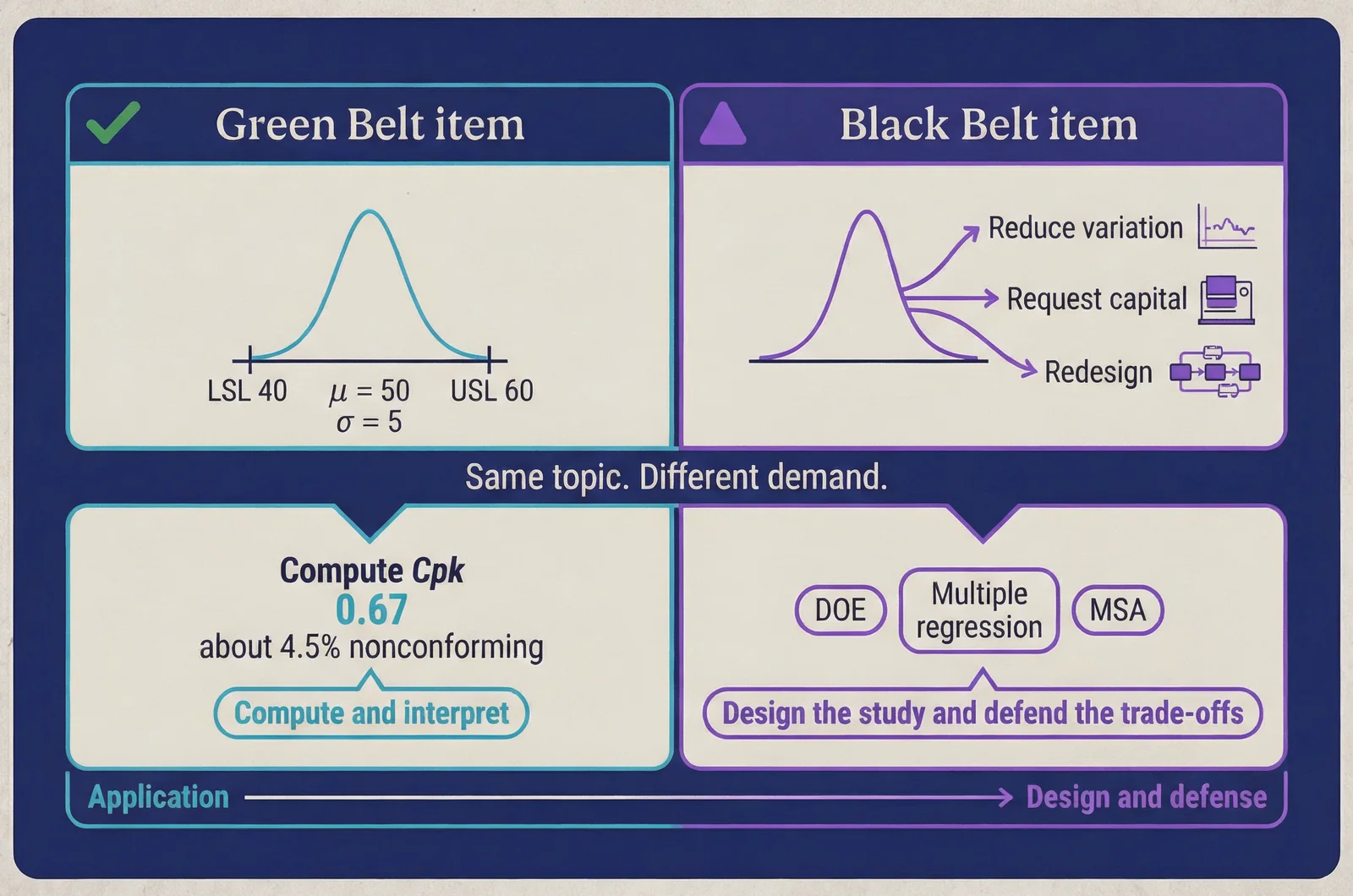
A capability question illustrates the gap. A Green Belt item might give you a process with a mean of 50, specification limits of 40 and 60, and a standard deviation of 5, then ask for Cpk. The answer is 0.67, with roughly 4.5% nonconforming. You compute and interpret. A Black Belt item assumes you already know that and asks whether the process is capable enough to justify the capital request, or whether you should reduce variation first.
That is the real dividing line. Green Belt questions test whether you can read a process. Black Belt questions test whether you can change one and prove it worked.
A Readiness Check You Can Run This Week
Before you register for either exam, run a diagnostic that takes about an hour.
- Take 20 Define and Measure questions cold, timed at roughly 90 seconds each.
- Score yourself, then read every explanation — including the ones you got right.
- Sort your misses into three buckets: forgot the definition, misread the scenario, or never learned the tool.
- If most misses are definitions, you are 6–10 weeks from Green Belt readiness.
- If most misses are scenario misreads, you understand the tools but need timed practice.
- If you hit tools you have never seen, you are looking at Black Belt material and should not register yet.
The bucket that matters most is the third. Definitions you can memorize. Tools you have never applied take project time, not flashcard time.
An interactive readiness estimator would help here: a short selector that asks how many DMAIC projects you have led, which statistical tools you have used on real data, and how many hours per week you can study, then returns a recommended starting belt and a study window. That is the kind of tool that turns a vague decision into a dated plan.
Where Practice Fits Without Turning Into Memorization
The failure mode in Six Sigma prep is treating questions as content to absorb rather than skills to rehearse. Candidates who review 500 items and still miss scenario questions usually memorized answers instead of decision rules.
Three habits fix that:
- Explain the wrong answers. For each distractor, write one sentence on why it fails. If you cannot, you do not understand the tool yet.
- Practice under the clock. The CSSGB gives you roughly 2.5 minutes per question across a 258-minute appointment, which is comfortable until you hit a calculation you have to set up from scratch.
- Revisit missed items after a week. Spacing exposes whether you learned the rule or just recognized the question.
ASQ's own question bank uses two modes — exam simulation and review — and includes three sets of 100 unique questions, each retakeable within a 365-day access window. The structure is deliberate: simulation builds pacing, review builds understanding. Use both, and note that ASQ states its questions are not actual exam questions, so treat any source claiming otherwise with suspicion.
Answering the Questions Candidates Ask Before Registering
Do I need a Green Belt before a Black Belt? Not always. Villanova notes that many professionals benefit from taking Green Belt first because it builds fluency before the broader scope and deeper analysis of Black Belt. If you already have significant process-improvement experience, Black Belt may be a reasonable next step.
How long should I study? Plan 8–12 weeks for Green Belt at 5–7 hours per week. Black Belt takes longer and depends on your project history, which no study schedule can compress.
Is the Green Belt exam open book? The ASQ CSSGB allows your own bound references. That does not make it easy — the constraint is time, not access to formulas.
What score do I need? A scaled score of 550 out of 750 on the ASQ exam. Scaled scoring means raw question counts do not map directly to your result.
Does the Green Belt expire? No. ASQ lists the CSSGB among its lifetime certifications with no recertification requirement. The Black Belt is different: 18 recertification units every three years, or retake the exam.
Which belt should I list on a resume? Whichever you hold, with the certifying body named. "ASQ CSSGB" and "IASSC ICGB" are not interchangeable to a recruiter who knows the difference.
The Shortlist, Ranked
If you want the compressed version: start with ASQ CSSGB unless your employer's program points elsewhere. Take IASSC ICGB if Lean tools dominate your daily work. Move to a Black Belt only after you have led a project with a documented result, and choose ASQ CSSBB when recognition matters most or IASSC ICBB when your project history is real but thinly documented. The blended Lean Six Sigma paths are worth it when your organization already speaks that language.
The deciding evidence is not the belt chart. It is whether you can sit down with a scenario question, identify the tool, and explain why the other three answers are wrong. That skill transfers to the job. Memorized answers do not.
References
- Green Belt or Black Belt? — Green Belt and Black Belt both build valuable problem-solving skills, but they prepare professionals for different levels of responsibility. One helps you apply improvement more
More Six Sigma and Certification Prep
- CSSGB Six Sigma Green Belt Questions
- CSSBB Certified Six Sigma Black Belt Questions
- Lean Six Sigma Green Belt Questions
Click through to browse exams and begin a practice session. Get started → |