HESI A2 Study Guide: What Each Section Actually Tests

HESI A2 Study Guide: What Each Section Actually Tests
The HESI A2 is the gate between you and nursing school, yet most applicants waste weeks studying subjects their program never assigned. Elsevier builds the exam from a menu of subtests, and each nursing program picks its own combination. Two candidates can sit "the same exam" on the same day and answer completely different questions. This guide maps what each section actually covers, how programs use them, and where to spend your limited study hours for the highest return.
Which Sections Will My Nursing Program Actually Require?
Your program decides. The HESI A2 is modular, with up to ten possible subtests available from Elsevier. No national standard exists. One school might require math, reading comprehension, vocabulary, grammar, anatomy and physiology, and biology. Another might drop biology and add chemistry or physics. A third might include only four sections and set its own time limits per section.
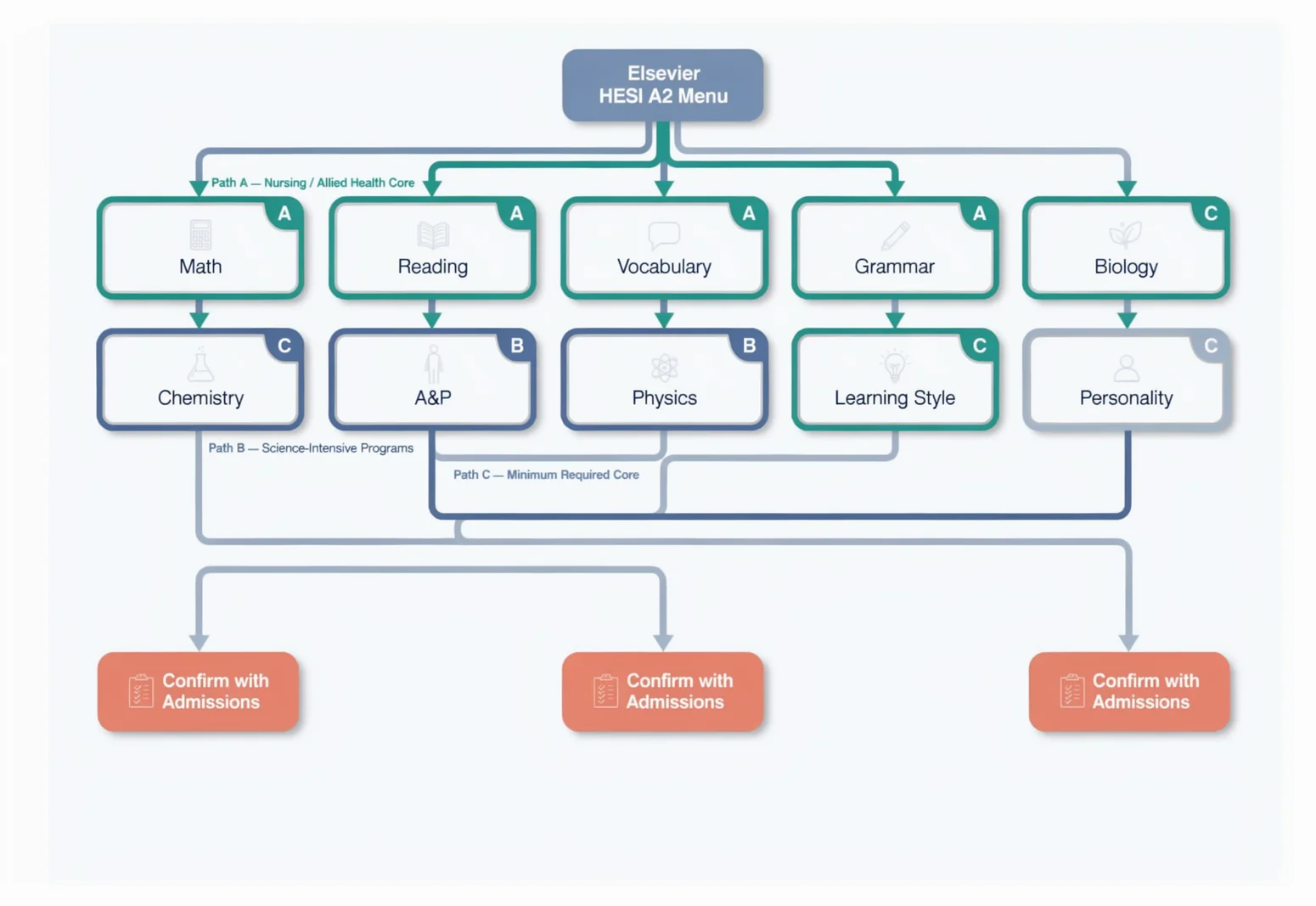
The single most valuable step you can take before opening a textbook is confirming your exact subject list with admissions. Studying a section you were never assigned is the most common way candidates lose a fortnight of prep time. Ask specifically:
- Which subtests are required?
- What are the time limits per section?
- What composite score or per-section minimum does the program use?
- Is the exam proctored on-campus, at a testing center, or remotely through ProctorU?
Remote proctoring through ProctorU using the Guardian Browser alongside Elsevier's Secure Browser has been available since 2026, though on-campus testing with the Secure Browser alone remains common.
What Does the Math Section Cover?
The math section tests clinical calculation readiness, not abstract mathematics. You will see whole numbers, fractions, decimals, ratios, proportions, percentages, and basic algebra. The emphasis sits on operations you will use in medication dosing and IV flow rates: converting between measurement systems, calculating drug quantities, and solving for unknowns in ratio problems.
Calculators are typically permitted, but the time pressure is real. Most programs allow 50 minutes for roughly 50 questions. Speed with unit conversions—especially between metric and household measurements—separates confident scorers from those who run short on time.
Practice tip: Drill dimensional analysis until it is automatic. Set up every conversion as a fraction chain so units cancel cleanly. This method reduces arithmetic errors and catches mistakes before you commit to an answer.
How Hard Is the Reading Comprehension Section?
Reading comprehension presents health-related and general passages followed by multiple-choice questions about main idea, supporting details, inferences, and author's purpose. The passages are not technically dense, but the questions reward careful reading over speed scanning.
Many applicants underestimate this section because the content feels familiar. The trap is subtle: answer choices often include statements that are factually true but not supported by the specific passage. Your task is to answer from the text, not from prior knowledge.
Time management varies by program. Expect roughly 60 minutes for 47 questions. The section rewards students who identify the passage structure quickly—main claim, evidence, qualification—and match each question back to that structure rather than re-reading repeatedly.
What Vocabulary Does the HESI A2 Actually Test?
The vocabulary section focuses on health science terminology and general academic words that appear in nursing textbooks and clinical documentation. You will see terms like "benign," "latent," "proximal," and "diffuse" alongside broader academic vocabulary.
This section offers the highest return per minute of study time. The tested word list is finite and predictable. A focused approach—fifteen new terms daily, reviewed the next morning—builds retention without consuming hours.
"A&P is 30 items in 25 minutes — about 50 seconds per question. It is a recall section, not a reasoning section, which makes it the most predictable part of the whole exam and the best use of your study time."
The same logic applies to vocabulary. Flashcards with the term on one side and a clinical context sentence on the other outperform isolated definitions. For example, learn "latent" through "latent tuberculosis infection shows no symptoms but retains reactivation risk" rather than merely "hidden."
What Grammar Rules Matter Most?
Grammar tests parts of speech, common errors, sentence structure, and punctuation. The questions are practical: identifying subject-verb agreement errors, spotting misplaced modifiers, choosing correct punctuation in compound sentences, and recognizing parallel structure failures.
Nursing documentation demands precision. A misplaced comma in a medication order or an ambiguous pronoun reference in a care plan can create real confusion. The grammar section reflects this clinical priority.
Most programs allocate 50 minutes for roughly 50 questions. Review the most common error patterns rather than attempting comprehensive grammar mastery. Subject-verb agreement, pronoun clarity, and comma splice repair cover the majority of tested items.
What Biology Content Appears on the Exam?
Biology covers cellular biology, metabolism, photosynthesis, genetics, and basic ecology. The depth is introductory—roughly equivalent to a one-semester college course—but the questions assume you can apply concepts rather than merely define terms.
You might need to predict the result of a genetic cross, identify the stage of mitosis from a diagram, or determine which environmental factor most limits a described ecosystem. Memorization alone will not suffice; you need to work with the concepts.
Programs that include biology typically allow 25 minutes for 25 questions. The pace is brisk. Prioritize cellular processes and genetics, which together account for most items.
How Much Chemistry Knowledge Is Required?
Chemistry, when required, tests atomic structure, the periodic table, chemical bonding, equations, stoichiometry, acids and bases, and solutions. The level is again introductory, but the questions require calculation and prediction, not just recognition.
Focus on balancing equations, calculating molarity, and predicting pH changes. These operational skills appear more often than pure recall of periodic trends. Time limits are typically tight—25 minutes for 25 questions—so fluent calculation matters more than encyclopedic knowledge.
If your program does not require chemistry, do not study it. The modular design means chemistry omission is common, and time spent here is time stolen from your required sections.
What Anatomy and Physiology Topics Are Most Testable?
Anatomy and physiology is the most predictable and highest-yield section for most nursing applicants. The body systems are fixed content: skeletal, muscular, nervous, circulatory, respiratory, digestive, urinary, endocrine, reproductive, and integumentary. Each system brings standard terminology, primary functions, and common pathologies.
The section is pure recall at speed—roughly 50 seconds per question across 30 items in 25 minutes. You need instant recognition of structures, hormones, and physiological responses. Flashcards with anatomical diagrams outperform text notes. Label blank diagrams repeatedly until you can identify structures from shape and position alone.
Pay special attention to:
- Heart blood flow and valve sequence
- Nephron structure and urine formation stages
- Synaptic transmission and neurotransmitter roles
- Endocrine gland locations and their secreted hormones
Is Physics Ever Required?
Physics is the least commonly assigned section. When included, it covers mechanics, energy, waves, electricity, and magnetism at a basic level. Most nursing programs omit physics entirely, and even those that include it rarely weight it heavily in admissions decisions.
Confirm with your program before devoting study time here. If physics is required, focus on conceptual understanding over complex calculation. The questions typically test whether you can predict the direction of a force or the effect of changing a variable, not whether you can derive equations from first principles.
What Score Do I Actually Need to Aim For?
There is no national passing score. Each program sets its own benchmark, and the range is wide. Most accredited programs use 75% as an absolute minimum for eligibility. Competitive admissions data from 2025 shows the average admitted student scored 86%, and elite BSN programs at major teaching hospitals report average admitted composites of 91% or higher.
That gap—75% to 91%—represents roughly six additional weeks of focused study for the average prepared candidate. Accurate target-setting matters more than raw effort. Ask your program specifically:
- Is there a minimum composite score?
- Are there per-section floors?
- How does your score compare to last year's admitted cohort?
- How many retakes are permitted, and what is the waiting period?
"Most accredited nursing programs set 75% as the absolute minimum passing benchmark for the hesi a2 exam, but competitive admissions data from 2025 shows the average admitted student scored 86%, and elite BSN programs at major teaching hospitals report average admitted composites of 91% or higher."
How Should I Structure My Study Time?
Begin with a diagnostic. Sit a timed mixed set across all your required subjects, then read every explanation—including for questions you answered correctly. Misunderstood lucky guesses are still weaknesses. An evening spent finding where you actually stand is worth more than an evening revising the subject that merely feels weakest.
Week 1–2: Build foundation in your two weakest subjects using the official Admission Assessment Exam Review, 6th as your primary text. Work through chapter questions and note every rationale.
Week 3: Add vocabulary at fifteen terms daily. This is the highest-return daily habit you can establish.
Week 4: Move to full-length timed sets under realistic conditions. Use HESI A2 practice questions to simulate the pacing and pressure of exam day. Review every explanation, not just errors.
Final days: Light review of flagged items only. Cramming new material in the last 48 hours increases anxiety without improving retention.
What Should I Know About Test Day Logistics?
Registration and availability vary by school. Some programs test frequently; others offer only a few dates per semester. Confirm your Evolve account is active and your testing mode—on-campus Secure Browser or remote ProctorU with Guardian Browser—is approved well in advance.
Bring required identification and arrive early. For remote proctoring, test your equipment, internet connection, and room setup the day before. ProctorU sessions require a clear desk, visible room scan, and uninterrupted internet. Technical failures during check-in are common and stressful; preparation prevents most of them.
Questions Candidates Still Ask
Can I use a calculator on the math section? Most programs permit basic calculators, but confirm with your specific testing center. The on-screen calculator in remote proctoring is standard four-function. Do not rely on calculator speed; fluency with mental estimation helps you catch entry errors.
How long are scores valid? Typically one to two years, but policies vary by program. Ask admissions directly rather than assuming.
Is the HESI A2 harder than the TEAS? The exams test similar content but with different emphasis. The HESI A2 is more modular and program-specific; the TEAS is standardized nationwide. Difficulty depends on your subject strengths and which sections your program requires.
Can I retake if I score below my target? Retake policies are program-specific. Some allow multiple attempts with waiting periods; others limit you to one or two sittings per application cycle. Know this before you test.
Building Toward Exam Day
The HESI A2 rewards preparation that is specific, timed, and explanation-driven. Generic study—hours with a textbook but no practice under pressure—produces familiar content but not fluent performance. The candidates who score competitively are those who simulate exam conditions repeatedly, review every rationale thoroughly, and adjust their focus based on performance data rather than comfort.
Your program's specific requirements are the only requirements that matter. Everything else is noise. Confirm your list, diagnose your gaps, and build deliberate practice around the sections and scores that actually determine your admission.
References
- Admission Assessment Exam Review, 6th — Exam Review, 6th Edition - 9780443114090HESI Admission Assessment Exam Review, 6th Edition! From the testing experts at HESI, this user-friendly guide walks you through the topics
- NursingPrep Central — NursingPrep Central ... HESI A2 Study ... : Every Subject, Free ... # HESI A2 Study Guide Start by finding out which subjects your programme actually assigns. The HESI A2 is built
More Exam Prep Resources
Click through to browse exams and begin a practice session. Get started → |