CFA Level 3 Exam Format: What the Essay Section Actually Tests

CFA Level 3 Exam Format: What the Essay Section Actually Tests
The CFA Level 3 exam is where the program shifts from testing what you know to testing how you apply it. After two levels of multiple-choice questions, candidates face a mixed format: constructed response essays in the morning and item sets in the afternoon. The essay section trips up more candidates than any other part of the exam, not because the material is harder, but because the format demands a different skill entirely. You must synthesize information, justify decisions under constraints, and produce clear, purposeful prose under severe time pressure.
This checklist walks through every structural element you need to verify before exam day. Use it to audit your readiness, spot gaps in your preparation, and understand exactly what graders evaluate when they score your responses.
What the Two Sessions Look Like
The exam runs 4 hours and 24 minutes, split into two equal sessions of 2 hours and 12 minutes each. Every question set—whether essay or item set—carries 12 points. The total exam contains 22 question sets: 11 constructed response (essay) sets and 11 item sets. Only 20 of these are scored; one essay set and one item set are trial questions that do not count toward your result.
Each session mixes the two formats. You might see 6 item sets and 5 essay sets in one session, then 5 item sets and 6 essay sets in the other. This balanced distribution means you cannot afford to be sharp in only one format. The CFA® Program Level III exam page confirms this structure, and the mixed design exists specifically to prevent candidates from front-loading their mental energy on one question type.
The morning session historically carried all essay questions, but the computer-based format now interleaves them. This change matters for stamina management. You will switch between writing prose and analyzing vignettes with multiple-choice options multiple times during a single session.
How the Essay Questions Are Built
Every essay set begins with a vignette describing a client scenario, portfolio constraint, or institutional mandate. The vignette is followed by several sub-questions that require written responses. These responses fall into two categories: word-based constructed responses and calculation-based responses.
The CFA Program Quick Start Guide_Level makes the distinction explicit. Word-based responses ask you to explain, recommend, or justify. Calculation-based responses require you to show your work and arrive at a numerical answer. Both types demand that you address the specific prompt rather than recite general knowledge about a topic.
A typical essay vignette might describe a private wealth client with specific tax constraints, an ethical dilemma involving soft-dollar arrangements, or an institutional portfolio that needs rebalancing after a market event. The sub-questions then isolate specific decisions: calculate the required return, recommend an asset allocation, explain why a particular derivative strategy violates the client's investment policy statement, or justify a trade-off between two competing objectives.
The key shift from Level 2 is this: at Level 2, you selected the correct analysis from given options. At Level 3, you must construct the analysis yourself and present it in a format that a grader can follow quickly.
What Graders Actually Score
CFA Institute uses a structured grading rubric for each essay question. Graders award points for specific elements: correct identification of the relevant concept, proper application to the scenario, and clear presentation of the conclusion. They do not award points for elegant prose or comprehensive background explanations.
The grading process works in layers. A senior grader establishes the rubric before any responses are read. Then multiple graders score subsets of responses, with quality checks to ensure consistency. If your response contains the elements the rubric rewards, you receive points regardless of whether a different grader would phrase the answer differently.
This has practical consequences for how you write. Bullet points are acceptable and often preferable to paragraphs. The CFA Program Quick Start Guide_Level explicitly notes that "meandering prose can potentially hurt your score." Graders read under time pressure; they want to locate your key points without parsing through filler.
For calculation questions, showing your work matters even if your final number is wrong. Partial credit exists for correct methodology with an arithmetic error. No credit exists for a correct number with no visible derivation. Write each step clearly, label your inputs, and state your conclusion in the context of the question asked.
Topic Weightings and Where Essays Cluster
The Level 3 curriculum divides into core topics and a specialized pathway. The 2026 curriculum maintains the structure introduced in 2025, with no changes from the prior year. The CFA® Program Level III exam page lists the current weightings:
| Topic | Exam Weight |
|---|---|
| Asset Allocation | 15–20% |
| Portfolio Construction | 15–20% |
| Performance Measurement | 5–10% |
| Derivatives and Risk Management | 10–15% |
| Ethical and Professional Standards | 10–15% |
| Pathway (Portfolio Management, Private Markets, or Private Wealth) | 30–35% |
The pathway you select during registration determines roughly one-third of your exam content. The three options are Portfolio Management, Private Markets, and Private Wealth. Each pathway applies the core curriculum to a specific professional context, and the essay questions reflect that context. A Private Wealth pathway candidate might see estate planning scenarios; a Portfolio Management candidate might face institutional rebalancing under liquidity constraints.
Essay questions cluster heavily in portfolio construction, asset allocation, and the pathway content. These are the synthesis-heavy topics where explaining your reasoning matters more than identifying a correct formula. Ethics essays appear regularly too, often presenting situations that require you to cite specific Standards and explain how they apply.
The Standards of Practice Handbook remains the primary reference for ethics preparation. The 12th edition contains the guidance and examples that inform exam questions, and familiarity with its structure helps you reference standards precisely in your responses.
Time Allocation: The Make-or-Break Calculation
With 132 minutes per session and mixed question formats, time management requires a personal plan rather than a universal rule. The exam does not pause between questions. You must budget, execute, and move on.
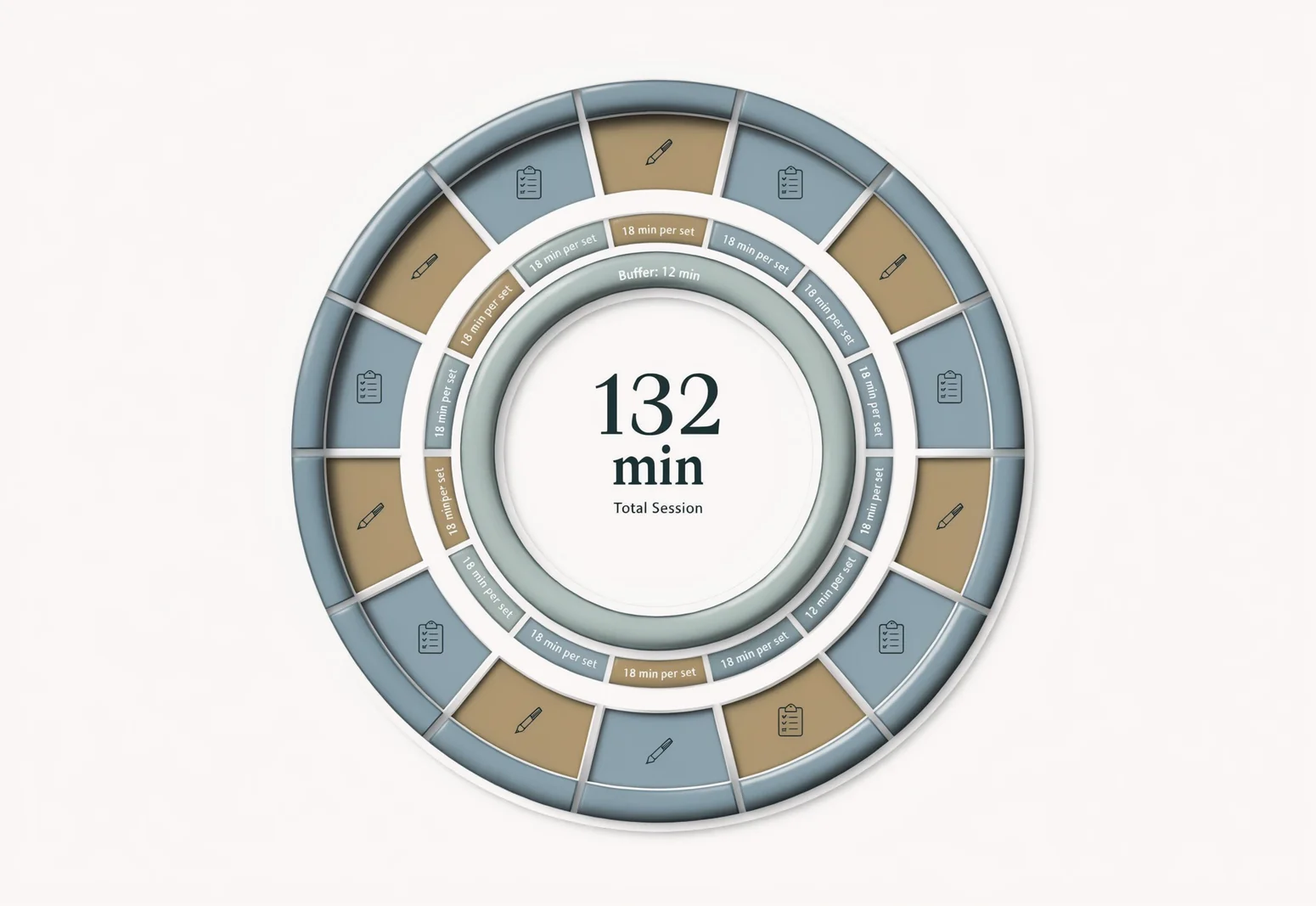
A practical approach: allocate roughly 18 minutes per essay set and 18 minutes per item set, since all carry equal points. This gives you a small buffer for review. If an essay question has three sub-parts, divide your time proportionally—perhaps 6 minutes per sub-part—and enforce the limit strictly.
The CFA Program Quick Start Guide_Level advises candidates to "plan how much time you can give each answer and stick with it." If you are stuck, move to a question you can answer confidently and return later if time permits. The computer-based interface allows navigation within a session, though you cannot return to a previous session once it ends.
Many candidates lose points not from ignorance but from incomplete responses. A partially answered essay set where you ran out of time earns fewer points than a complete response with modest depth. Finishing every question is a strategic priority.
How to Practice for the Essay Format
Reading about essay questions does not prepare you to write them. You need repeated practice with the specific constraints: timed conditions, vignette-based prompts, and the physical or digital act of producing prose under pressure.
The most effective practice mimics exam conditions. Use official CFA Institute mock exams and past essay questions released from prior years. Write your responses by hand or in a text editor with no spell-check, depending on how you will take the actual exam. Time yourself strictly. Review your answers against the published guideline answers, not to match them word for word, but to identify which rubric elements you hit and which you missed.
For calculation practice, focus on presentation. A grader should see your formula, your inputs, your computation steps, and your conclusion without searching. Practice stating assumptions explicitly when the vignette leaves room for interpretation.
For word-based responses, practice the discipline of answering exactly what is asked. If the question asks you to "explain one advantage," give one advantage, not three. If it asks you to "justify your recommendation," explain why your choice fits the client's constraints, not why the alternative is wrong in general.
The CFA Institute official vendor page on Quizra provides context on the organization that designs these questions, which helps candidates understand the exam's professional orientation.
Common Essay Pitfalls to Audit Before Exam Day
Run through this checklist in the final weeks of preparation. Each item represents a failure mode that costs candidates points they could have earned.
Answer the question asked, not the question you prepared for. Essay prompts are specific. A question about "tax-aware withdrawal sequencing" is not an invitation to discuss tax-efficient investing broadly. Read the prompt twice before writing.
Show calculation work even when the final answer seems obvious. Partial credit protects you against arithmetic slips. No work means no protection.
Use bullet points when they improve clarity. Graders scan for content, not style. Dense paragraphs hide your points.
State assumptions explicitly when the vignette is ambiguous. This demonstrates professional judgment and can earn points even if your assumption differs from the grader's expected case.
Manage time per sub-question, not per vignette. A 12-point essay set with four sub-parts deserves roughly equal time per part unless the point allocation specifies otherwise.
Practice with the interface you will use. If your exam center uses a specific software for constructed response, simulate that environment. Typing speed and formatting tools matter.
Review ethics scenarios from the Standards of Practice Handbook. Ethics essays require precise standard identification and application. Vague references to "professionalism" earn no points.
Verify your pathway materials separately. The 30–35% pathway weighting means substantial exam content depends on your chosen specialization. Do not neglect this material in favor of core topics.
The 2026 Exam Context: Pass Rates and Timing
The February 2026 Level 3 exam saw 11,269 candidates sit for the test, with an overall pass rate of 50%. First-time test takers passed at 59%, while candidates with at least one deferral passed at 34%. The ten-year average pass rate stands at 51%, so the 2026 result aligns closely with historical norms.
These numbers matter for planning. Level 3 is not materially easier than earlier levels despite the higher pass rates historically associated with it. The candidate pool at Level 3 is self-selected for persistence and preparation quality, which explains much of the difference. The exam itself tests deeper synthesis, and the essay format introduces execution risk that multiple-choice exams avoid.
The 2026 curriculum is identical to 2025, which was the first year of the three-pathway structure. CFA Institute has indicated this stability is intentional, giving candidates time to adapt to the new format without simultaneous curriculum changes. If you are retaking or using slightly older materials, verify that your resources reflect the pathway structure rather than the pre-2025 unified curriculum.
What to Verify in Your Final Week
In the days before the exam, shift from learning new material to confirming operational readiness. Check your exam confirmation, travel time to the test center, and identification requirements. Confirm which pathway you registered for and that your practice materials match.
Review a small set of representative essay questions you have already answered, focusing on your strongest and weakest responses. Note the pattern in what you missed: Was it time pressure? Misreading the prompt? Calculation presentation? Ethics standard identification? Target your final review on the pattern, not on covering more content.
Sleep and arrival logistics matter more than last-minute cramming for an exam this long. Four and a half hours of sustained focus, with the cognitive load of switching between essay and item-set formats, requires physical readiness.
Questions Candidates Still Ask
How much does the essay section count toward my total score?
The exam does not publish separate session scores. All 20 scored question sets contribute equally to your result, regardless of format. Each set is worth 12 points, so essays and item sets have identical weight in the final calculation.
Can I use bullet points in essay responses?
Yes. The CFA Institute materials explicitly note that bullet points are acceptable. Use them when they improve clarity and help graders locate your key points quickly.
What happens if I run out of time on an essay question?
Move on. Incomplete responses earn fewer points than complete responses across all questions. The computer-based interface allows you to flag questions and return if time permits, but do not sacrifice a full question set to polish an incomplete one.
How do I choose between the three pathways?
Select based on your career trajectory. Portfolio Management suits traditional asset management roles. Private Markets fits private equity, venture capital, and real estate investment. Private Wealth targets individual client advisory and family office work. The core curriculum is identical; only the pathway-specific content differs.
Are 2025 study materials valid for 2026?
Yes. The 2026 Level 3 curriculum is unchanged from 2025. If your materials reflect the pathway structure introduced in 2025, they remain current.
Exams and Study Paths Worth Exploring
- Series 6 vs Series 7 comparison
- CFA Institute official vendor page
- Comparing Official And Unofficial GMAT Practice Questions
Click through to browse exams and begin a practice session. Get started → |