How Many ACT Test Questions Are on Each Exam Section?
The current ACT test questions total 131 across the three core sections, or 171 if you take optional Science. English has 50 questions, Math has 45, and Reading has 36. Science adds 40 questions; optional Writing adds one essay. This breakdown follows the shorter format documented in ACT’s 2025–2026 materials. Use the counts and time limits below to choose matching practice materials, set your section timers, and understand why older guides give different answers.
How many questions are on the current ACT?
The ACT core contains 131 multiple-choice questions and takes 125 minutes of standard testing time, excluding breaks and administrative procedures.
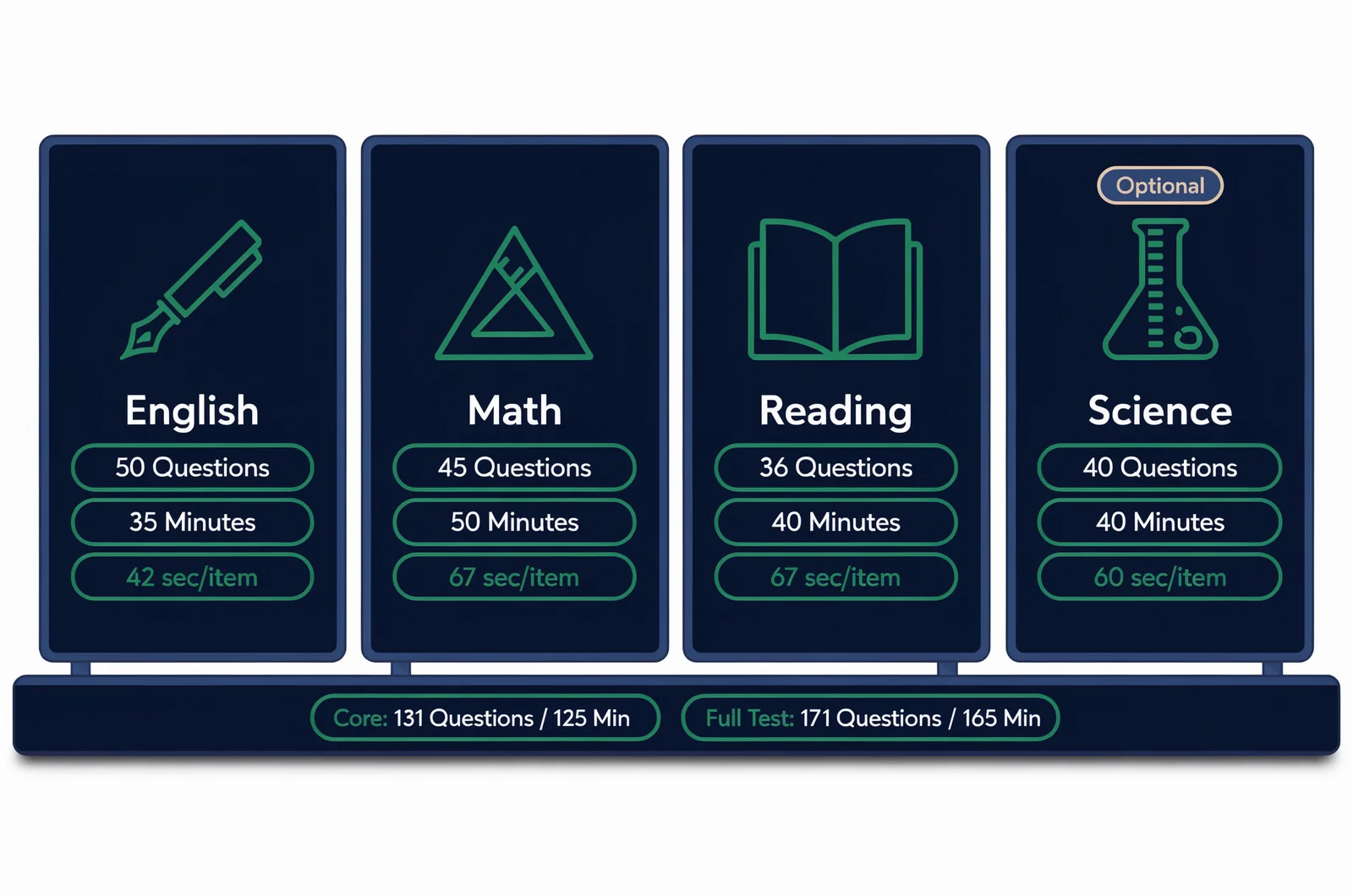
The section breakdown is:
| Multiple-choice section | Questions presented | Standard time | Average time per question |
|---|---|---|---|
| English | 50 | 35 minutes | 42 seconds |
| Math | 45 | 50 minutes | About 67 seconds |
| Reading | 36 | 40 minutes | About 67 seconds |
| Science, optional | 40 | 40 minutes | 60 seconds |
Question counts and standard limits follow ACT’s 2025–2026 preparation guide. The averages are calculated from those limits and include time spent reading passages or interpreting information.
Taking Science brings the multiple-choice total to 171 questions and 165 minutes, or 2 hours and 45 minutes. Writing is a separate essay section.
Treat these averages as planning figures. A short English correction may take less time than an organization question. Reading requires time with the passage before you can answer its questions.
The counts describe everything presented, including embedded questions that do not contribute to your score. For timed practice, complete the full section. If you have approved testing accommodations, use your assigned limits.
Why do older ACT guides list 215 questions?
Older guides describe the previous ACT format, which had 215 questions across English, Math, Reading, and Science.
The older breakdown was 75 English questions, 60 Math questions, 40 Reading questions, and 40 Science questions. Its standard section limits were 45, 60, 35, and 35 minutes, respectively. ACT’s older practice booklet, identified as a 2023–2024 resource, shows that structure.
Those numbers explain conflicting search results. A worksheet can contain legitimate practice material while using an earlier section length.
Older questions can still support focused skill review. Use a grammar item to examine punctuation or a math item to practice setting up an equation. However, a complete older form will give you a different timing experience.
Also compare equivalent totals. The current 131-question figure excludes optional Science; the older 215-question figure includes Science. The current total with Science is 171.
Before starting a timed rehearsal, check the question count and time limit printed on each section. Keep older forms labeled separately in your study folder so you can interpret their results correctly.
How many questions are in ACT English?
ACT English has 50 multiple-choice questions to complete in 35 minutes, an average of 42 seconds per question.
The section asks you to edit passages, including decisions about punctuation, grammar, wording, and organization. ACT’s official English practice section shows how questions connect to portions of a passage.
For practice, separate the editing decision from the surrounding topic. Ask what the item requires: a sentence correction, a clearer expression, or a decision about the passage’s purpose.
Consider this original practice illustration: The list of topics is long. The singular subject is list, so is agrees with it. The nearby plural noun topics does not determine the verb. Explaining that relationship makes the answer useful beyond one question.
An explanation-based library such as Quizra’s independently authored question collection can support that review habit. When checking an English answer, identify the rule or editing goal, then apply it to a fresh sentence.
For a simple practice checkpoint, see whether you have reached roughly question 25 after about 17½ minutes. This is an even-pace reference, not an official requirement.
If you fall behind, inspect the cause afterward. Did you reread the whole passage unnecessarily, struggle with a particular rule, or spend too long comparing two choices? Record the specific cause beside the missed item before your next session.
How many questions are in ACT Math?
ACT Math has 45 multiple-choice questions and a 50-minute standard time limit.
That works out to about 67 seconds per question. The current section uses four answer choices, and a permitted calculator may be used. ACT’s official Math practice section includes problems involving algebra, functions, geometry, and other mathematical skills.
Use the average to monitor a group of questions rather than imposing the same deadline on every problem. Straightforward calculations can leave time for longer solutions.
A useful practice routine is to identify the requested quantity before calculating. Write down what the answer must represent, then work toward it.
For an original illustration, suppose a question gives 2x + 3 = 11 and asks for 2x. Solving gives x = 4, but the requested answer is 8. Circle the requested expression in practice so an intermediate result does not become your final answer.
Calculator use deserves its own review. Check whether you entered the correct expression and whether the result answers the question. Repeating a calculation cannot repair a mistaken setup.
After a timed set, classify each missed problem by what interrupted the solution:
- You did not recognize the mathematical relationship.
- You chose a workable method but made an arithmetic error.
- You solved for the wrong quantity.
- You knew a method but could not finish in time.
Choose the next drill from that diagnosis.
How many questions are in ACT Reading?
ACT Reading has 36 multiple-choice questions and a 40-minute standard time limit.
The average is about 67 seconds per question, including passage-reading time. Budgeting that entire amount for each answer choice would leave no allowance for understanding the text.
ACT’s passage-based Reading examples illustrate questions about a narrator’s point of view, reasonable inferences, and a paragraph’s purpose. That older example page is useful for question style; its displayed section timing belongs to the earlier format.
For current timed practice, use the 36-question, 40-minute structure.
Keep passages and their question sets together when possible. A handful of isolated questions cannot show how much time you spend understanding the text and locating evidence.
During review, identify the passage detail that supports the correct answer. Then explain why your selected answer fails. It might go beyond the text, confuse two viewpoints, or describe something true but irrelevant to the question.
For a hypothetical inference question, imagine a character repeatedly postpones an uncomfortable conversation. An answer about reluctance may fit the described behavior. An answer assigning an unrelated motive would require evidence the passage has not supplied.
Avoid turning your notes into a complete passage summary. Write a brief reminder of its main purpose and where supporting details appear.
When you practice again, track both total time and accuracy. Compare whether a faster first reading actually leaves you enough understanding to answer without repeated searches.
How many questions are in ACT Science, and is it optional?
ACT Science is optional in the shorter format and adds 40 multiple-choice questions with a 40-minute standard limit.
The section uses scientific passages and associated questions, including information presented through data and experiments. Calculators are prohibited in Science, as stated in ACT’s official Science practice section.
Whether you should take it depends on your testing arrangements and application plans. Check your registration or school’s testing instructions, then review the requirements of colleges on your list. Record that decision before building your full practice schedule.
The section’s average is 60 seconds per question, including time spent understanding the supplied information.
For practice, begin by identifying what a question asks you to compare or retrieve. Check graph axes, units, table headings, and the conditions described in an experiment.
In a hypothetical table, one row might report a measurement at 20°C and another at 30°C. If the question asks about 30°C, locate that row before calculating or interpreting anything. A correct calculation using the wrong row still produces the wrong answer.
When reviewing an experiment question, distinguish what changed from what was measured. Write those two things in separate notes if you keep mixing them up.
For questions comparing explanations, summarize each explanation briefly before evaluating the choices. Keep the explanations attached to their authors or labels.
If Science is part of your planned ACT, include its complete timed section in rehearsals.
Does ACT Writing add more multiple-choice questions?
ACT Writing adds one essay, with a 40-minute standard limit; it does not add another multiple-choice question set.
ACT’s Writing section description explains that the prompt presents an issue and perspectives for you to address.
Adding the essay produces these testing-time totals:
- Core sections plus Writing: 165 minutes, or 2 hours and 45 minutes.
- Core sections plus Science and Writing: 205 minutes, or 3 hours and 25 minutes.
These totals exclude breaks and administrative time. Leave room in your test-day schedule for the full appointment.
Prepare for Writing with a complete prompt and a timed response. Multiple-choice English practice cannot show whether you can plan, develop, and revise an essay within the limit.
In a practice session, decide how much time to reserve for planning and checking your response. Afterward, examine whether your position is clear and whether each paragraph supports it.
Confirm your Writing selection before choosing the length of your next full rehearsal.
Are all ACT questions included in your score?
Some ACT questions are unscored field-test items, although they remain part of the section you must complete.
The 2025–2026 guide lists 40 scored English items, 41 scored Math items, 27 scored Reading items, and 34 scored Science items. The field-test questions are not identified during the actual test. ACT also states that there is no penalty for guessing. These details appear in its question-count and scoring guidance.
The practical instruction is to attempt every question within the section’s allowed time. Trying to identify experimental items gives you no reliable basis for deciding what to skip.
When scoring a released practice form, follow that form’s answer key and conversion instructions. Use the scored items identified there for its score calculation.
Keep two separate review records if helpful. One can track your result according to the booklet’s scoring instructions. The other can track learning needs across every question you attempted.
An unscored practice item can still reveal a misunderstood rule, a reading error, or a slow calculation. Review it for that purpose.
For your next timed session, use the number of questions presented as your workload. Use the answer key’s scoring instructions after the timer stops.
How can you use the section counts to plan ACT practice?
Use complete sections to rehearse timing and smaller question sets to examine specific errors.
A short session can help you understand a grammar rule or practice interpreting a graph. A complete section lets you observe how that skill holds up across the full workload.
Keep those purposes visible in your study log. Record whether a session was focused review or a timed rehearsal, along with the section and resource used. That makes results easier to compare.
What can you accomplish in a short study window?
Choose one question type, attempt a manageable set, and leave time to explain your decisions.
For a hypothetical 15-minute session, you could:
- Spend two minutes reviewing an error from your previous session.
- Spend seven minutes answering fresh questions on the same skill.
- Spend five minutes checking explanations and identifying remaining gaps.
- Spend one minute recording what to revisit.
Adjust that split to the material. A passage-based task may need a longer uninterrupted window than a few sentence corrections.
With explanation-based practice such as Quizra’s library, write down your reasoning before reading the explanation. Then compare the two. Check that the material matches the specific assessment you are preparing for.
Review correct guesses as well as wrong answers. A correct choice with uncertain reasoning gives you a useful study target.
End the session with one concrete note, such as review subject–verb agreement when a phrase separates the subject and verb.
When should you complete a whole timed section?
Complete a whole section when you need to measure pacing, endurance, or the effect of difficult questions on later answers.
Use a current-format form and the applicable time limit. Choose paper or screen practice to match your planned delivery format, and keep section timers separate.
Record how far you reached, which questions you rushed, and where you spent more time than expected. During review, distinguish a knowledge gap from a pacing problem. They need different practice.
Once individual sections feel manageable, rehearse the complete combination you plan to take, including selected optional sections.
A useful pacing calculator would accept a section, remaining questions, and minutes left, then display the average seconds available per question. Treat that figure as a practice checkpoint rather than a deadline for every item.
Schedule your next session around the clearest weakness in your review notes.
Where can you compare ACT and SAT scores?
The concordance article below addresses score comparisons between the two college admissions tests.
Click through to browse exams and begin a practice session. Get started → |