Server+ (v5) Practice Questions
Prepare for SK0-005 with more than an answer.
Unlock the full exam and previous versions
- v1Version 1 277 questions Current
- SK0-004Legacy CompTIA Server+ (v4) 606 questions Locked
- Exam fee
- $369 USD
- Level
- Professional
- Valid for
- 3 years
Domains covered on the exam 4
- Server Hardware Installation and Management18%
- Server Administration30%
- Security and Disaster Recovery24%
- Troubleshooting28%
- 1
Case Study:
A mid-sized e-commerce company, 'Global Mart', is experiencing rapid growth and needs to overhaul its server infrastructure to improve performance, reliability, and security. Their current setup consists of several aging physical servers co-located in a single data center.
Current Environment:
- Web Tier: Two physical Apache servers behind a hardware load balancer.
- Application Tier: A single, powerful physical server running a monolithic Java application.
- Database Tier: A single physical server running a MySQL database.
- All servers are running an end-of-life version of CentOS.
- Backups are performed nightly to a local NAS device using file-level copies.
Business Requirements:
- Increase application availability to 99.99%.
- Improve scalability to handle seasonal traffic spikes (up to 3x normal load).
- Enhance disaster recovery capabilities with an RPO of 15 minutes and an RTO of 2 hours.
- Strengthen security posture by isolating tiers and hardening all systems.
- The new solution must be deployed in their existing data center rack space.
Technical Proposal:
The proposed solution is to virtualize the entire stack on three new high-density host servers. The hosts will form a high-availability cluster. The application will be refactored into microservices running in containers. A new SAN will be purchased for shared storage.Which proposed architectural change is MOST critical for meeting the scalability requirement of handling 3x traffic spikes?
Show answer details
Correct answer: C
While the HA cluster and SAN contribute to reliability, the most critical change for scalability is refactoring the monolithic application into microservices and running them in containers. Containers are lightweight and can be spun up or down rapidly. This allows for horizontal scaling where individual components of the application (e.g., product catalog, shopping cart) can be scaled independently and automatically to handle traffic spikes, which is far more efficient and responsive than scaling a monolithic application on a single server or even as multiple large VMs.
- 2
Case Study:
A mid-sized e-commerce company, 'Global Mart', is experiencing rapid growth and needs to overhaul its server infrastructure to improve performance, reliability, and security. Their current setup consists of several aging physical servers co-located in a single data center.
Current Environment:
- Web Tier: Two physical Apache servers behind a hardware load balancer.
- Application Tier: A single, powerful physical server running a monolithic Java application.
- Database Tier: A single physical server running a MySQL database.
- All servers are running an end-of-life version of CentOS.
- Backups are performed nightly to a local NAS device using file-level copies.
Business Requirements:
- Increase application availability to 99.99%.
- Improve scalability to handle seasonal traffic spikes (up to 3x normal load).
- Enhance disaster recovery capabilities with an RPO of 15 minutes and an RTO of 2 hours.
- Strengthen security posture by isolating tiers and hardening all systems.
- The new solution must be deployed in their existing data center rack space.
Technical Proposal:
The proposed solution is to virtualize the entire stack on three new high-density host servers. The hosts will form a high-availability cluster. The application will be refactored into microservices running in containers. A new SAN will be purchased for shared storage.To meet the RPO of 15 minutes, which technology should be implemented for the MySQL database?
Show answer details
Correct answer: B
A Recovery Point Objective (RPO) of 15 minutes means the company can tolerate a maximum of 15 minutes of data loss. Nightly backups could result in up to 24 hours of data loss. Asynchronous replication continuously copies data to a secondary location with a slight delay. This method is ideal for meeting a low RPO like 15 minutes without the high cost and performance impact of synchronous replication. SAN-level replication is efficient as it operates at the block level, independent of the database.
- 3
True or False: When decommissioning a server that processed sensitive data, performing a standard format of the hard drives is sufficient to meet data sanitization requirements for most compliance standards like NIST 800-88.
Show answer details
Correct answer: B
False. A standard format (or quick format) only deletes the file system's pointer table, leaving the actual data on the disk platters recoverable with specialized software. Compliance standards like NIST 800-88 require more robust methods such as cryptographic erase, multiple-pass overwriting (purging), or physical destruction (e.g., shredding, degaussing) to ensure data is truly unrecoverable.
- 4
An administrator is configuring a new VMware ESXi host. To provide network redundancy and increased throughput for virtual machine traffic, the administrator plans to team two physical 10GbE NICs. Which vSwitch configuration option should be used to actively use both uplinks simultaneously for different VMs?
Show answer details
Correct answer: B
The 'Route based on originating virtual port' policy is the default and most common method for load balancing on a vSphere Standard Switch. It pins the traffic from a specific virtual NIC to a specific physical uplink. This ensures that different virtual machines can use different physical NICs, effectively load balancing the traffic across the available uplinks and using them simultaneously. Configuring one NIC as standby provides only failover, not active load balancing. IP Hash requires switch-side configuration (LACP), and MAC hash can cause issues with some switches.
- 5
A server is configured with two power supplies for redundancy. Each power supply is rated at 1100W. The server's typical power draw under load is 800W. Both PSUs are connected to the same PDU, which is connected to a single UPS. Which aspect of power redundancy has been improperly implemented?
graph TD subgraph Rack Server -->|PSU1| PDU Server -->|PSU2| PDU PDU --> UPS end UPS --> UtilityPower[Utility Power]Show answer details
Correct answer: B
While the server itself has redundant power supplies, true redundancy requires eliminating single points of failure throughout the power chain. In this configuration, both the PDU and the UPS are single points of failure. If either the PDU fails or the UPS fails, the server will lose power despite having two PSUs. A proper redundant setup would involve connecting each PSU to a separate PDU, and each PDU to a separate UPS and power circuit (A/B power).
- 6
Which of the following is typical of software licensing in the cloud?
Show answer details
Correct answer: C
- 7
A server administrator wants to run a performance monitor for optimal system utilization. Which of the following metrics can the administrator use for monitoring?(Choose two.)
Show answer details
Correct answer: A, E
- 8
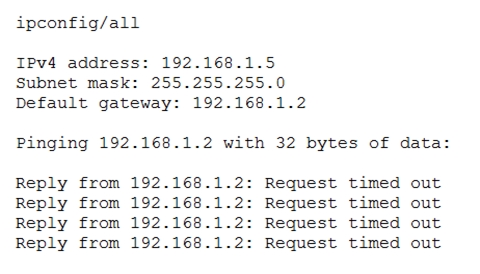
After configuring IP networking on a newly commissioned server, a server administrator installs a straight-through network cable from the patch panel to the switch. The administrator then returns to the server to test network connectivity using the ping command. The partial output of the ping and ipconfig commands are displayed below:The administrator returns to the switch and notices an amber link light on the port where the server is connected. Which of the following is the MOST likely reason for the lack of network connectivity?
Show answer details
Correct answer: D
- 9
A user cannot save large files to a directory on a Linux server that was accepting smaller files a few minutes ago. Which of the following commands should a technician use to identify the issue?
Show answer details
Correct answer: C
- 10
Following a recent power outage, a server in the datacenter has been constantly going offline and losing its configuration. Users have been experiencing access issues while using the application on the server. The server technician notices the date and time are incorrect when the server is online. All other servers are working. Which of the following would MOST likely cause this issue? (Choose two.)
Show answer details
Correct answer: A, B