Best NCLEX-RN Prep Programs, Ranked by Question Quality

Choosing NCLEX-RN prep in 2026 means sorting through a crowded market of full courses, standalone question banks, live review classes, and book bundles that all promise readiness. The price spread alone is wide, from free resources to programs pushing $900, and the marketing language on both ends sounds identical. This ranking cuts through that by judging each major option on the thing that actually builds exam skill: the quality of its practice questions, the depth of its rationales, and how closely its testing experience mirrors the real computerized adaptive exam. If you are a repeat test-taker or a first-time candidate with eight weeks and a full-time job, the right answer is different, and the list below is ordered to help you find yours.
How this ranking was scored
Every program here was assessed on five criteria, weighted toward what the NCLEX-RN actually measures now that the Next Generation NCLEX (NGN) format is standard and the 2026–2029 test plan is in effect as of April 1, 2026.
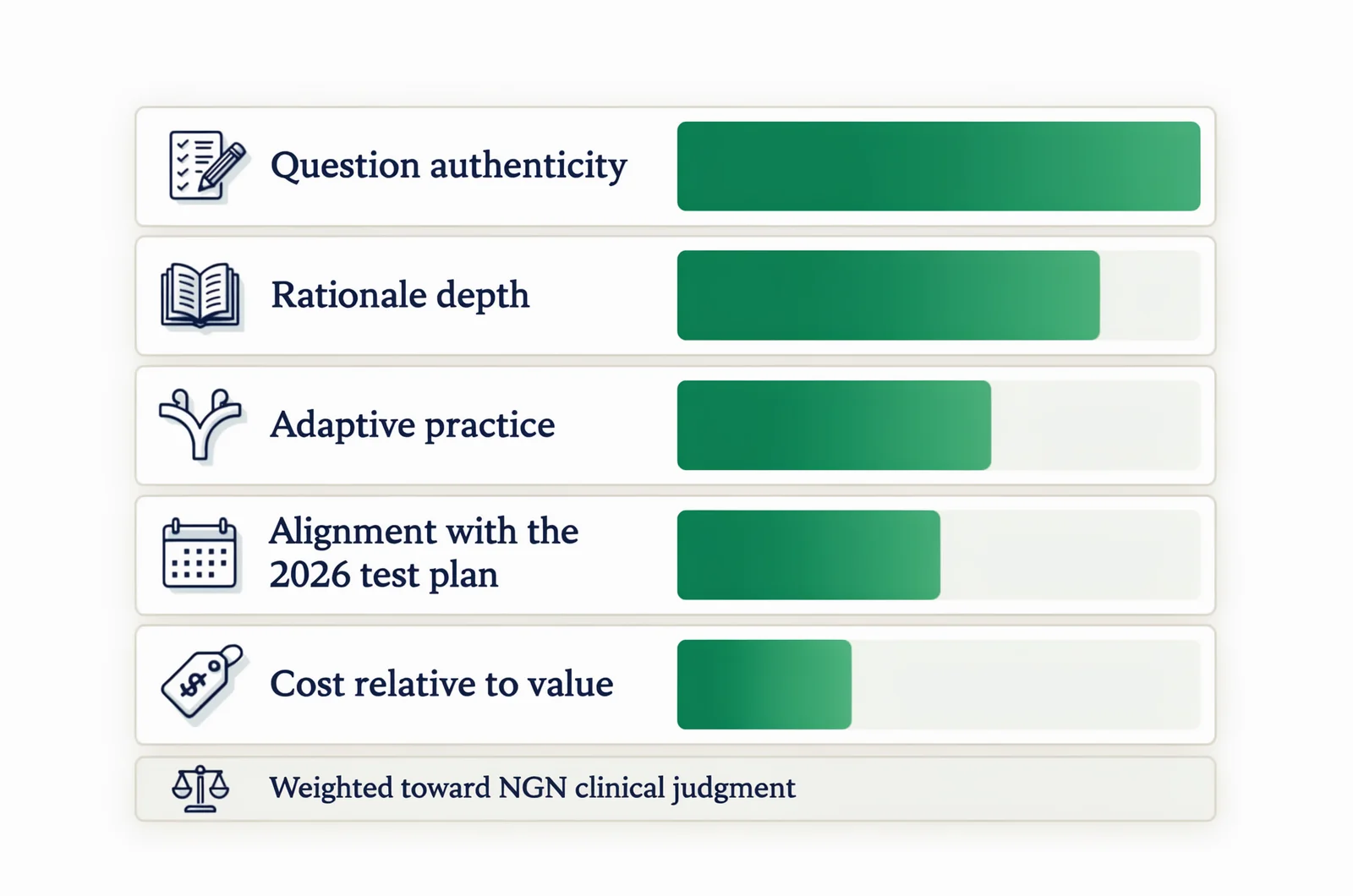
- Question authenticity. Do items read like real NCLEX items, including NGN case studies, bow-tie items, and trend questions, or like textbook recall drills?
- Rationale depth. Does the explanation teach the underlying clinical reasoning, including why wrong answers are wrong, or just restate the correct one?
- Adaptive practice. The real exam is computerized adaptive testing (CAT) with 85 to 150 items in up to five hours. Programs that simulate that behavior score higher than fixed-form quizzes.
- Alignment with the current test plan. The 2026–2029 plan kept the passing standard at 0.00 logits and made mostly minor category wording changes, but stale materials still circulate.
- Cost relative to what you get. A cheaper bank with excellent rationales can outrank a pricey course that leans on lectures.
One honest caveat up front: no commercial product has proven it raises pass rates on its own. A review of the literature on commercial NCLEX-RN preparation products found "no consensus or even pattern of success with any individual product," with schools that improved first-time pass rates typically combining coaching, advising, and curricular changes rather than relying on one tool. Treat any program as raw material for your own study system, not a machine you feed money into.
The ranked list
1. UWorld: the rationale benchmark
UWorld earns the top spot because its explanations are the closest thing the market has to a teaching engine. Each question in its NCLEX prep course comes with a visual, illustrated rationale that walks through the correct answer and dismantles each distractor, which is exactly the skill the NGN clinical judgment items test. The bank covers alternate item types, includes CAT-style self-assessments, and has been the comparison point in nursing student forums for years for a reason: after enough UWorld blocks, real exam questions feel familiar rather than foreign.
Best for: candidates who learn by doing questions and reading deeply, especially repeat test-takers who need to fix reasoning errors rather than content gaps.
Limitation: it is a question bank first. If you need structured content review because your pharmacology or fundamentals are shaky, you will need to pair it with a review book or course, and the subscription price sits at the higher end of the Qbank category.
Verdict: the strongest single purchase for question quality, and the standard every other bank on this list is measured against.
2. Archer Review: the value challenger with unlimited CAT
Archer Review has grown past a million nursing students largely on price-to-quality ratio. Its NCLEX-RN prep package combines a large Qbank with unlimited CAT exams, readiness assessments, and live review sessions, which is an unusual amount of adaptive practice at its price point. The rationales are shorter than UWorld's but direct, and the readiness assessments give a useful signal about whether you are trending toward the passing standard before you book a test date.
Best for: budget-conscious candidates who still want genuine CAT simulation and a structured assessment cadence, and students who like occasional live instruction without paying full-course prices.
Limitation: explanation depth trails UWorld. If your weakness is understanding why rather than recognizing what, you may outgrow the rationales and want a second explanation source.
Verdict: the best value in the category, and the easiest recommendation for someone who wants adaptive practice without a $400 commitment.
3. Kaplan: the structured full course
Kaplan is the most complete program on this list, and its question quality is good rather than best-in-class. Its NCLEX review lineup spans live online classes, a self-paced course option, the Decision Tree method for breaking down clinical judgment items, and the Question Trainer, a sequence of progressively longer practice tests that builds stamina toward the 150-item maximum. The Decision Tree is a genuinely useful framework for NGN-style prioritization and delegation items, and the Kaplan practice tests and questions let you sample the style before buying.
Best for: candidates who want a calendar, classes, and a decision-making method handed to them, and students whose schools bundle Kaplan into the program.
Limitation: rationales are thinner than UWorld's, and the full-course pricing reported across 2026 comparison coverage runs roughly $399 to $899 depending on format. You are paying for structure as much as for questions.
Verdict: pick it if you need the scaffolding of a course; skip it if all you want is the best question bank per dollar.
4. Princeton Review: the familiar self-guided option
The Princeton Review's NCLEX-RN self-paced course brings its admissions-test playbook to nursing: a structured self-guided path, practice drills, and test-taking strategy framing. The strategy content is solid for candidates who freeze on alternate item formats, and the brand's experience with adaptive-style testing shows in how it teaches pacing.
Best for: candidates who already trust the Princeton Review format from other exams and want a clean, guided path rather than assembling their own plan.
Limitation: the nursing-specific question ecosystem is smaller and less discussed in student communities than UWorld or Archer, so there is less third-party validation of how closely its items track the current NGN style. Treat its bank as a supplement rather than your primary reasoning trainer.
Verdict: a competent mid-tier course that makes the most sense for self-paced learners who value structure and strategy coaching over sheer question volume.
5. NCLEX Key and budget newcomers: worth a trial, not a foundation
Newer entrants like NCLEX Key compete on price and modern interfaces, and some deliver respectable NGN-style items. The problem is verification: with a short track record, you cannot easily confirm that item difficulty calibrates to the real passing standard the way established CAT assessments do. If budget is the binding constraint, use a free trial from a newcomer alongside a proven bank rather than instead of one.
Best for: students adding a second question source for variety after exhausting a primary bank.
Limitation: thin evidence base. No long outcome history, smaller item pools, and rationale quality that varies question to question.
Verdict: a supplementary tool, not the program you build your plan around.
Where an independent question library fits
One more category deserves a mention because it matches how many candidates actually study: short, self-paced sessions squeezed around work shifts. Quizra's NCLEX-RN practice questions are independently authored with integrated explanations, designed for exactly those fifteen-minute windows on a break rather than scheduled course modules. It is not a full course with lectures or live classes, so it will not replace content review if your fundamentals need rebuilding. But as a low-friction way to keep question volume high between longer study blocks, or as a second bank to cross-check your reasoning against different item writers, it fills a gap the big programs leave open.
What the 2026 test plan changes mean for your choice
Timing matters for this decision. The 2026 NCLEX-RN test plan took effect April 1, 2026, and the format stayed stable: still 85 to 150 items, still five hours, still CAT, passing standard still 0.00 logits through March 31, 2029, with mostly minor category wording updates. That means two things for buyers. First, any program still marketing around pre-NGN item formats is disqualified immediately. Second, materials built for the 2023–2026 cycle remain largely valid, so you do not need to panic-buy "2026 edition" everything.
The pass-rate context adds urgency. NCSBN quarterly figures show the first-time pass rate for US-educated candidates at 86.8 percent in Q1 2026, near the historical norm, but one analysis of the post-test-plan window reported a dip to 78.9 percent in the April–June quarter right after the new plan took effect. Whether that drop holds or normalizes, the practical lesson is the same: practice aligned to the current plan, with CAT-style pacing, is not optional.
A useful habit before paying for anything: run a free CAT-style assessment first and see where you actually stand. If you are already near the passing standard, a cheap bank plus rationales may be all you need. If you are far below it, that is when a structured course earns its price. A simple readiness-estimator tool, where you plug in your assessment scores and study weeks remaining and get back a suggested resource tier, would make this decision far easier than reading marketing pages.
Matching the program to your situation
Budget and learning style narrow this list fast:
- Under $150, self-motivated: Archer Review, plus free resources for content gaps. Add a second independent bank if you burn through the items.
- Weak fundamentals, first attempt: Kaplan's structured course or a self-paced option paired with a review book, using UWorld-style rationales as your reasoning trainer.
- Repeat test-taker: UWorld. Your problem is almost never content volume; it is the reasoning pattern that rationales expose.
- Working full-time, fragmented schedule: any bank with strong mobile access and short-session design, studied in daily 20-question blocks rather than weekend marathons. Consistency beats intensity for CAT preparation, because the exam rewards calibrated judgment built over hundreds of items.
- Near test date, unsure of readiness: unlimited CAT assessments, taken weekly, are the cheapest honest signal available.
Questions candidates ask before buying
Is one question bank enough to pass? For many first-time candidates with solid nursing school fundamentals, yes, provided you complete most of it and read every rationale, including the ones you answered correctly. The literature on prep products shows no single product drives outcomes on its own, so the differentiator is how you use the explanations, not which logo is on the login page.
How many practice questions should I complete before test day? Common guidance from prep providers and nurse educators clusters around 2,000 to 3,000 questions with full rationale review, spread over six to twelve weeks. Volume without explanation review builds recognition, not judgment.
Do I need a live review course like Hurst or Kaplan's live classes? Only if self-paced study has failed you before or you know you will not follow a solo schedule. Live courses add accountability and content review, not better questions.
Are the 2026 test plan changes a reason to rebuy materials? No. The 2026–2029 plan kept the format, item range, time limit, and passing standard intact, with mostly category wording updates. Materials updated for NGN remain appropriate.
Keep building your question habit
- NCLEX-RN practice questions
- SAT vs ACT score comparison: official concordance table
- CFA Level 3 exam format: what the essay section actually tests
Click through to browse exams and begin a practice session. Get started → |