Free GMAT Practice Questions: A Video Set Solved Step by Step

If you have been hunting for free GMAT practice questions, you have probably noticed the same thing everyone notices: most pages hand you a question, an answer letter, and almost no reasoning. That works for a quick confidence check. It does not work when you are three weeks from test day and still missing the same question type twice in a row. This article is built around a recorded GMAT Club session where an instructor solves tough quantitative items live, in timed conditions, with other test takers watching. Below you get the video, a walkthrough of what it covers, the format facts you need to check before you trust any practice set, and the reasoning patterns that separate a lucky guess from an earned answer.
Video: 10 Tough GMAT Quant Questions (with Live Video Explanations)
The session comes from GMAT Club, runs just over 84 minutes, and focuses on Time & Speed and Time, Speed & Distance problems — two of the most reliably misread topics in the quantitative section. The instructor, Piyush Beriwala, walks through ten questions and explains each one afterward. What makes it useful as a companion piece is the structure: you attempt the questions under time pressure first, then hear the reasoning. That order matters more than most prep advice admits.
What the recorded session actually covers
Ten questions sounds small. In a live format, it is not. Each item gets a full explanation, and the explanations are where the value sits, because the instructor is not just showing the algebra. He is showing the decision he made before writing anything down.
The topic focus is deliberate. Time & Speed and Time, Speed & Distance questions look like arithmetic and behave like logic puzzles. They hide unit conversions, they hide relative motion, and they hide the difference between "average speed" and "the average of two speeds." A question can be solved correctly with a wrong method and still produce the right answer, which is exactly the trap that punishes you on the next one.
The session format also mirrors real test conditions in a way that a static question bank cannot. You get a clock, a group of peers solving alongside you, and no ability to pause and look something up. GMAT Club describes the setup as a live practice test with peers, followed by explanation of every question.
Why the timed-first format changes what you learn
When you solve untimed, you are testing whether you know the method. When you solve timed, you are testing whether you can find the method under pressure. Those are different skills, and only the second one shows up on test day.
Timed practice exposes the specific moment you freeze. Maybe it is the second you realize two variables are moving toward each other. Maybe it is a percentage change buried inside a rate. Naming that moment is the whole point. An explanation you read after a timed attempt sticks differently than one you read after a leisurely solve, because you remember the discomfort.
What the video does not cover
The session is quantitative-heavy and built around two related topic families. It is not a full exam simulation, and it does not touch Reading Comprehension or Critical Reasoning in depth. Treat it as one strong rep, not a study plan.
That is not a criticism. It is a scoping note. If your weakness is verbal, this video will not fix it. If your weakness is rate problems and unit traps, it is close to ideal.
The GMAT format facts that decide whether your practice is even valid
Here is the part most free question pages get wrong, and it is not their fault. A large share of material circulating online was written for the pre-2024 exam. The format changed, and material written for the old version can quietly train you on a configuration the test no longer runs.
The current exam uses a 205–805 score scale. The old 200–800 scale is gone. Analytical Writing stands alone and is unscored. Data Sufficiency no longer exists as its own section — it now lives inside Data Insights, alongside Multi-Source Reasoning, Table Analysis, Graphics Interpretation, and Two-Part Analysis. That last point is the one that catches people, because so much prep content still treats Data Sufficiency as a standalone block worth its own study slot.
The practical implication is simple. Before you sink hours into any free set, check what exam version it was written for. A question bank labeled "2026" that still lists Data Sufficiency as a separate section is a signal, not a guarantee.
Section structure and timing
The current exam runs three sections totaling 2 hours and 15 minutes. A full-length practice test breaks down as 21 Quantitative, 23 Verbal, and 20 Data Insights questions. Single-section practice runs 45 minutes per section.
That 45-minute window is worth internalizing. If you have been practicing in 20-minute bursts with no clock, your pacing data is fiction. You will not know whether you are slow, and slowness is the most common cause of a score that does not match your knowledge.
Why the score scale change matters for how you interpret practice results
Under the old scale, a 700 meant one thing. Under the new scale, a 690 on the GMAT Focus and a 734 on the legacy 10th Edition exam are not comparable numbers, even though both appear in the same admissions conversations. Poets&Quants reported that for the Class of 2027, students submitting the new GMAT outnumbered legacy submissions at 45 of 47 top-ranked U.S. business schools with comparable data — a reversal from the prior year, when the legacy exam still dominated at 44 of 45.
Legacy scores remain valid through 2028, so admissions committees are reading two scales at once. When you compare your practice results to a school's reported average, check which exam that average refers to. Mixing them produces anxiety with no diagnostic value.
How to work through a tough quant set without wasting it
Ten questions is a finite resource. Most people burn through them in one sitting, feel productive, and retain almost nothing. A slower pass extracts far more.
The method below assumes you are working from a recorded set like the one above, but it applies to any timed block.
Attempt before you watch, every time
Pause the video before each explanation. Solve the question cold, with a timer running. Write down your answer and one sentence explaining why. That sentence is the artifact that matters.
If you got it right, the sentence tells you whether you understood or guessed. If you got it wrong, the sentence tells you which assumption failed. Without it, you are just collecting correct answers.
Log the trap, not the topic
"Rate problems" is too broad to act on. "I assumed the two trains were moving for the same amount of time when one started later" is actionable. That is a specific, repeatable error.
Build a running list of traps in your own words. After ten or fifteen entries, patterns appear. Most test takers have three or four recurring traps, not thirty. Fixing four things is a realistic project. Fixing everything is not.
Re-solve wrong questions after 48 hours
Not the next day. Two days out, the memory of the explanation has faded enough that you have to reconstruct the reasoning. If you can reconstruct it, you own it. If you cannot, you memorized it.
This is the difference between practice that builds understanding and practice that builds a short-term answer key. Quizra's question bank is built around that distinction, with explanations attached to each item so the reasoning is available at the moment you need it rather than in a separate answer PDF.
Convert every rate question into a units check
Time & Speed problems fail on units more often than on algebra. Minutes against hours. Meters against kilometers. A rate given per hour applied to a duration in minutes.
Before solving, write the units next to every number. It takes eight seconds and catches a category of error that no amount of algebra practice fixes.
Reading the answer choices like an experienced test taker
The explanation in a good video session does two jobs. It shows why the right answer is right, and it shows why each wrong answer was designed to be chosen. The second job is the one that raises scores.
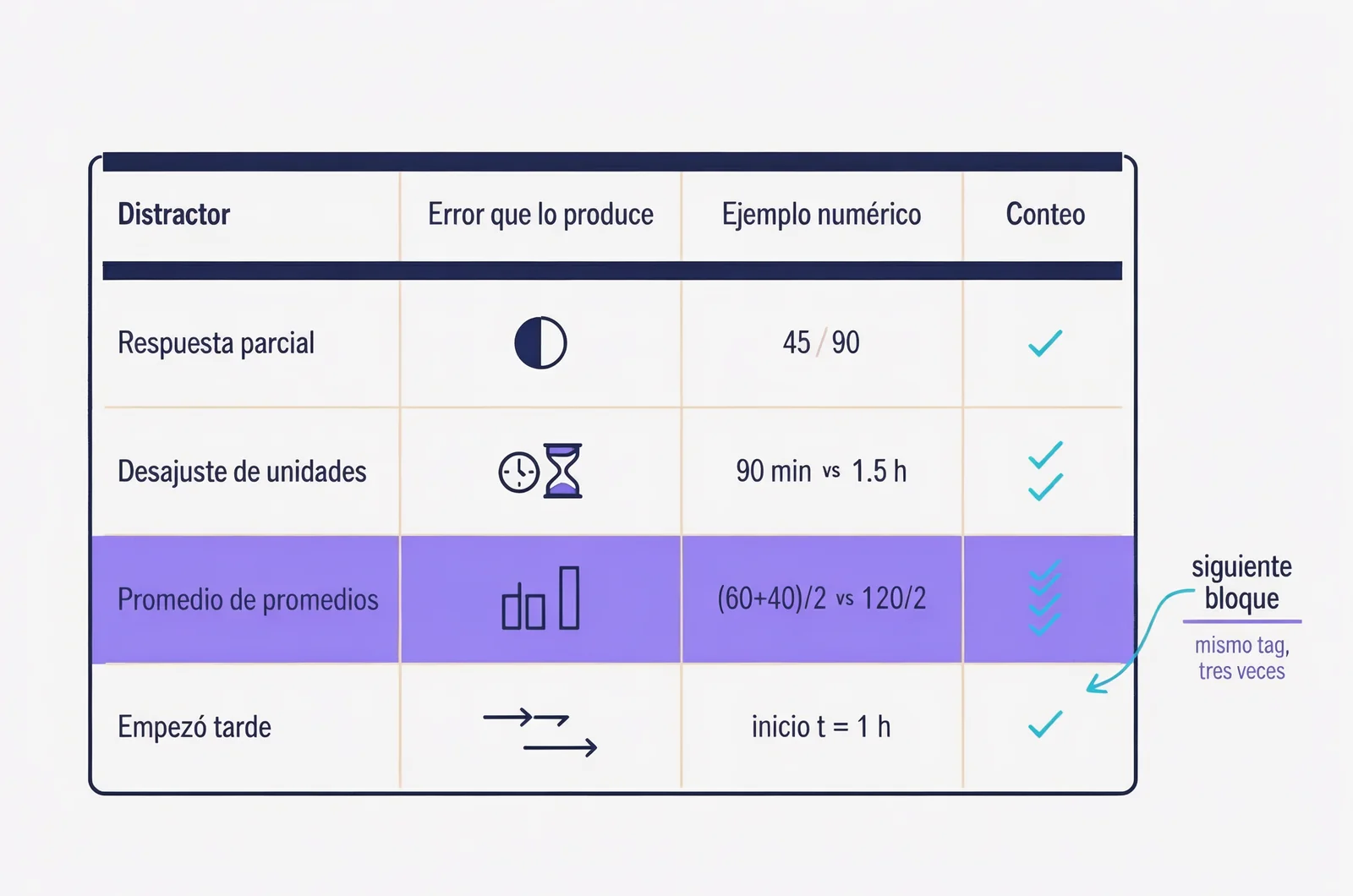
Distractors are not random. They are built from specific mistakes.
- The partial-answer distractor. You solve the first half of a two-step problem and stop. The intermediate value appears as a choice. It feels like confirmation, which is why it works.
- The unit-mismatch distractor. You compute correctly but in the wrong unit. The number is real; the label is wrong.
- The average-of-averages distractor. You average two rates instead of computing total distance over total time. This is the single most common Time & Speed error.
- The "started later" distractor. You ignore that one object began moving after the other and treat the durations as equal.
When you review, tag each wrong choice you were tempted by. If the same tag shows up three times, that is your next study block.
A quick self-check you can run today
Pick any ten questions you have already answered. For each one, cover the explanation and say out loud why the answer you rejected was wrong. If you cannot, you did not eliminate it — you avoided it.
That gap is where points live. An interactive trap-tagger would help here: a simple tool where you log a question, select the distractor type from a short list, and see a running count by category. After twenty entries, the chart tells you what to drill. No such tool is required to start, though. A spreadsheet with two columns does the same job.
Building a practice routine around short sessions
The audience for this material is usually working. Study windows are 30 to 45 minutes, grabbed before work or after dinner. A routine has to survive that constraint or it will not survive at all.
Three structural choices make short sessions work.
One topic per session. Switching between quant and verbal inside 30 minutes means you spend the first five minutes reorienting. Stay in one domain.
One timed block, then review. Ten questions timed, then twenty minutes of explanation review. The review is not optional and should take longer than the questions.
A fixed weekly count, not a fixed weekly duration. "Four sessions this week" is a commitment you can keep. "Six hours this week" collapses the first time a meeting runs long.
For the GMAT specifically, the 45-minute single-section window is a useful ceiling. If you can hold focus for 45 minutes on one section, you can hold it on test day. Build toward that rather than starting there.
Where free material fits and where it stops working
Free sets are excellent for exposure. They show you question types, they show you the interface, and they cost nothing. What they rarely provide is volume with consistent explanations across a full domain.
The gap shows up around week three. You have seen the common patterns, you know your traps, and now you need repetition against a large pool with reasoning attached. That is the point where a structured question bank earns its place — not because free material failed, but because you have outgrown the sample size.
Quizra's approach is question-first: search by exam or topic, work in short sessions, and read the explanation on the same screen as the question. For a busy schedule, that removes the friction of juggling a PDF, a video, and a separate answer key.
Questions test takers ask before they start
How many free GMAT practice questions should I solve before paying for anything?
Enough to identify your recurring traps. For most people that is 40 to 60 questions across all three sections, reviewed properly. If you are still guessing at your weak areas after that, more free questions will not help — you need explanations with more depth, not more volume.
Is the old GMAT material still worth using?
For format practice, no. The section structure and score scale changed, and Data Sufficiency now sits inside Data Insights. For concept drilling on topics that did not change, some legacy material still has value, but you have to separate the concept from the format yourself. That is extra work most people skip.
How long should I spend reviewing a question I got right?
Long enough to confirm you did not guess. If you can state the reason the correct answer is correct and name one distractor you rejected, move on. That takes under a minute. If you cannot, treat it as a wrong answer and review it fully.
Do live sessions beat solo practice?
They test different things. Live sessions add time pressure and peer comparison, which surface pacing problems. Solo practice lets you go deeper on a single concept. Use live sessions to diagnose and solo work to repair.
What if my practice scores are flat for two weeks?
Check whether you are re-solving old questions or only attempting new ones. Flat scores usually mean new material is masking old gaps. Go back to questions you missed two weeks ago and re-solve them cold. If you miss them again, the problem is not your question supply.
Where to go after the video
The session above gives you ten well-explained quantitative items and a clear look at how an experienced instructor reads a rate problem. That is a strong single rep. Turn it into a routine: attempt timed, log the trap, re-solve in 48 hours, and keep a running count by error type.
If you want to keep going with material built for the current exam format, browse the GMAT section and start a session.
References
GMAT Quiz #17 — # GMAT Quiz #17 - Live GMAT Practice Covering Quant, Verbal, RC, & Data Insights ... Join us in a live GMAT practice session and solve 25 challenging GMAT questions with other
GMAT Quant Practice Session: Problem — Graduate Management Admission Test Graduate Management Admission
CompTIA Security+ Practice Questions That Explain Every Wrong Answer
Click through to browse exams and begin a practice session. Get started → |