How the NCLEX-RN Test Format Scores Clinical Judgment
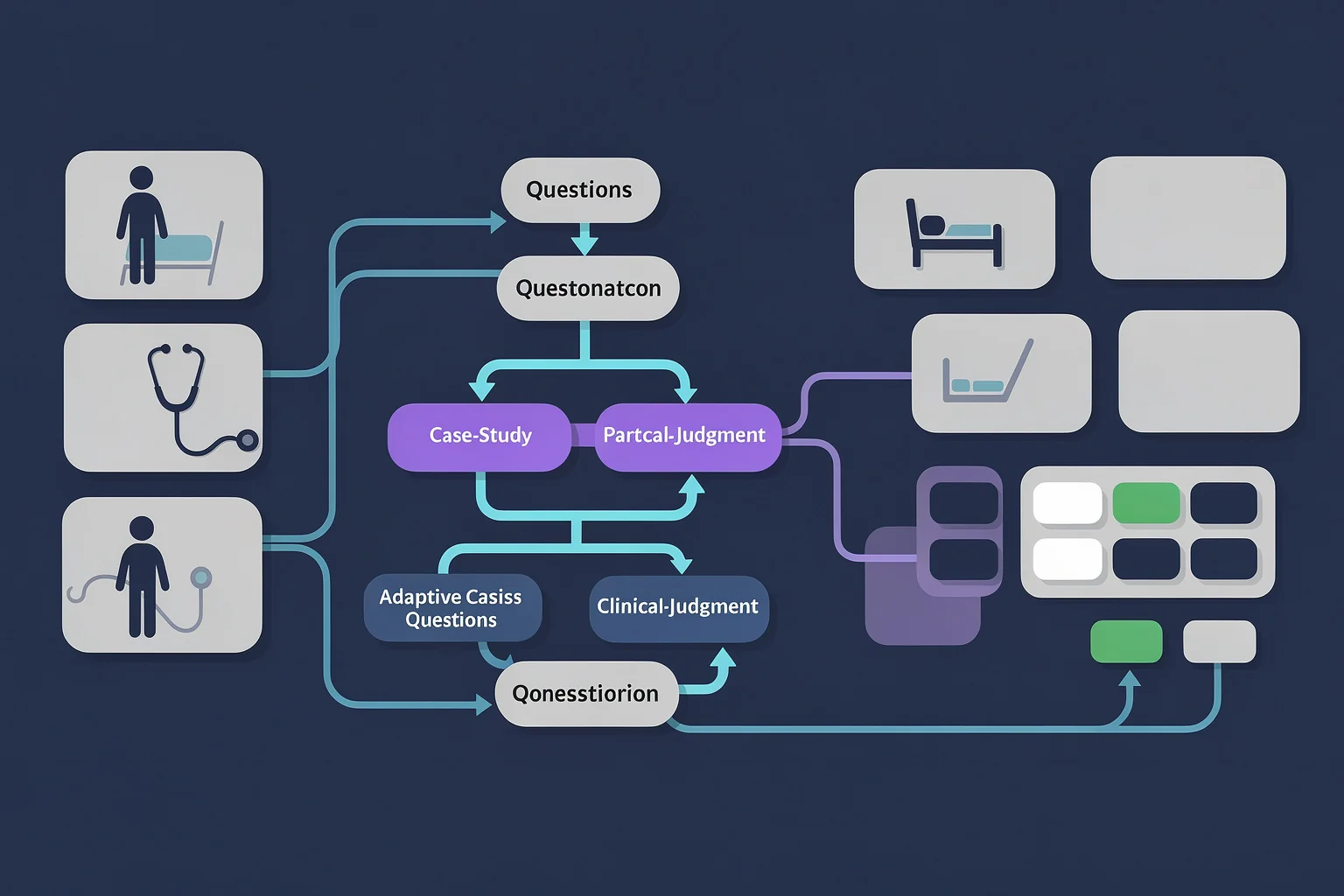
Most people preparing for the NCLEX-RN assume the exam works like a traditional test: answer 150 questions, get a percentage, pass or fail. That model is wrong, and it quietly breaks the way many candidates study. The NCLEX-RN is a computer adaptive test that picks each question based on how you handled the last one, and it decides your result the moment your ability estimate is precise enough. If your nclex-rn prep is built on memorizing answer keys, you are training for a test you will not actually sit.
This guide maps the format from the inside out. You will see how the adaptive engine selects items, how clinical judgment case studies are scored, how partial credit works on questions with more than one correct answer, and what the passing standard actually measures. Once the mechanics are clear, the study tactics that follow make far more sense.
What the NCLEX-RN test format actually measures
The exam does not test whether you can recall facts in isolation. It tests whether you can make safe nursing decisions under uncertainty, which is why the test plan is organized around client needs and clinical judgment rather than textbook chapters.
The National Council of State Boards of Nursing (NCSBN) builds the exam from a test plan that is revised every three years. The current version took effect April 1, 2026 and runs through March 31, 2029. The 2026 RN Test Plan English lays out the content categories, the item formats, and the scoring rules in one document, and it is the only source that should settle arguments about what is on the exam.
Two structural facts shape everything else:
- The exam is administered adaptively, meaning the difficulty of each item is chosen based on your performance on the items before it.
- Clinical judgment is measured directly through case studies, not inferred from stand-alone questions.
That second point matters more than most candidates realize. Clinical judgment is not a theme sprinkled across the exam. It is a scored construct with its own item sets and its own scoring model.
The 2026 test plan did not redesign the exam. The eight content areas, the percentage ranges, the adaptive algorithm, and the question formats carried over from 2023. One subcategory was renamed: what was called Safety and Infection Control now appears under updated wording. If you studied against the 2023 plan, your content map is still valid.
How adaptive item selection decides which question you see next
Here is the mechanism that separates the NCLEX-RN from every practice test you took in nursing school. The exam does not hand you a fixed set of questions. It estimates your ability after each response and then selects the next item that gives the most information about where your true ability sits.
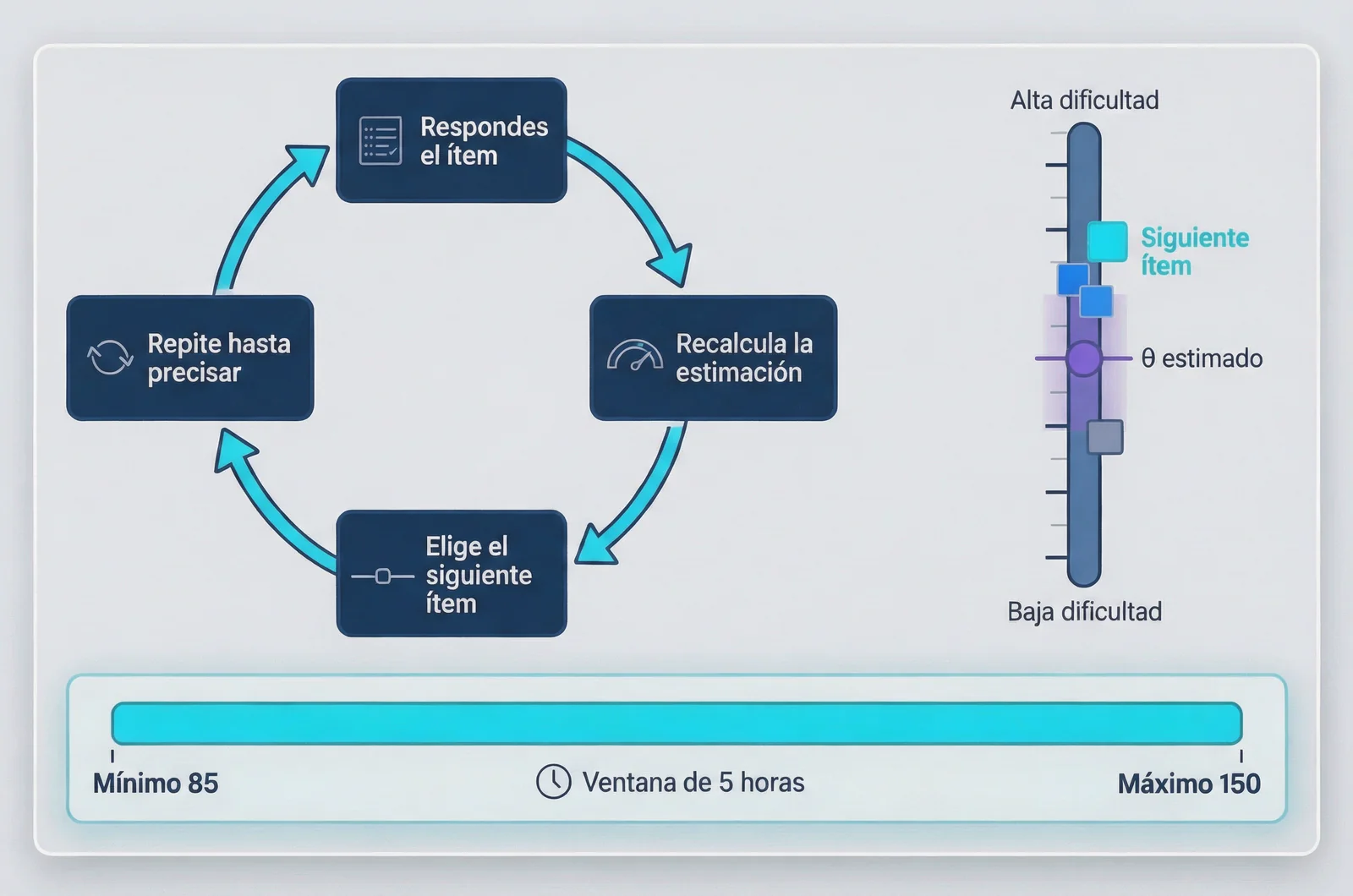
The process works roughly like this:
- You answer an item.
- The scoring engine recalculates your ability estimate using every item you have completed.
- The engine selects the next item whose difficulty is closest to your current estimate.
- The cycle repeats until the estimate is precise enough to compare against the passing standard.
This is why the exam length varies. The 2023 RN Test Plan English documents a minimum of 85 items and a maximum of 150 for RN candidates, all inside a five-hour window that includes breaks. The 2026 plan keeps those same limits.
A few consequences follow directly from that design:
- You cannot skip a question and come back. Each answer feeds the next selection.
- A hard question is not a punishment. It usually means your estimate just moved up.
- Running past 85 items is normal. The exam continues until the measurement is confident, not until a timer expires.
The practical takeaway: your job is to answer each item as honestly and carefully as you can, because every response is data. Second-guessing a correct answer to "look smarter" actively hurts you, since the engine will respond by raising difficulty beyond your real level.
How clinical judgment case studies are scored
Case studies are the part of the format that most nclex-rn prep materials handle badly. They are not long multiple-choice questions. They are item sets built around a single patient scenario, and they are scored differently from stand-alone items.
At minimum length, 18 of the 85 items come from three clinical judgment case studies. Each case study contains six items, and those six items map to the six cognitive steps of the NCSBN Clinical Judgment Measurement Model. The case studies span content areas, so they are counted separately from the content-specific items rather than folded into a single category.
What that means in practice:
- Each case study walks a patient from presentation through recognition, analysis, planning, action, and evaluation.
- The six items are designed to measure distinct steps, not repeat the same skill six times.
- Because the sets cross content areas, you cannot predict the clinical topic from the step being tested.
The scoring model rewards a defensible clinical reasoning path. If you are asked to recognize cues, the correct response reflects what a careful nurse would notice first, not what is most dramatic. If you are asked to prioritize actions, the answer follows a safety hierarchy: assess before intervening, and address threats to airway, breathing, and circulation before comfort measures.
A useful habit is to name the cognitive step silently before answering. Recognizing that an item is asking you to generate solutions rather than take action changes which options you eliminate.
Partial credit, alternate formats, and how points add up
NCLEX items are not all scored zero or one. The test plan states that partial scoring applies to items with more than one key, and it names three methods: plus/minus, zero/one, and rationale scoring.
That single sentence explains a lot of confusing practice-test behavior. On a multiple-response item where three options are correct, selecting two of them can earn partial credit under some scoring methods and nothing under others. The method depends on the item, and you do not see which one is in play.
The exam also uses a range of formats beyond standard multiple choice. Items may be stand-alone or part of a case study, and they may include charts, tables, and graphics. Every item goes through an extensive review before it ever reaches a candidate.
What this means for how you answer:
- Read the item stem for the number of selections required. "Select all that apply" and "select three" are different tasks.
- Treat every option as independently true or false. Partial credit rewards getting individual judgments right, not hedging.
- Do not leave a multi-select item blank because you are unsure of one option. Partial credit exists precisely for that situation.
The 15 unscored items embedded in the exam are worth knowing about too. They are being trialed, they do not count toward your score, and you cannot identify them. Trying to spot them wastes time you need for scored items.
How the passing standard is applied to your ability estimate
The NCLEX-RN does not report a percentage. It reports whether your final ability estimate is at or above the passing standard, which is expressed in logits on a scale where the passing point sits at 0.00.
That standard holds at 0.00 logits through March 31, 2029, according to the 2026 test plan. The estimate itself is computed from your responses to all completed items, which is why the exam cannot stop early on a whim. It stops when the measurement is precise enough to make a defensible pass or fail decision.
Three things follow from this:
- A hard exam is not a failing exam. Difficult items are what the engine serves when your estimate is high.
- A short exam is not automatically a pass or a fail. It means the estimate stabilized quickly.
- There is no partial pass. The decision is binary, and it is made against one fixed line.
This is also why "how many questions did you get?" is a useless post-exam comparison. Two candidates can answer 85 and 145 items respectively and land on the same side of the standard.
Why recall-style prep underperforms on this format
If the exam measures clinical judgment through adaptive item selection and partial-credit scoring, then a study plan built on memorizing answers is training the wrong skill. You can recognize a fact and still miss the item, because the item is asking what you would do, in what order, and why.
The research literature reflects this. A study published in SAGE Open Nursing on the effect of a commercial NCLEX-RN preparation product on first-time pass rates found no consensus or even a consistent pattern of success with any individual product. Schools that improved pass rates did it through interventions like appreciative advising, continuous quality improvement, and structured coaching rather than through a single question bank.
That finding is not an argument against practice questions. It is an argument against passive practice. The difference between useful and useless question work comes down to what happens after you answer:
- If you check the answer and move on, you practiced recognition.
- If you explain why each wrong option is wrong, you practiced discrimination.
- If you name the clinical judgment step the item was testing, you practiced the actual construct.
That third habit is where a question-first library with integrated explanations earns its place. Quizra's nursing practice sets are built so that each item carries its reasoning with it, which lets you turn a five-minute window between shifts into a real study session instead of a score check. The goal is not a higher practice percentage. It is a more accurate ability estimate on exam day.
Reading the test plan like a study document
Most candidates download the test plan, skim the content list, and never open it again. That is a waste, because the document is structured to tell you exactly how the exam will behave.
Read it in this order:
- The administration section, for item counts, time limits, and the adaptive process.
- The scoring section, for partial credit methods and how the passing standard is applied.
- The clinical judgment section, for the six cognitive steps and how case studies are assembled.
- The content categories, for the percentage ranges that tell you where the weight sits.
The percentage ranges are the part worth acting on. They tell you how many items to expect from each client needs category, which is a direct signal about where to spend your limited study hours. A category carrying a larger share of the exam deserves proportionally more practice, even if it is the one you find least interesting.
One caution: the test plan describes the exam, not your readiness. Reading it will not raise your ability estimate. It will, however, stop you from preparing for a test that does not exist.
Questions candidates ask before their first attempt
Does the exam get harder if I am doing well? Yes. The adaptive engine selects items near your current ability estimate, so a rising estimate produces harder items. That is the system working correctly, not a warning sign.
Can I pass in 85 questions? Yes. The minimum-length exam can end in a pass if your estimate is precise and above the standard. It can also end in a fail at 85 items.
Is partial credit available on every question? No. Partial scoring applies to items with more than one key, and the method used depends on the item. Standard single-answer items are scored right or wrong.
Did the 2026 test plan change what I need to study? Not materially. The content areas, percentage ranges, adaptive algorithm, and item formats carried over. One subcategory was renamed. A study plan built on the 2023 plan still holds.
How long should I expect to be at the testing center? The exam itself allows five hours, and that window includes all breaks. Plan for a longer total visit once check-in and the post-exam survey are counted.
Should I use practice questions that mimic the adaptive format? Format mimicry matters less than reasoning practice. What you need from a question bank is accurate, exam-aligned items with explanations that teach the clinical judgment step being tested.
Where to take this next
The format rewards candidates who understand the machine they are sitting in front of. Adaptive selection, case-study scoring, partial credit, and a fixed passing standard are not trivia. They are the rules that determine which questions you see and how your answers are counted.
If you want to test your reasoning against exam-aligned items with explanations attached, browse the nursing exam library and start a short session. Five focused questions with full reasoning will teach you more than fifty answers you never unpacked.
References
Principles for Nursing — Principles The ANA policy documents and publications noted ... 9 and ... 10, as well as state ... practice acts, government regulations, and organizational policies and
Green Belt Vs Black Belt: Which Exam Questions Should You Tackle First
Click through to browse exams and begin a practice session. Get started → |